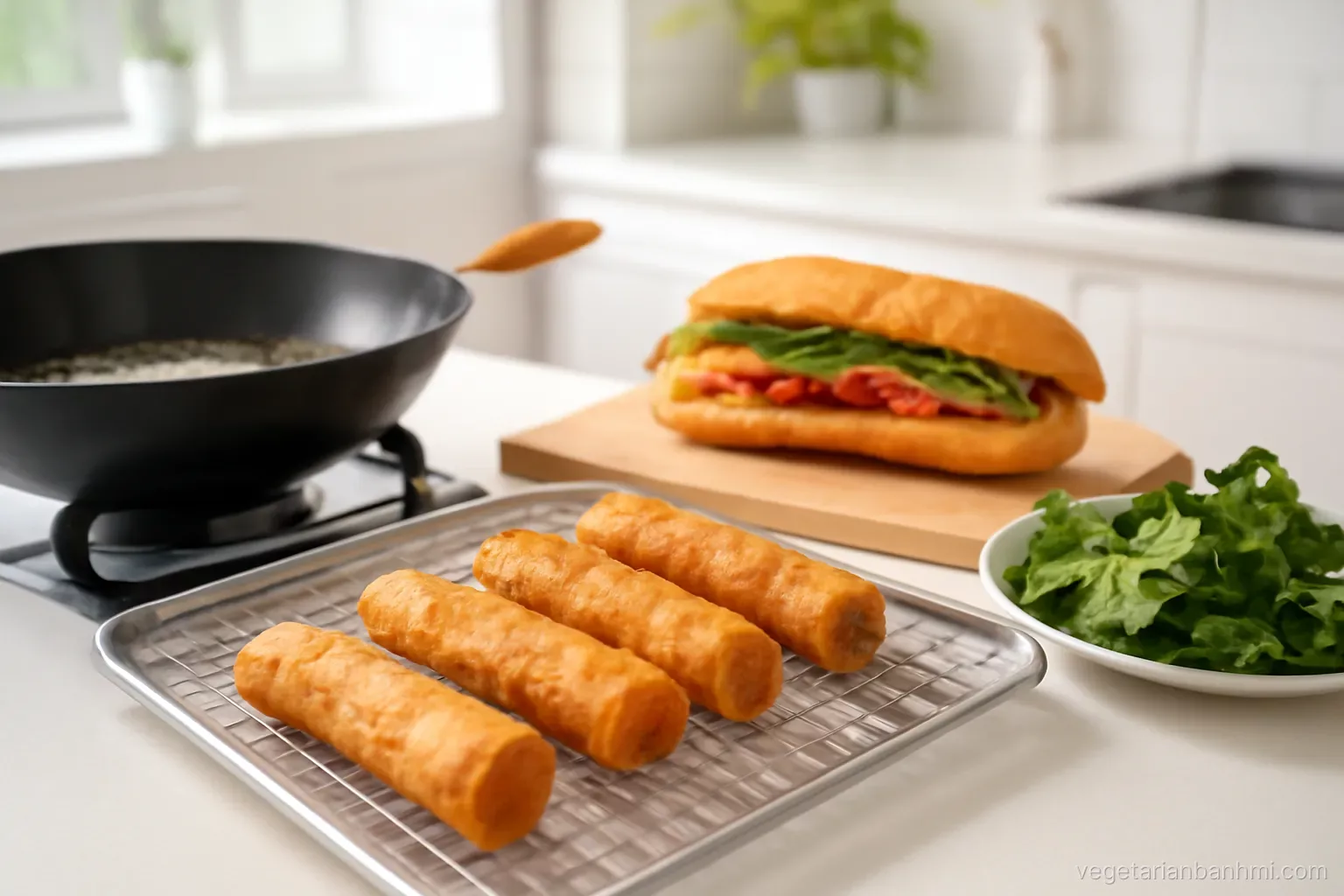
Short answer: Vegan chả giò (Vietnamese fried spring rolls) are made by rolling a filling of grated taro or jicama, carrot, wood ear mushrooms, glass noodles and crumbled tofu in rice paper or wheat wrappers, then frying them at 170–175 °C (340–350 °F) for about 6–8 minutes until deep gold. This recipe makes about 20 rolls for 4 people. Serve them hot next to a banh mi with lettuce, herbs and a fish-sauce-free dipping sauce.
Why chả giò belongs next to a banh mi
A banh mi is crunchy, fresh and tangy, but it is also cool and fairly light. A plate of hot, shattering spring rolls adds exactly what is missing: warmth, a little richness and a second kind of crunch. In the south of Vietnam the rolls are called chả giò; in the north the same idea is called nem rán. The vegetarian version, chả giò chay, is a staple at Buddhist vegetarian restaurants and family celebrations, where the filling relies on taro, mushrooms and tofu instead of pork and shrimp.
Fried rolls are not the same thing as the fresh rice paper rolls (gỏi cuốn) you may already know. Fresh rolls are soft, cold and packed with herbs; chả giò are hot, crisp and savoury. If you want a lighter side, our Sides, Soups & Salads section has fresh rolls, salads and soups too. For a weekend lunch, two or three fried rolls per person plus half a banh mi each makes a generous, satisfying spread.
Ingredients for about 20 rolls (serves 4)
The filling should be fairly dry and finely cut, so it cooks through in the time the wrapper takes to crisp. Grating or shredding the vegetables is the secret; big chunks tear the wrapper and stay raw in the middle.
- 200 g (7 oz) firm tofu, pressed for 15 minutes and crumbled
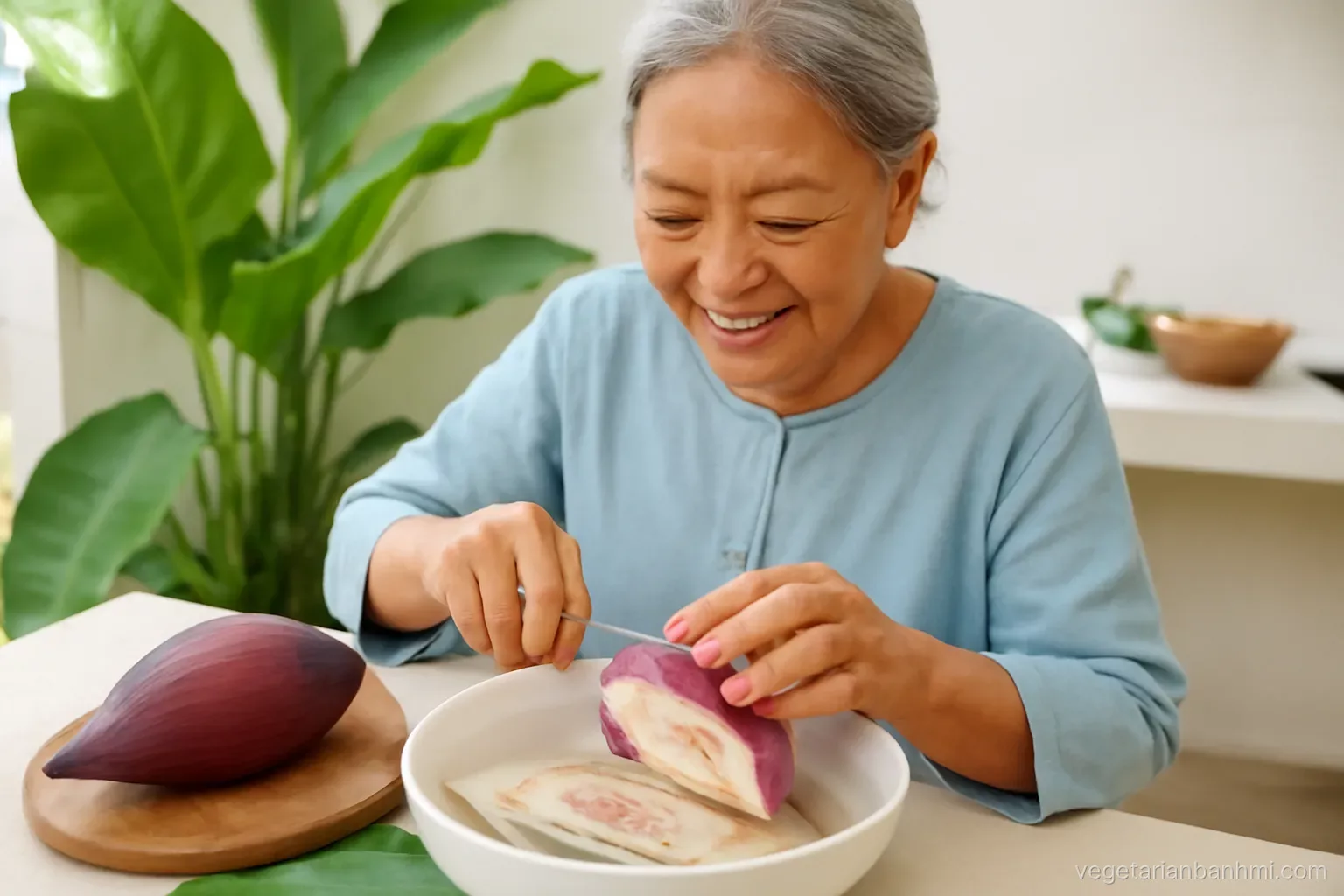
- 200 g (7 oz) taro, peeled and grated, or jicama, grated and squeezed dry
- 1 medium carrot, about 100 g (3.5 oz), grated
- 10 g (about 1/3 oz) dried wood ear mushrooms, soaked 15–20 minutes and finely chopped
- 40 g (1.5 oz) dried glass noodles (mung bean vermicelli), soaked 10 minutes and cut into 3 cm (1 in) lengths
- 3 shallots or 1 small onion, finely chopped, and 2 scallions, sliced
- 1 tbsp soy sauce, 1 tsp vegan mushroom seasoning or salt to taste, 1 tsp sugar, 1/2 tsp ground black pepper
- 1 tbsp cornstarch or tapioca starch, mixed into the filling to bind it
- 20 wrappers: 22 cm (8.5 in) round rice paper, or 20–22 cm (8–8.5 in) square wheat spring roll wrappers
- Neutral oil for frying, about 1 litre (4 cups) for a medium wok
Most "egg roll" recipes bind the filling with egg; the starch here does the same job. Check the wheat wrappers you buy, because some brands contain egg, and look for wrappers labelled vegan or with only flour, water, oil and salt.
Rice paper or wheat wrappers?
Traditional southern chả giò use rice paper, which fries into a blistered, glass-like shell. Wheat spring roll wrappers are easier to handle and give a smoother, more even crunch. Both are good; the choice depends on your skill, your kitchen and how you plan to cook them.
| Feature | Rice paper | Wheat spring roll wrapper |
|---|---|---|
| Texture after frying | Bubbly, very crackly, slightly chewy inside | Smooth, flaky, evenly crisp |
| Ease of rolling | Needs quick dipping; can tear | Easy, used straight from the pack |
| Best cooking method | Deep-frying | Deep-frying, air fryer or oven |
| Gluten | Usually gluten-free (check the pack) | Contains wheat |
| Common problem | Rolls stick together or burst | Pale patches if not oiled for oven or air fryer |
A useful trick for rice paper is to dip each sheet briefly in water mixed with a little sugar or vinegar (about 1 tsp per 250 ml / 1 cup); it helps the rolls brown and blister. Do not soak the paper until floppy; it keeps softening as you fill it.
Step by step: mixing, rolling and frying
- Make the filling. In a large bowl, combine the tofu, taro or jicama, carrot, wood ear, glass noodles, shallots and scallions. Add the soy sauce, seasoning, sugar, pepper and starch, and mix with your hands for a minute until it holds together when squeezed. If it feels wet, add another spoon of starch.
- Roll. Lay a wrapper on a damp board (or a dry one, for wheat). Put about 2 heaped tablespoons, roughly 35 g, of filling in a log near the bottom edge, leaving 3 cm (1 in) at each side. Fold the bottom over, fold in the sides, and roll tightly towards the top. Seal wheat wrappers with a dab of flour-and-water paste.
- Rest. Place rolls seam side down on a tray, not touching. Rice paper rolls benefit from 10–15 minutes uncovered to dry a little before frying.
- Heat the oil. Bring oil 4–5 cm (about 2 in) deep to 170–175 °C (340–350 °F). Use a thermometer; too hot and the outside browns before the filling cooks, too cool and the rolls absorb oil.
- Fry in batches. Lower in 5–6 rolls at a time, leaving space between them. Fry 6–8 minutes, turning occasionally, until deep golden and blistered. Drain on a wire rack rather than paper towels, which trap steam and soften the bottoms.
For extra-crisp rolls that stay crunchy for longer, use the double-fry method: fry first at about 160 °C (320 °F) for 4–5 minutes until pale gold, rest them on a rack for at least 10 minutes, then fry again at 180 °C (355 °F) for 1–2 minutes. The first fry cooks the filling; the second drives out moisture from the wrapper. It is also handy for parties, because the first fry can be done an hour ahead.
Air-fryer and oven options
If you would rather not deep-fry, use wheat wrappers, which crisp much better than rice paper with little oil. Brush or spray every roll lightly but completely with oil, because any dry patch stays white and papery. In an air fryer, cook at 200 °C (400 °F) for 12–15 minutes, turning halfway, in a single layer. In the oven, bake on a rack set over a tray at 220 °C (425 °F) for 20–25 minutes, turning once. The result is lighter and less blistered than deep-fried chả giò, but still a very good side for a banh mi lunch.
Make ahead, freeze and reheat
Chả giò are an excellent make-ahead food, and freezing raw rolls is the best way to do it. Arrange the uncooked rolls on a lined tray without touching and freeze until hard, about 2 hours, then move them to a freezer bag. They keep their best quality for around 1–2 months. Fry straight from frozen, without thawing, at about 165 °C (330 °F) for 9–11 minutes so the centre heats through before the wrapper overbrowns.
Cooked leftovers should go into the fridge within 2 hours of frying (1 hour if the room is above 32 °C / 90 °F) and be eaten within 3–4 days, following USDA guidance. Reheat in an air fryer or oven at 190–200 °C (375–400 °F) for 6–8 minutes, until the inside reaches 74 °C (165 °F); the microwave makes them soft and chewy. For more on planning sides and fillings in advance, see our Meal Prep & Storage guides.
The dipping sauce and how to serve
Classic chả giò come with nước chấm, a sweet-sour dipping sauce normally made with fish sauce. For a vegan version, stir together 3 tbsp lime juice, 3 tbsp sugar and 6 tbsp warm water until the sugar dissolves, then add 2 tbsp light soy sauce, 1 minced garlic clove and 1 sliced bird's eye chili. Taste and adjust: it should be sour, sweet and salty in roughly equal measure. Our Sauces & Spreads section has a fuller fish-sauce-free version.
Serve the rolls whole or cut in half on the diagonal, with a plate of lettuce leaves, mint, Thai basil and cilantro. In Vietnam, people wrap a piece of roll in lettuce with herbs and dip the whole bundle. Put the banh mi in the middle of the table, halved or quartered, and let everyone mix the two. Pickled carrot and daikon left over from the sandwich make a great extra topping for the lettuce wraps.
Common problems and fixes
Rolls that burst usually have a filling that is too wet or packed too loosely; squeeze grated jicama hard in a cloth and roll tightly. Rolls that stick together in the oil were crowded or added too fast; fry fewer at once and keep them moving for the first minute. Greasy rolls mean the oil was too cool, so check the thermometer between batches. A pale, soft crust after a few minutes on the table is solved by the double-fry method or by serving straight from the rack.
Sources
- USDA Food Safety and Inspection Service – fsis.usda.gov (leftovers and safe reheating temperatures)
- USDA FoodData Central – fdc.nal.usda.gov (ingredient nutrition data)
- Vietnam National Authority of Tourism – vietnam.travel (Vietnamese cuisine overview)
Frequently asked questions
What is the difference between chả giò and gỏi cuốn?
Chả giò are fried spring rolls, served hot and crisp. Gỏi cuốn are fresh rolls in soft rice paper, served cold with herbs and noodles. Both can be made vegan and both go well with banh mi.
Can I make vegan chả giò without taro?
Yes. Grated jicama, sweet potato or extra carrot work well. Squeeze watery vegetables dry and add a little more starch so the filling holds together.
Why are my rice paper spring rolls sticking together when frying?
Rice paper is sticky while damp. Let rolls dry for 10–15 minutes before frying, fry only 5–6 at a time and keep them apart, and stir gently during the first minute.
Can I freeze vegan spring rolls?
Freeze them raw on a tray, then bag them, and use within about 1–2 months for best quality. Fry from frozen at a slightly lower temperature for a few extra minutes.
Are spring roll wrappers vegan?
Rice paper usually contains only rice, tapioca, salt and water. Some wheat spring roll wrappers contain egg, so read the label and choose ones made with flour, water, oil and salt.
Crispy Rolls at Home, Crusty Banh Mi in Saigon
Fry a batch of chả giò with this recipe and build your own vegan banh mi plate at home. If you are in Ho Chi Minh City, taste the sandwich side of the meal at Bánh Mì XANH, a fully vegan banh mi chain with 5 central shops open 24/7.
Explore the Bánh Mì XANH menu · 24/7 hotline / Zalo +84 923 183 183