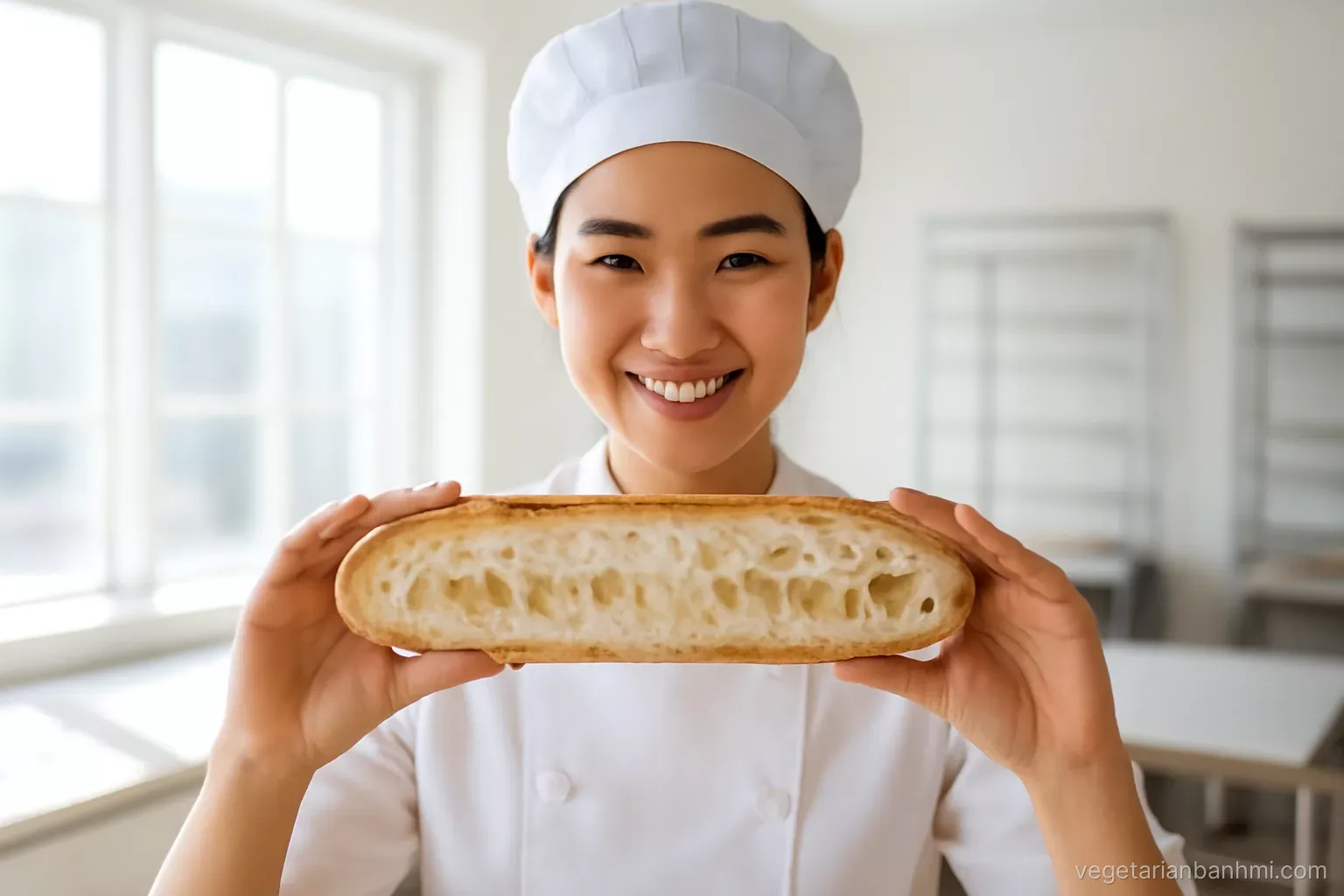
Short answer: A good banh mi roll is light because the dough is soft, well conditioned and proofed further than a French baguette, so the crumb becomes a cloud of thin, fragile cells under a crust that is barely a millimetre thick. High heat and steam in the first minutes of baking set that eggshell crust. Rice flour, despite the popular story, is at most a minor and optional player; the real secrets are flour, proofing and oven technique.
What a great banh mi roll actually feels like
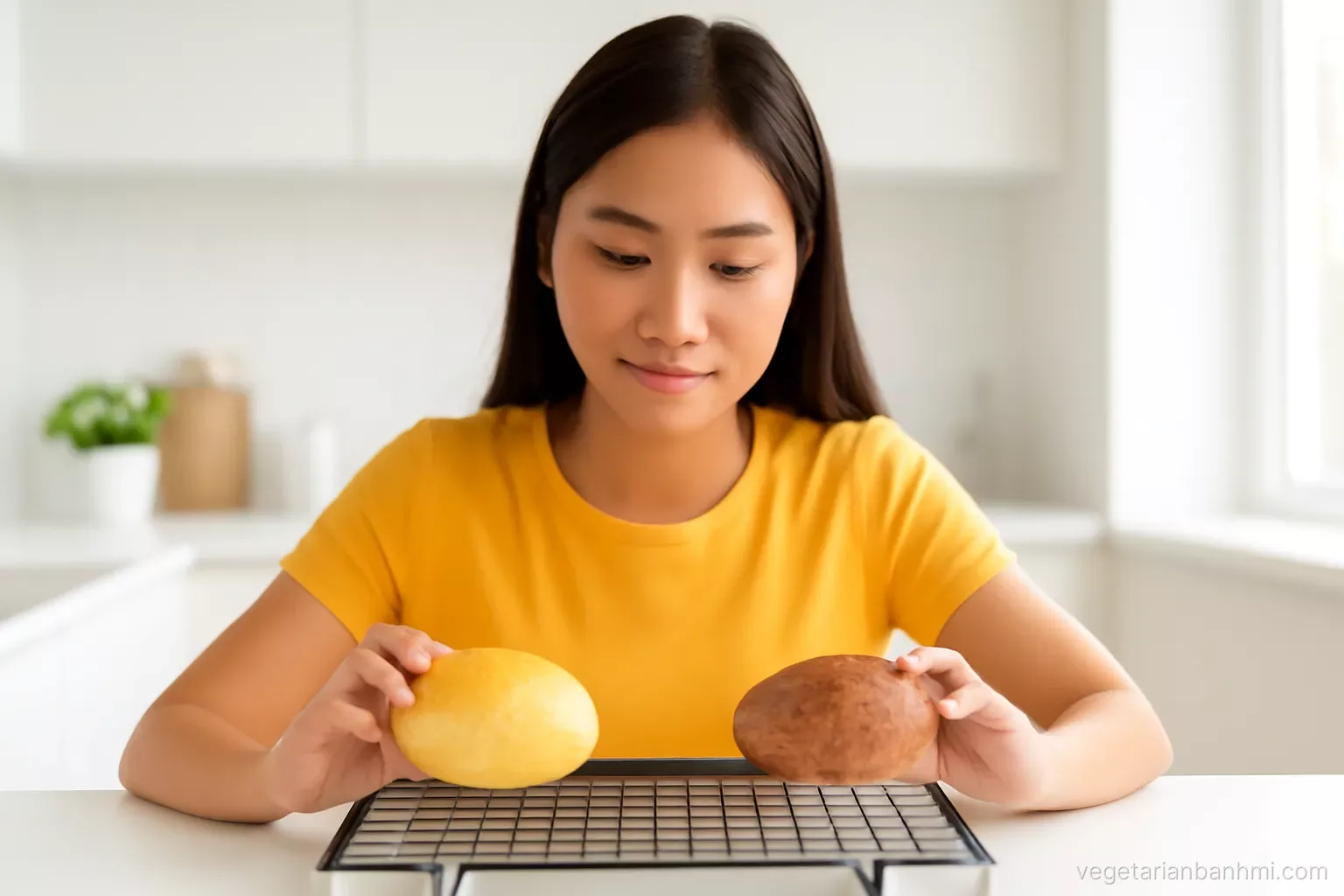
Before we talk about why, it helps to describe the target. Pick up a fresh bánh mì (the Vietnamese word for both bread and the sandwich) in Saigon and it feels almost weightless for its size: a roll roughly 20–25 cm long often weighs well under 100 g. Press it and the crust crackles like thin glass, shedding flakes onto your shirt. Tear it and the inside is white, cottony and open, with no big irregular holes and no chew to speak of. That combination is the whole point of the sandwich. The crust supplies crunch and a toasty flavour, the soft crumb soaks up sauce and pickle juices, and the bread never fights you, so your teeth reach the tofu, mushrooms and herbs without a tug-of-war.
Compare that to a French baguette de tradition. The French loaf has a thicker, darker, chewier crust and an irregular, glossy, open crumb with a pronounced wheaty, slightly sour taste. It is a wonderful bread, but stuffed with fillings it becomes a jaw workout, and its strong character competes with delicate herbs. Vietnamese bakers inherited the baguette during the colonial period and, over decades, reshaped it into something that suits a sandwich eaten on a motorbike at seven in the morning.
The rice flour myth
Almost every article about banh mi bread repeats that the airiness comes from mixing rice flour into wheat flour. It is a tidy explanation, and some bakers do add a little, but it does not survive close inspection. Andrea Nguyen, the cookbook author behind Viet World Kitchen and The Banh Mi Handbook, calls the rice flour idea mythology: in her testing small amounts made little difference, and a Vietnamese baker she interviewed used only flour, yeast, sugar and water. Rice flour contains no gluten-forming proteins, so it cannot build the structure that holds gas; in large amounts it makes bread denser and paler, not lighter, because it browns less readily than wheat.
Where rice flour may help is in small quantities to soak up humidity in a tropical bakery, and home bakers on forums such as The Fresh Loaf report mixed results. Our view: if you bake at home, skip it on your first attempts and focus on the factors below. You can experiment later with replacing 5–10% of the flour, but do not expect miracles.
The five things that really create the texture
Several small decisions stack up. None of them is exotic, which is good news if you want to bake your own or choose the right roll from a shop.
- Moderate-protein, conditioned flour. Vietnamese bakeries generally use a wheat flour that is not as strong as a high-gluten bread flour. Dough conditioners (often called bread improvers) such as ascorbic acid, the chemical name for vitamin C, strengthen the gluten network so it stretches thin without tearing. Home bakers can mimic this with a crushed 100 mg vitamin C tablet per 350 g flour.
- A soft, smooth, well-kneaded dough. Banh mi dough is kneaded until very smooth and elastic, which creates an even, fine network rather than the irregular holes of a long-fermented, lightly mixed French dough.
- A generous final proof. Rolls are left to rise until they are puffy and fragile, often around two and a half times their shaped size. That over-the-edge proof stretches the cell walls very thin. It is also why the bread is light and why a home loaf proofed too long collapses.
- A little sugar and fat. A spoonful of sugar feeds the yeast and helps the crust colour quickly in a short bake; a touch of oil keeps the crumb tender. Many traditional formulas use small amounts of each.
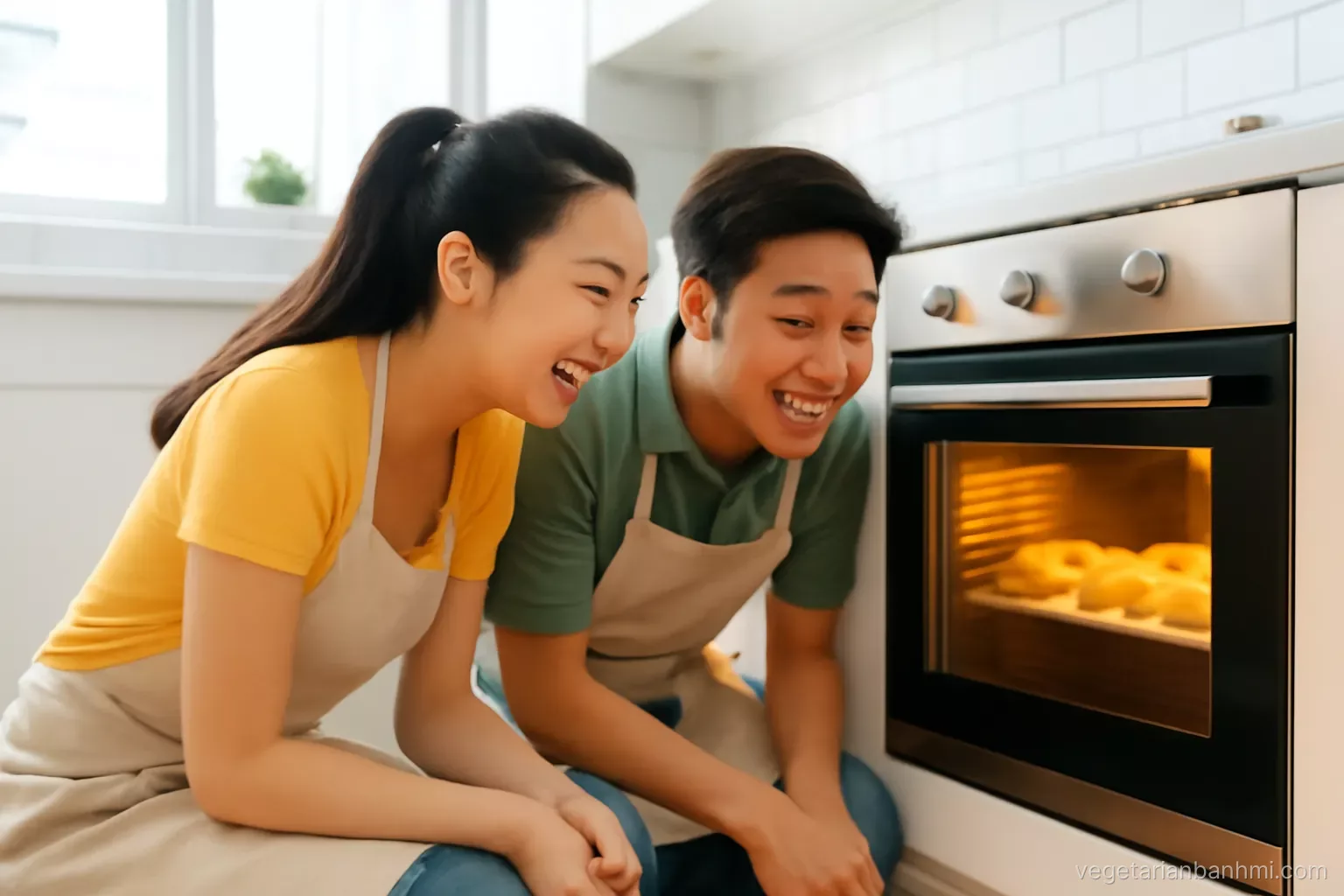
- Hot oven, lots of steam, short bake. Steam keeps the surface moist so the roll can spring up fully before the crust hardens, then evaporates and leaves a thin, glassy, blistered skin. Because the rolls are small and baked fast, the crust has no time to thicken.
Banh mi bread and French baguette side by side
This comparison is a simplification, since bakeries vary, but it is a useful mental model when you are standing in front of a bread shelf abroad.
| Feature | Vietnamese banh mi roll | French baguette de tradition |
|---|---|---|
| Typical size | 20–25 cm, single-serve roll | 55–65 cm loaf, around 250 g |
| Crust | Very thin, pale gold, shatters and flakes | Thicker, deep brown, crunchy then chewy |
| Crumb | White, fine, cottony, very light | Creamy, glossy, irregular open holes |
| Flavour | Mild, slightly sweet, toasty crust | Pronounced wheat and fermentation notes |
| Fermentation | Usually short, yeasted, same-day | Often long or cold fermentation |
| Additions | Often a little sugar, oil, dough conditioner | By French rule, only flour, water, salt, yeast or leaven |
| Best eaten | Within hours, or re-crisped | Same day |
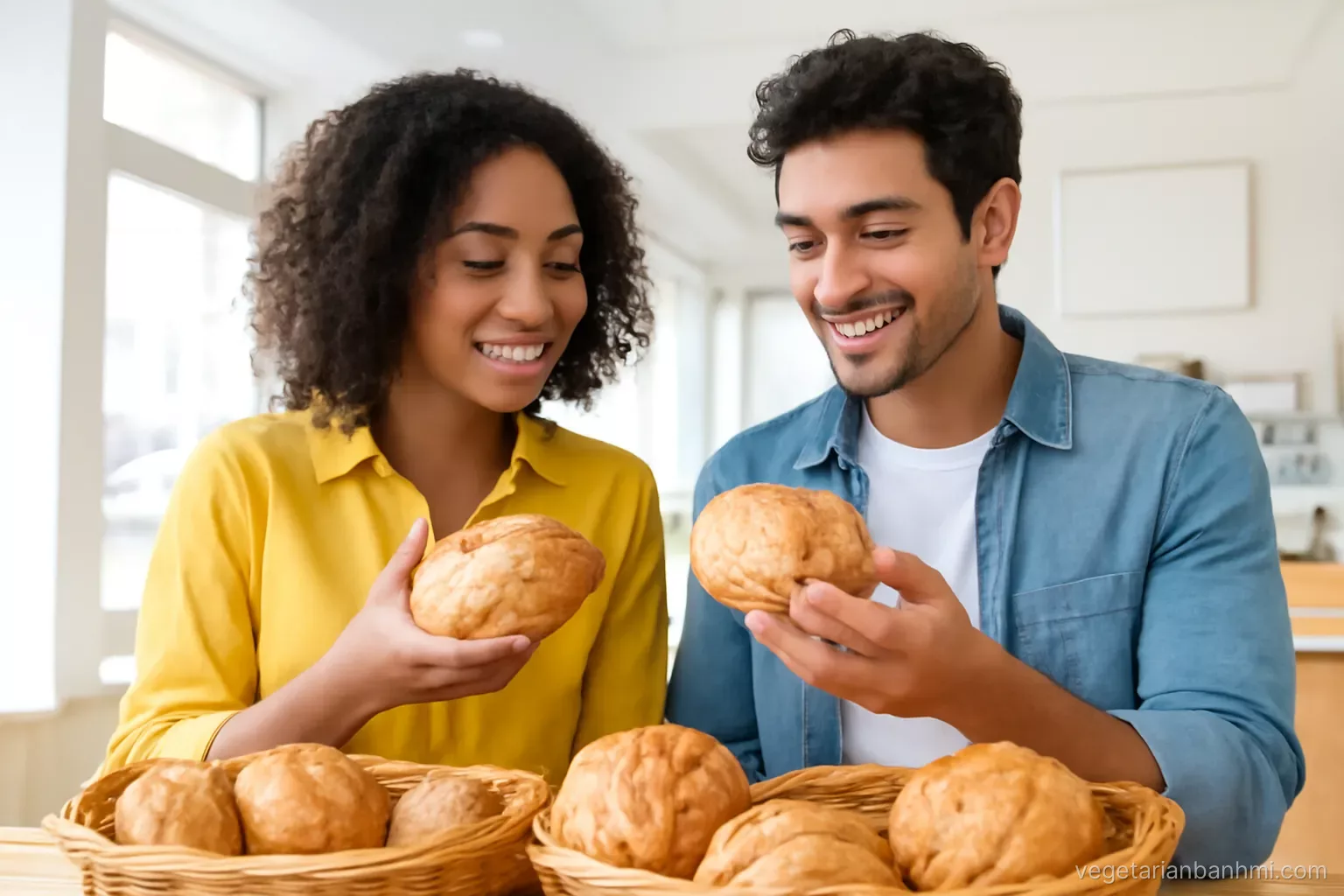
The practical lesson: when shopping outside Vietnam, look for a light, inexpensive, thin-crusted roll rather than an artisan loaf. Andrea Nguyen makes a similar point: pricey rustic or sourdough bread is a poor fit for banh mi. We go through the best options country by country in our guide to store-bought bread, filed under The Bread.
Why the bread matters even more in a vegetarian banh mi
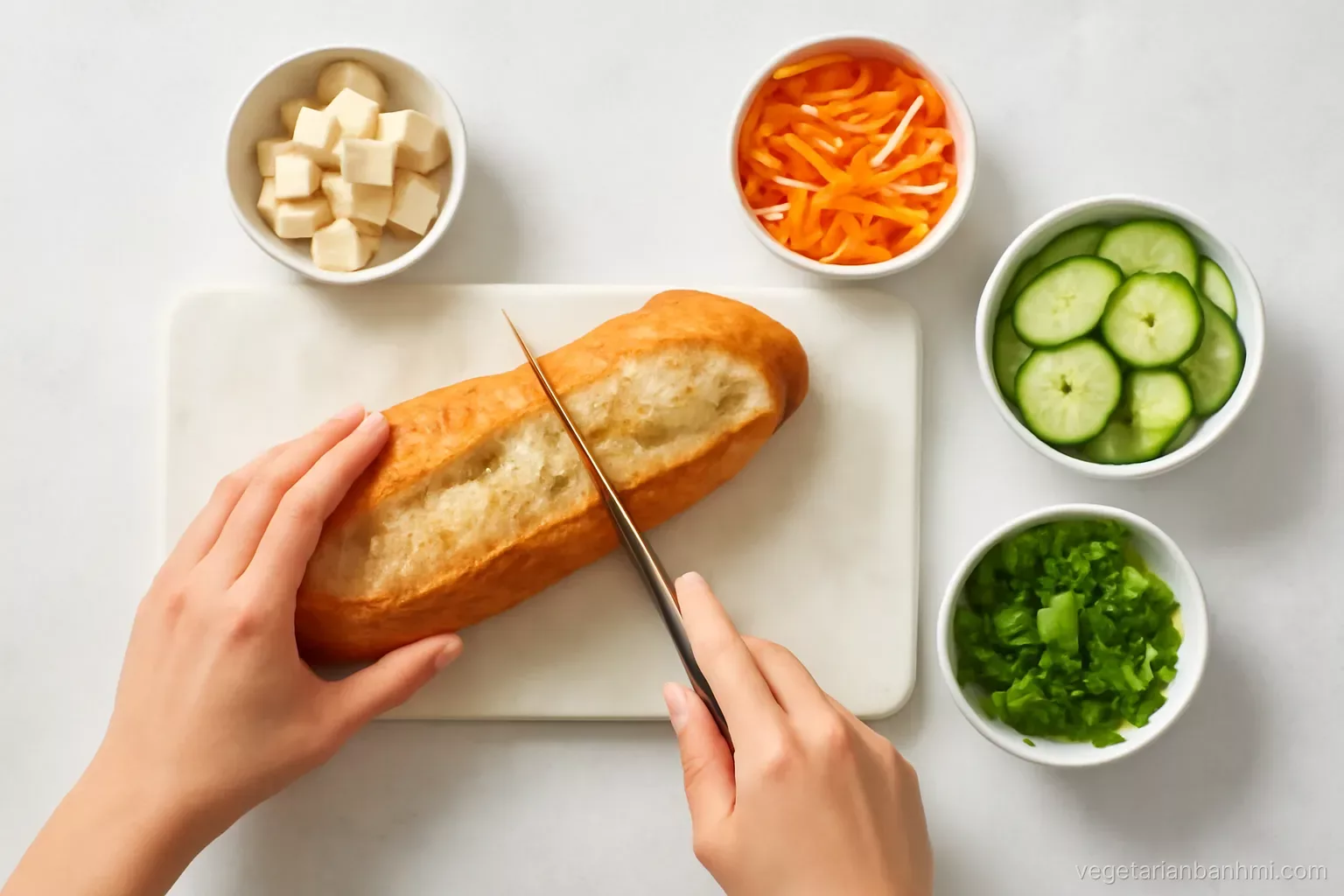
Meat banh mi gets a lot of richness from pâté, pork fat and cold cuts. A vegetarian or vegan sandwich relies on contrast instead: crisp lemongrass tofu, juicy mushrooms, sharp đồ chua (pickled carrot and daikon), cool cucumber and handfuls of herbs such as ngò (cilantro). A heavy, chewy roll flattens all of that. A light one frames it, letting each layer register. That is why we spend so much time on bread on this site; you can make a superb filling from our plant-based fillings guides and still end up with a disappointing sandwich if the bread is wrong.
The airy crumb also matters for sauce. A vegan mayo or mushroom pâté spread on a fine, cottony crumb clings and soaks in a little, so every bite tastes seasoned. On an open, holey crumb the sauce drips through the gaps and pools at the bottom of the wrapper.
Is banh mi bread vegan?
A basic roll made from flour, water, yeast, salt, a little sugar and vegetable oil is vegan, and that describes many Vietnamese bakery rolls. But you cannot assume it everywhere. Some supermarket rolls labelled French bread or sub rolls in North America and Europe contain milk powder, butter or eggs for softness. Some dough conditioners include L-cysteine, which can be derived from animal sources, and some bakeries brush rolls with egg or butter. If you are strictly vegan:
- Read the ingredient list on packaged rolls and look for milk, whey, casein, butter, egg and L-cysteine.
- At a bakery, ask whether the dough or the glaze contains milk, butter or egg.
- When in doubt, bake your own; our home recipe uses only plant ingredients.
- In Vietnam, a fully vegan shop removes the guesswork for the whole sandwich, not just the bread.
Common misunderstandings and quick fixes
"My roll is crusty but heavy." The dough was probably under-proofed or too strong. Use all-purpose flour or mix bread flour with all-purpose, and let the shaped rolls rise until they jiggle when you shake the tray.
"The crust is thick and leathery." Too long in the oven at too low a temperature, or not enough steam at the start. Bake hot, around 230°C (450°F), and keep the bake short.
"It was perfect, then went soft an hour later." This is normal. The thin crust absorbs moisture from the crumb and the air, especially in humid weather or in a plastic bag. Store rolls in a paper bag and re-crisp in a hot oven for a few minutes before filling.
"It tastes of nothing." Banh mi bread is meant to be mild, but it should still taste of toasted wheat. Make sure you use about 1.8% salt relative to flour, and let the crust reach a real golden colour rather than pale blond.
Nutrition at a glance
USDA FoodData Central lists generic French or Vienna bread at about 272 kcal, 10.8 g protein, 52 g carbohydrate and under 3 g fat per 100 g. A typical light banh mi roll of 70–90 g therefore contributes very roughly 190–240 kcal and 8–10 g protein before any filling. Because the bread is so airy, a banh mi feels more substantial than the numbers suggest, and most of the protein in a vegetarian version comes from tofu, tempeh or seitan rather than the roll.
Sources
- Viet World Kitchen (Andrea Nguyen) – vietworldkitchen.com, notes on banh mi bread, rice flour and dough conditioners
- The Fresh Loaf – thefreshloaf.com, home baker discussions of Vietnamese baguette formulas
- USDA FoodData Central – fdc.nal.usda.gov, entry for bread, French or Vienna
Frequently asked questions
Do Vietnamese bakers really use rice flour in banh mi bread?
Some may add a little, but it is not what makes the bread light. Rice flour has no gluten, so it cannot trap gas; cookbook author Andrea Nguyen calls the rice flour explanation a myth. Conditioned wheat flour, a generous proof and a hot, steamy bake matter far more.
Can I use a French baguette for banh mi?
You can, and it will taste good, but the crust is chewier and the crumb denser, so the sandwich is harder to bite. If a baguette is all you have, choose a thin, light, inexpensive one, scoop out a little crumb and re-crisp it before filling.
Why does banh mi bread go soft so quickly?
The crust is extremely thin, so it absorbs moisture from the crumb and the air within an hour or two, especially in humid weather or plastic bags. Keep rolls in paper and give them 3–5 minutes in a 200°C (400°F) oven to bring the crackle back.
What is the role of vitamin C in banh mi dough?
Ascorbic acid acts as a dough conditioner that strengthens the gluten network so it can stretch very thin and hold more gas. That supports a taller, lighter roll. At home, a crushed 100 mg tablet per 350 g flour is a common amount.
Is store-bought banh mi bread always vegan?
Not always. Many simple rolls are, but some contain milk powder, butter, eggs or animal-derived L-cysteine, and some are glazed with egg or butter. Check the label or ask the bakery, or bake your own with plant ingredients.
Taste the Crackle Before You Bake It
Once you know what a light, shattering crust feels like, it is much easier to recreate at home with the guides in this section. If you are in Ho Chi Minh City, try it at Bánh Mì XANH, a fully vegan banh mi chain with 5 central shops open 24/7, and use it as your benchmark for crust and crumb.
Explore the Bánh Mì XANH menu · 24/7 hotline / Zalo +84 923 183 183