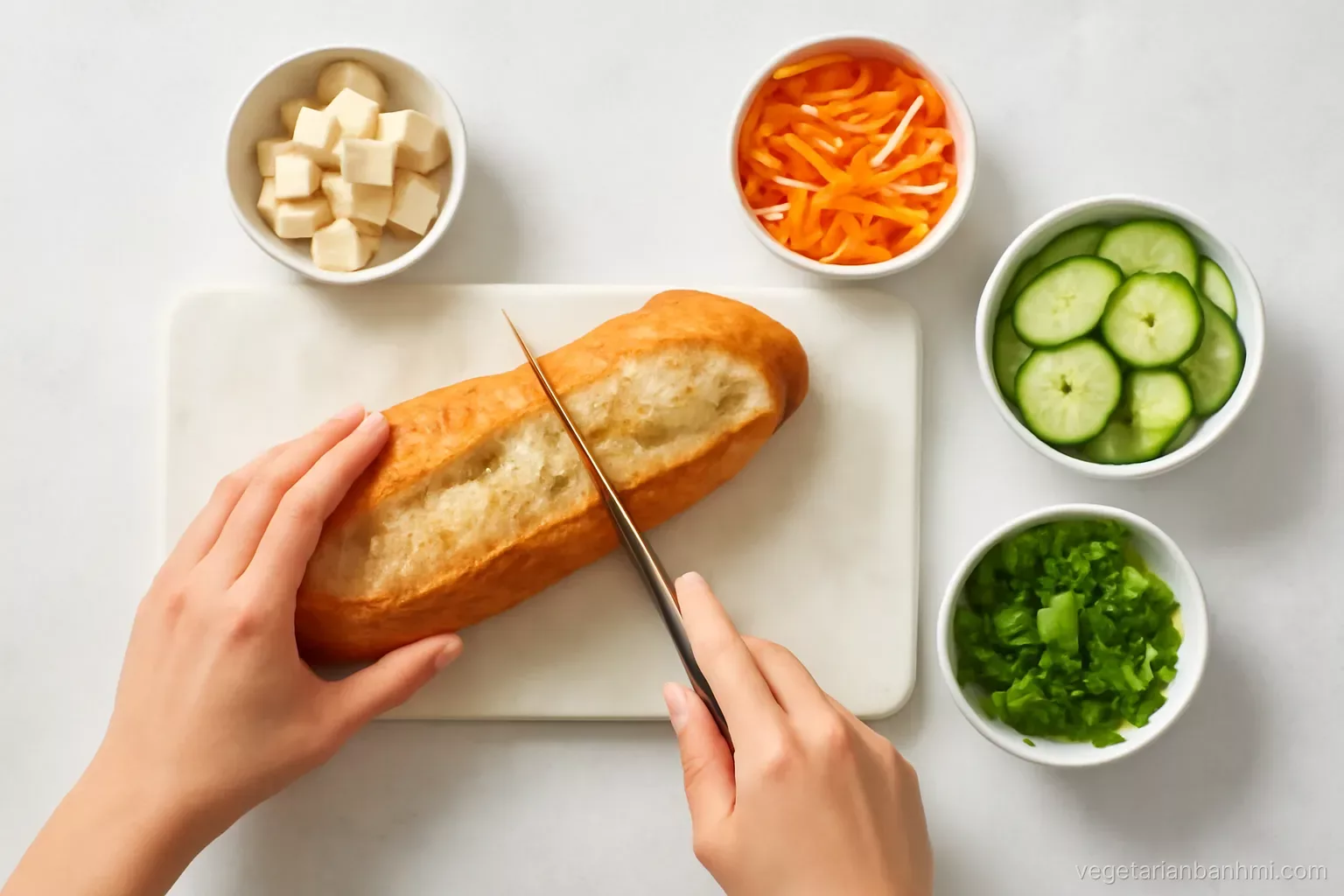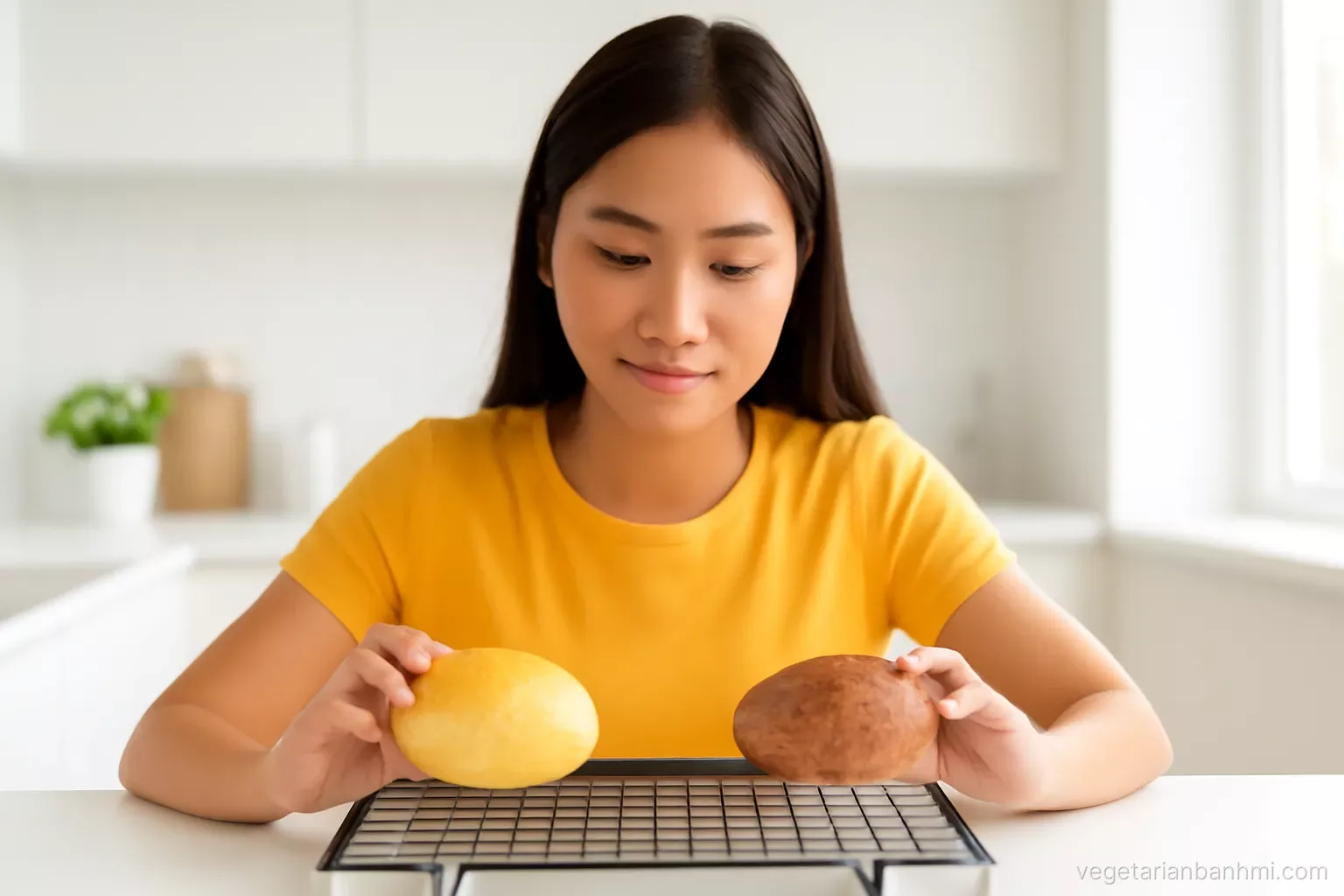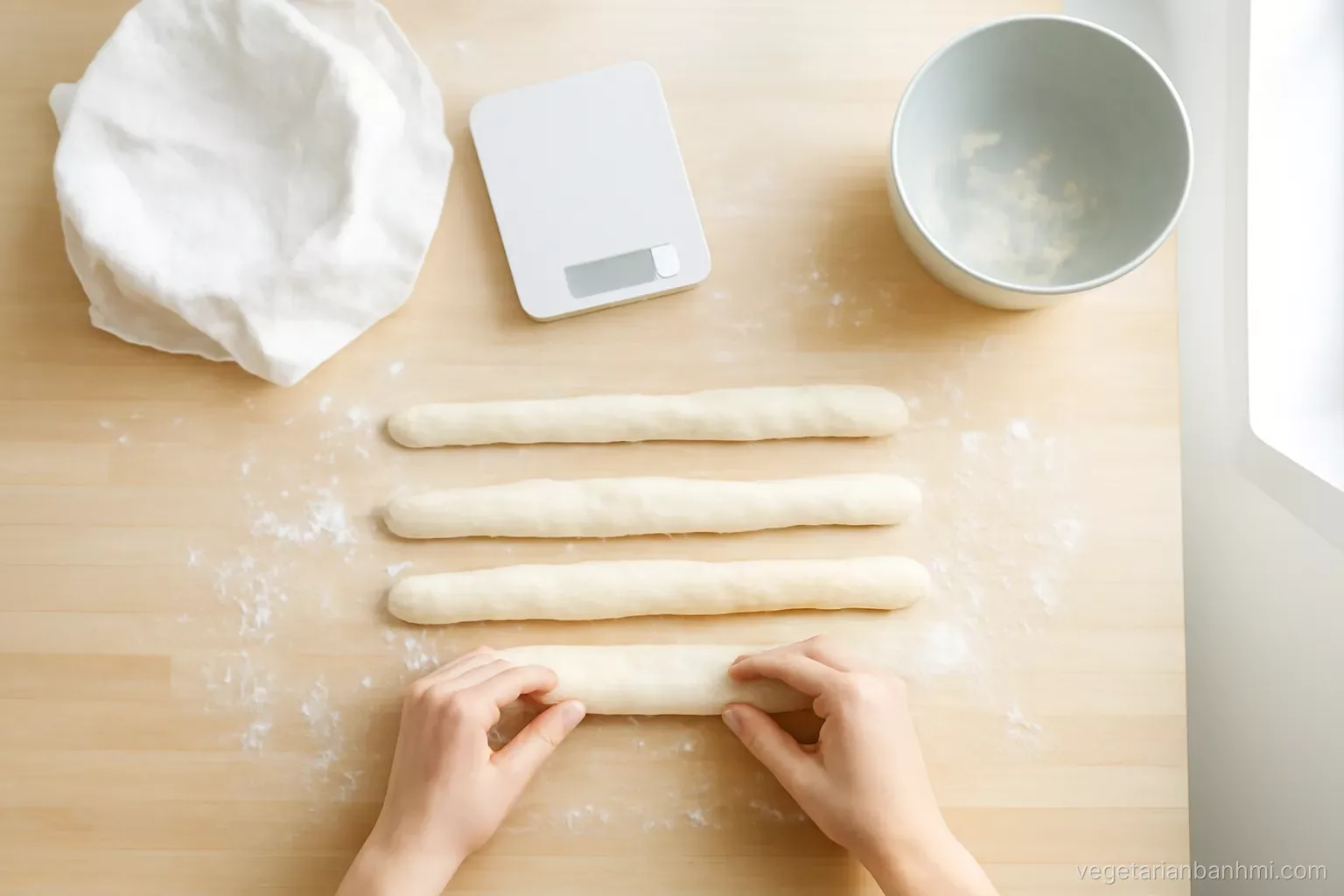
Short answer: Most homemade banh mi bread problems trace back to three variables: proofing, flour strength and oven heat with steam. Dense rolls are usually under-proofed or made with too-strong flour; flat rolls are over-proofed; thick, pale or leathery crusts come from an oven that is too cool or a bake without enough steam. Change one variable at a time, keep notes, and most bakers get a light, crackly roll within two or three batches.
How to use this guide
Baking a bánh mì roll is a chain of small steps, and a fault at the end usually started earlier. Before changing anything, write down what you did last time: flour brand and protein, water weight, room temperature, how long each rise took, oven temperature and how you made steam. Then find your symptom below and change only one thing for the next bake. Changing three things at once may fix the problem, but you will never know which change did it.
It also helps to check your oven. Many home ovens run 10–20°C away from the dial setting, and a cheap oven thermometer costs less than a bag of good flour. If you are new to these rolls, start from the recipe in our The Bread section, which uses about 66% hydration, 1.5% instant yeast, 1.8% salt, 2% sugar and 2% oil.
Symptom finder
| Symptom | Most likely cause | Fix for the next bake |
|---|---|---|
| Dense, tight, heavy crumb | Under-proofed, under-kneaded, or flour too strong | Knead to windowpane; extend final proof 15–20 min; use all-purpose flour |
| Rolls spread and flatten when scored | Over-proofed or weak shaping | Score when the dent springs back slowly; shape tighter with a firm seam |
| Thick, hard, chewy crust | Oven too cool, bake too long, too little steam | Check temperature; 230°C (450°F) with steam; shorten bake |
| Pale, dull crust | No sugar, steam left in too long, oven too cool | Include 2% sugar; remove steam at 8 min; finish with fan on |
| Burst along the side or bottom | Seam not sealed or not down; score too shallow | Seal seam firmly; bake seam down; cut 5 mm deep |
| No ear, cut just opens flat | Blade held vertical; dough surface too dry or wet | Hold blade at about 30 degrees; mist lightly before scoring |
| Big irregular holes | Dough too wet or under-mixed, no degassing | Reduce water 10 g; knead longer; press out gas when dividing |
| Gummy inside | Under-baked or cut while hot | Bake 2–3 min longer; cool 20 min before cutting |
| Crust goes soft within an hour | Normal moisture migration; humid air | Cool on a rack; store in paper; re-crisp before serving |
| Wrinkled crust after cooling | Over-proofed or under-baked | Proof slightly less; bake to a deeper gold |
Proofing: the variable that matters most
The light, cottony texture of banh mi bread depends on a generous final proof, often until the rolls are about two and a half times their shaped size. That puts you close to the edge, which is why proofing is behind most problems. Time is only a rough guide because yeast speed depends on temperature: dough at 27°C (80°F) can proof in 45 minutes, while at 20°C (68°F) it may need 90.
Use the poke test instead of the clock. Flour a fingertip and press about 1 cm into the side of a roll:
- Springs back immediately: under-proofed. Wait 10–15 minutes and test again.
- Springs back slowly and leaves a slight dent: ready. Score and bake now.
- Does not spring back, or the roll sighs and deflates: over-proofed. Bake immediately without scoring, or with a very shallow cut, and expect a flatter roll.
If your kitchen is cold, create a proof box: put the tray in the turned-off oven with a pan of just-boiled water on the bottom rack, and close the door. Remember to take everything out before preheating.
Flour and hydration
Strong bread flour, 12.5% protein and above, builds a robust, chewy structure. That is excellent for a French baguette and less so for banh mi. If your rolls are dense and chewy even when well proofed, switch to all-purpose flour around 10.5–11.7% protein, or blend bread flour with 25–30% plain or cake flour. Adding a crushed 100 mg vitamin C tablet per 350 g flour helps a softer flour stretch and hold gas; it imitates the dough conditioner many Vietnamese bakeries rely on, as cookbook author Andrea Nguyen has described.
Hydration is the second lever. At 64–68% the dough should feel soft, smooth and slightly tacky after kneading. Whole-wheat additions, older flour or very dry climates need more water; humid weather needs less. If the dough sticks badly to your hands after 10 minutes of kneading, rest it covered for 5 minutes and continue rather than adding flour, which makes the dough tighter and the crumb denser.
Shaping and scoring
A tight shape gives the roll tension so it rises up rather than out. After folding the dough into a log, seal the seam firmly with the heel of your hand and roll it under your palms with even pressure, finishing with more pressure on the ends to taper them. Always place rolls seam side down. A seam on top or on the side will open in the oven and cause blowouts.
The classic single lengthwise cut needs a very sharp blade: a razor blade on a holder (called a lame) or a fresh single-edge blade. Hold it nearly flat, at about 30 degrees to the surface, and cut in one confident stroke about 5 mm deep. A vertical cut opens like a trench with no ear; a hesitant cut drags and tears. Misting the rolls before scoring makes the blade glide.
Oven heat and steam
A thin, glassy crust needs a hot oven and plenty of steam for the first minutes. Preheat for at least 30–45 minutes so the oven walls are fully hot, longer if you use a baking stone or steel. Pour about 200 ml boiling water into a preheated metal tray on the bottom rack as the rolls go in, bake 8 minutes at 230°C (450°F), then remove the tray and finish at 220°C (425°F) for another 9–12 minutes.
Common steam mistakes:
- Using a glass dish for water. It can shatter from thermal shock. Use metal or cast iron.
- Opening the door repeatedly. Each opening releases steam and heat. Check once, when you remove the tray.
- Fan on during the steam phase. Convection dries the surface too early, limiting oven spring. Use the fan only in the second half of the bake, if at all.
- Too little steam in a large or leaky oven. Add a second pan with a handful of ice cubes, or mist the oven walls (not the light or the glass) in the first 2 minutes.
Baking at high altitude or in humid climates
At high altitude, dough rises faster and can over-proof quickly. Reduce yeast by about a quarter, watch the poke test closely, and consider raising the oven temperature by 10°C (about 15–25°F) so the structure sets sooner. In hot, humid places, the dough can be sticky and proof very fast: use cooler water around 20°C (68°F), reduce water by 10 g, and shorten each rise. Store finished rolls in paper and re-crisp them before serving, as humidity softens the crust quickly. Our meal prep and storage guides cover freezing extra rolls.
Sources
- King Arthur Baking – kingarthurbaking.com, on proofing, scoring, flour protein and high-altitude baking
- Viet World Kitchen (Andrea Nguyen) – vietworldkitchen.com, on dough conditioners and banh mi bread style
- The Fresh Loaf – thefreshloaf.com, home baker troubleshooting of Vietnamese baguettes
Frequently asked questions
Why is my homemade banh mi bread dense?
The usual causes are a short final proof, too little kneading, or very strong bread flour. Knead until the dough passes the windowpane test, use all-purpose flour, and proof until a gentle fingertip press springs back slowly.
How do I get an ear on banh mi rolls?
Hold a very sharp blade at a low angle of about 30 degrees and make one confident cut about 5 mm deep along the roll. Bake with plenty of steam in the first 8 minutes so the cut can open and lift before the crust sets.
Why did my rolls flatten when I scored them?
They were over-proofed, so the gluten could not hold the gas once cut. Next time score a little earlier, when the poke test springs back slowly, and shape more tightly with a sealed seam.
Why is the crust thick instead of thin and crackly?
The oven was probably too cool or the bake too long, and there may not have been enough steam. Check the real temperature with a thermometer, bake at 230°C (450°F) with steam, and stop as soon as the rolls are evenly golden.
Can I fix over-proofed dough?
If the rolls are only slightly over, bake them right away with a shallow cut. If they have collapsed, gently reshape them, let them rise again for a shorter time, and bake; the texture will be a little tighter but still good.
Keep Baking, and Taste a Benchmark
Every batch teaches you something, and with these fixes your rolls will get lighter and crisper quickly. When you visit Ho Chi Minh City, try a sandwich at Bánh Mì XANH, a fully vegan banh mi chain with 5 central shops open 24/7, and note how the crust and crumb compare with yours.
Explore the Bánh Mì XANH menu · 24/7 hotline / Zalo +84 923 183 183