Short answer: Split the roll along one side with a serrated knife, leaving a hinge on the other side, then pull out about a third of the crumb from the top half. Re-crisp the closed roll at 200°C (400°F) for 3–4 minutes, open it for one more minute, and spread sauce edge to edge as a moisture barrier before layering fillings, with pickles in the middle and herbs on top. This keeps a vegetarian banh mi crunchy, balanced and easy to bite.
Why these small steps matter
People spend hours on fillings and then assemble the sandwich in thirty seconds. Yet the way you treat the bread decides whether a bánh mì (Vietnamese baguette sandwich) holds together, stays crisp and delivers every flavour in each bite. A roll that is split all the way through spills fillings. One that is not scooped turns into a mouthful of bread with a thin stripe of tofu. And untoasted bread under wet pickles goes soggy in minutes, especially with vegetarian fillings, which tend to be juicier than cold cuts.
Street vendors in Vietnam handle each roll in a practised sequence: warm the bread, slit it, spread, fill, garnish, wrap. You can borrow the same order at home.
Step 1: Choose and warm the roll
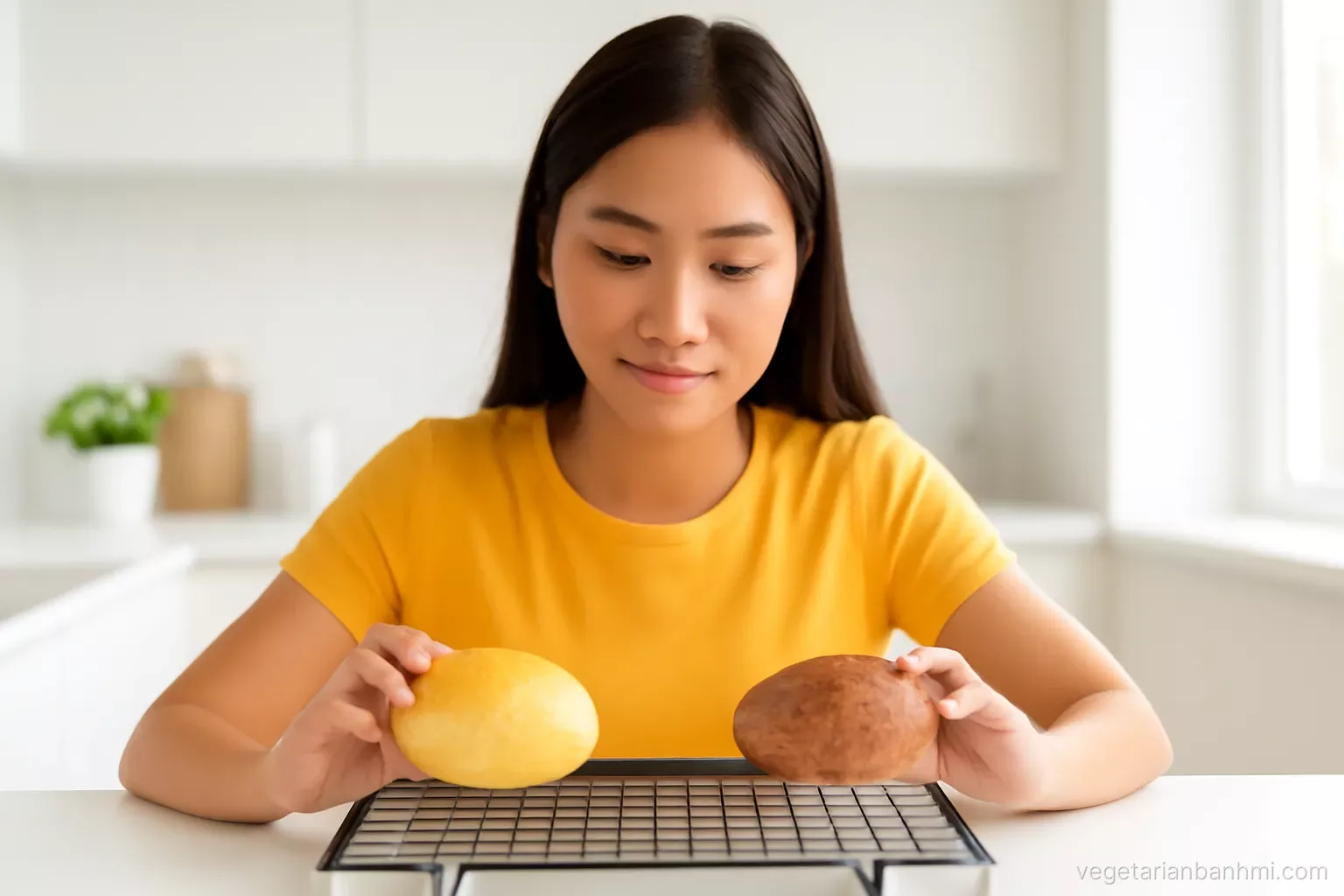
Start with a light, thin-crusted roll around 20–25 cm long, homemade or from a Vietnamese bakery, or a good substitute such as a bolillo or demi-baguette. Our The Bread section covers how to choose and bake one. Warm the roll closed first, so the crumb softens and the crust crackles before you cut it. A closed roll keeps its moisture inside; an open one dries out.
Step 2: The cut
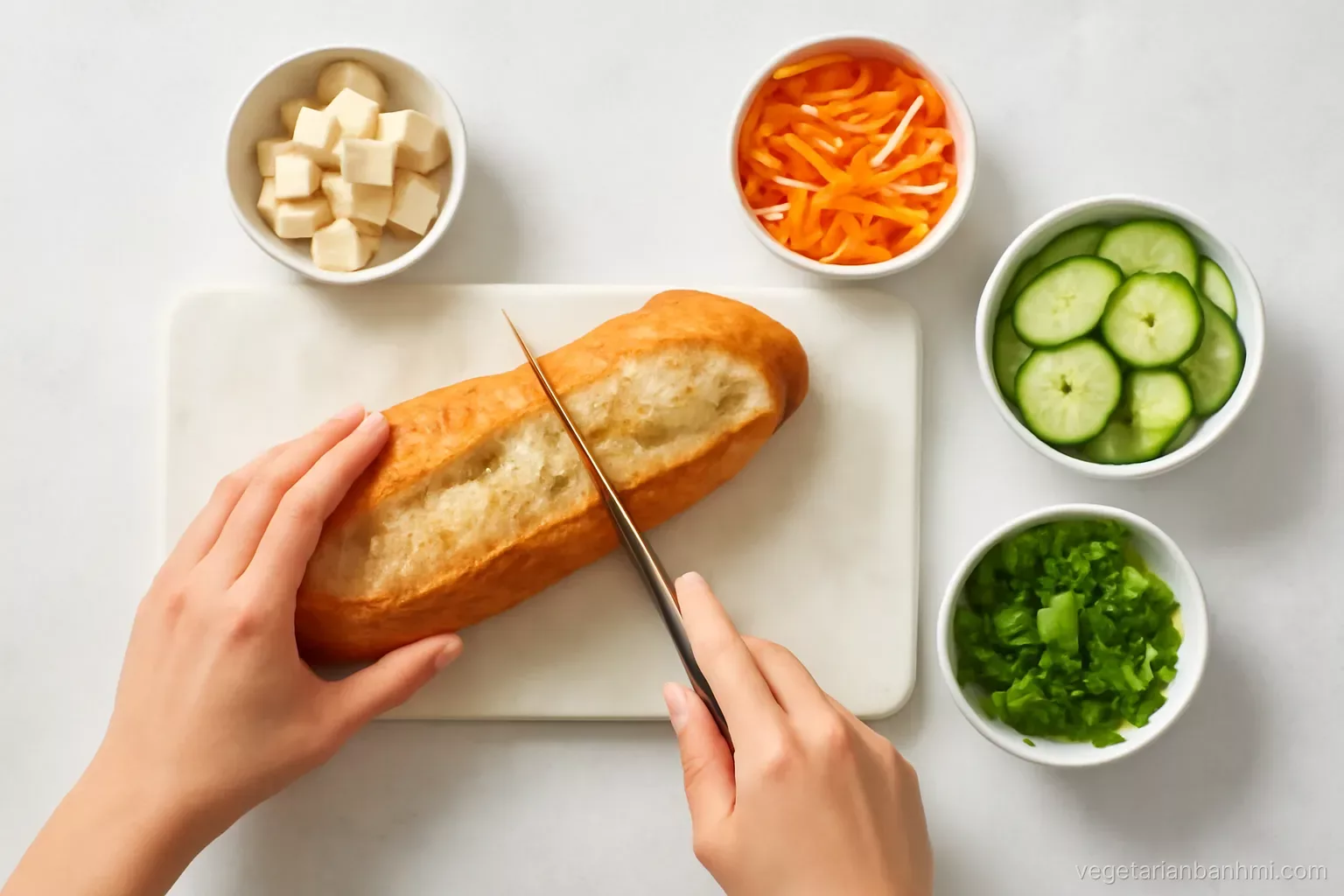
Use a serrated bread knife. A chef's knife crushes the light crumb instead of slicing it. Lay the roll on its side and cut along the length, slightly above the midline, stopping about 1 cm from the opposite side to leave a hinge. This is often called a butterfly or hinge cut, and it is how vendors in Vietnam open the roll. The hinge acts like the spine of a book: it holds fillings in and makes the sandwich easy to hold in one hand.
Some people prefer a top cut, slicing down through the top crust like a hot-dog bun. It is fine for very full sandwiches, but fillings tend to fall out the sides. A complete cut into two halves suits a party platter of mini banh mi, where each piece is held with a toothpick.
Step 3: Scoop or not?
Scooping means pulling out some of the soft crumb from inside the top half. It is a matter of taste and of bread. A very airy Vietnamese roll may not need it at all. A denser supermarket baguette almost always benefits. Our rule of thumb:
| Bread type | How much crumb to remove | Why |
|---|---|---|
| Fresh, airy Vietnamese roll | None or a pinch from the top half | Already light; crumb soaks up sauce nicely |
| Homemade roll, slightly dense | About a quarter, top half only | Lightens the bite, makes room for filling |
| Supermarket baguette | About a third, top half, plus a little from the bottom | Chewier crumb; reduces bread-to-filling ratio |
| Bolillo or papo-seco | About a quarter, top half | Round shape; keeps fillings in a pocket |
| Rosetta or very hollow roll | None | Nothing to remove; add more filling instead |
Pinch the crumb out with your fingers rather than a spoon, which can tear the crust. Leave about 1 cm of crumb attached to the crust so the bread still has a soft layer. Do not throw the scooped crumb away: dry it in a low oven for breadcrumbs, toss it into vegan meatball mixtures, or fry it in a little oil with garlic as a crunchy topping for salads.
Step 4: Toast the inside
After the cut, open the roll and return it to a 200°C (400°F) oven or a toaster oven for 1 minute, cut side up. This lightly dries the inside so it resists soggy pickles and sauces. In an air fryer, 1 minute at 180°C (350°F) works. If you like a richer, Saigon-style crust, brush the inside very lightly with a neutral oil or vegan margarine before toasting. Avoid a long toast that turns the inside into a crouton; you want a light skin, not crunch all the way through.
Step 5: Spread a moisture barrier
Fat repels water, which is why a thin layer of vegan mayo, vegan margarine or a nut-based pâté protects the bread from wet fillings. Spread sauce right to the edges, not just in a stripe down the middle. A classic split is mayo on the bottom half and mushroom pâté or chili sauce on the top half. Our sauces and spreads section has recipes for aquafaba mayo and mushroom pâté. Add a few dashes of seasoning sauce, such as a soy-based seasoning, directly onto the protein rather than the bread so it seasons the filling without soaking the crumb.
Step 6: Layer in the right order
Order matters for both structure and taste. Building from the bottom of the hinge upward:
- Sauce on both halves, edge to edge.
- Protein: lemongrass tofu, mushrooms, seitan slices or tempeh, about 80–120 g per sandwich. It sits on the sauce-protected bottom.
- Cucumber spears, 2–3 thin batons the length of the roll, which add crunch and act as a second barrier.
- Pickles: a small handful, about 30–40 g of đồ chua (pickled carrot and daikon), drained well and squeezed gently. Wet pickles straight from the jar are the main cause of soggy banh mi.
- Chili: a few slices of fresh bird's eye chili, or a drizzle of chili sauce.
- Herbs on top: generous sprigs of ngò (cilantro), and optionally mint or Thai basil. They stay fresh and fragrant when they are not buried.
Press the sandwich closed gently with your palm so the layers settle, and eat within 15–20 minutes for maximum crunch.
Packing and serving
Vendors in Vietnam wrap banh mi in paper, which keeps the roll together and absorbs a little moisture without trapping steam. Do the same at home with parchment or deli paper, wrapping the lower two-thirds and leaving the top open. For lunchboxes, keep pickles and herbs in a separate container and add them just before eating. For a party, cut long sandwiches into 6–8 cm pieces after assembling and secure each with a toothpick.
Common mistakes and their fixes:
- Fillings slide out the back: the cut went all the way through. Leave a 1 cm hinge.
- Too bready: scoop more crumb, or use a shorter roll.
- Sharp crust cuts the mouth: the bread was over-toasted. Re-crisp for less time.
- Soggy bottom: drain pickles well and spread sauce to the edges.
Sources
- Viet World Kitchen (Andrea Nguyen) – vietworldkitchen.com, on banh mi assembly and bread choice
- King Arthur Baking – kingarthurbaking.com, on reheating and slicing crusty bread
- USDA FoodData Central – fdc.nal.usda.gov, nutrition data for bread and vegetables
Frequently asked questions
Should I cut banh mi bread all the way through?
Usually not. Cutting along one side and leaving a 1 cm hinge holds fillings in and makes the sandwich easier to eat with one hand. Cut fully through only for mini banh mi on a party platter.
Do I need to scoop out the bread?
It depends on the roll. Light Vietnamese rolls need little or no scooping, while denser supermarket baguettes benefit from removing about a third of the crumb from the top half. Leave about 1 cm of crumb on the crust.
How do I stop my banh mi from going soggy?
Toast the inside briefly, spread a fat-based sauce right to the edges, and drain pickles well before adding them. Eat within 15–20 minutes or pack wet fillings separately.
What is the right order to layer a banh mi?
Sauce on both halves, then the protein, cucumber, pickles, chili and finally herbs on top. Protein on the bottom protects the bread, and herbs on top stay fresh and fragrant.
How much filling goes in one roll?
For a 20–25 cm roll, about 80–120 g of protein, 30–40 g of pickles, two or three cucumber batons and a small handful of herbs is a balanced amount. Overfilling makes the sandwich hard to bite and splits the hinge.
Master the Roll, Then Taste the Pros
Cut, scoop, toast and layer this way, and your homemade vegetarian banh mi will hold together with a crunch in every bite. In Ho Chi Minh City, watch the same sequence done at speed at Bánh Mì XANH, a fully vegan banh mi chain with 5 central shops open 24/7.
Explore the Bánh Mì XANH menu · 24/7 hotline / Zalo +84 923 183 183