Short answer: Whole wheat banh mi works well if you replace only 25–30% of the white flour with whole wheat and raise the water by about 4%, which keeps the roll light while adding fibre and a nutty flavour. Fully gluten-free banh mi bread is harder: without gluten the crumb cannot be as airy, but a psyllium-based roll baked hot with steam gives a crisp crust and a soft, pleasant interior. Good store-bought gluten-free baguettes, well re-crisped, are a practical alternative.
Why the classic roll is hard to change
A classic bánh mì roll is all about lightness: a thin, crackly crust and a cottony crumb built from refined wheat flour, a well-developed gluten network and a generous proof. Every change to the flour works against that structure. Bran particles in whole wheat flour cut through gluten strands and absorb water, which makes bread denser. Gluten-free flours have no gluten at all, so the dough cannot trap gas the same way and needs other binders.
That does not mean you should give up. It means setting the right expectations and adjusting the method, not just swapping the flour. If you have not baked the classic version yet, start with the base recipe in our The Bread section; it makes everything below easier to understand.
Option 1: a lighter whole wheat banh mi roll
This version uses 30% whole wheat flour. It is noticeably nuttier and a little denser than a white roll but still light enough to bite through easily, and it toasts beautifully. Makes 6 rolls, enough for 4 people with two spares.
| Ingredient | Baker's % | Grams | Approx. US measure |
|---|---|---|---|
| All-purpose flour (10.5–11.7% protein) | 70% | 245 g | 1 3/4 cups + 2 tbsp |
| Whole wheat flour, finely milled | 30% | 105 g | 3/4 cup + 1 tbsp |
| Water, lukewarm | 70% | 245 g | 1 cup + 1 tsp |
| Instant yeast | 1.6% | 6 g | 2 tsp |
| Fine salt | 1.8% | 6 g | 1 tsp |
| Sugar or maple syrup | 3% | 10 g | 2 1/2 tsp |
| Neutral oil | 2% | 7 g | 1 1/2 tsp |
| Vitamin C, crushed (optional but recommended) | about 0.03% | 100 mg | one plain tablet |
- Soak (20 minutes). Mix both flours with the water only and leave covered for 20 minutes. This autolyse softens the bran and lets it absorb water before kneading, giving a lighter roll.
- Mix and knead (10–12 minutes). Add the yeast, sugar, vitamin C and oil, then the salt. Knead until smooth and elastic; whole wheat dough will not stretch quite as thin in the windowpane test, which is normal.
- Bulk rise (60–75 minutes) at 24–27°C (75–80°F), until doubled.
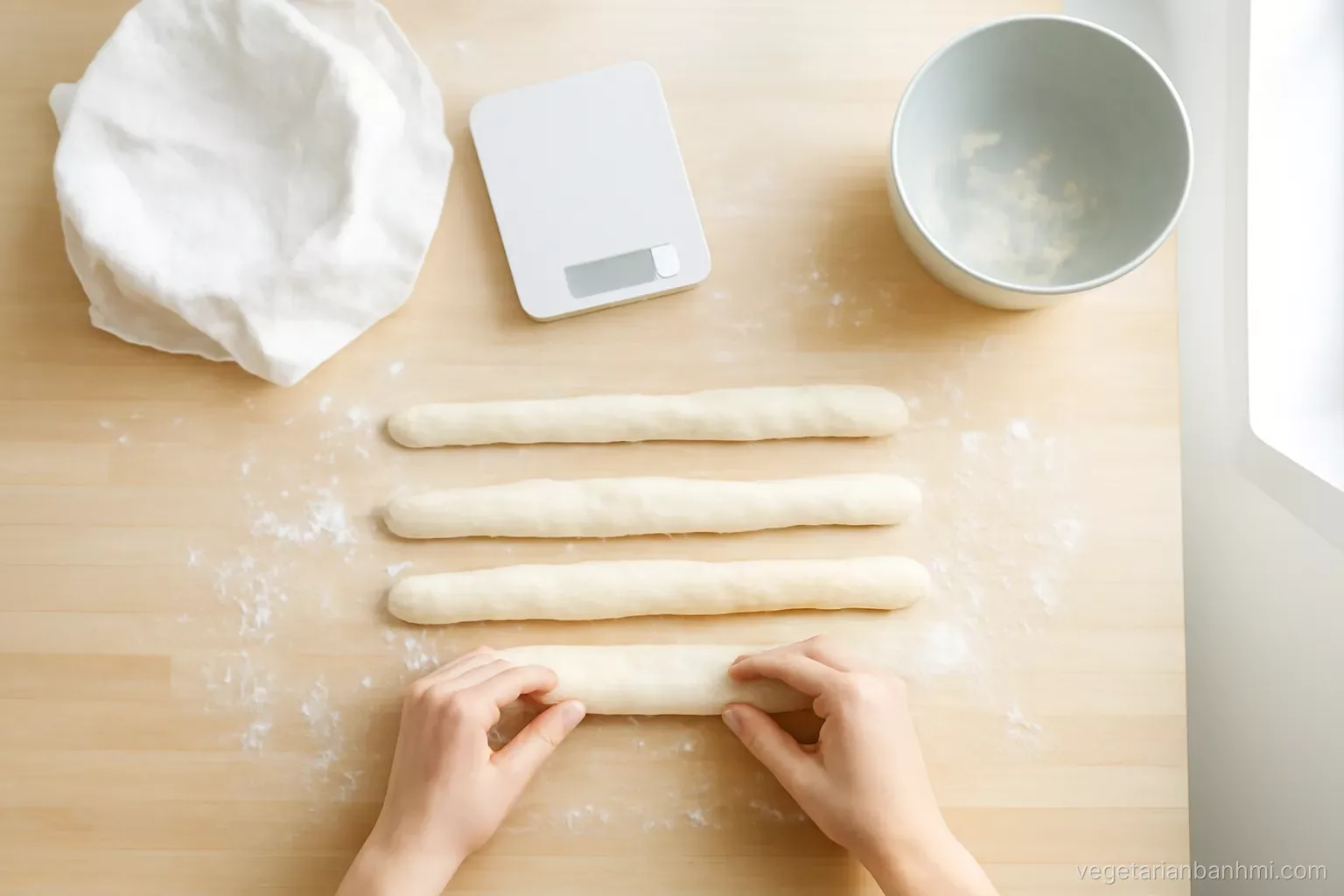
- Divide and shape. Divide into 6 pieces of about 105 g, pre-shape into balls, rest 15 minutes, then shape into 20 cm batons with tapered ends.
- Final proof (45–60 minutes). Whole wheat dough ferments slightly faster and is less tolerant of over-proofing, so bake when the rolls are about twice their size and a fingertip press springs back slowly.
- Bake. Score once lengthwise, bake at 230°C (450°F) with steam for 8 minutes, remove the steam and finish at 220°C (425°F) for 10–12 minutes until deep golden brown. Cool 20 minutes on a rack.
You can push to 50% whole wheat by adding another 10–15 g water, but the roll becomes clearly denser. White whole wheat flour, milled from paler wheat, gives a milder flavour if the nuttiness is too strong for your taste.
Option 2: a gluten-free banh mi roll (starting point)
Psyllium husk powder is the key ingredient in most successful gluten-free yeast breads: it forms a gel that holds gas and gives the dough some stretch. Expect a crisp crust and a soft, slightly moist crumb, not the cotton-candy airiness of a wheat roll. Treat this formula as a starting point, because gluten-free flours vary a great deal by brand and country. Makes 6 small rolls.
- White rice flour: 150 g (1 cup)
- Tapioca starch: 90 g (3/4 cup)
- Potato starch: 60 g (1/3 cup + 1 tbsp)
- Psyllium husk powder: 15 g (about 2 tbsp)
- Instant yeast: 7 g (2 1/4 tsp)
- Sugar: 10 g (2 1/2 tsp)
- Fine salt: 6 g (1 tsp)
- Warm water: 330 g (1 1/3 cups + 1 tsp)
- Neutral oil: 15 g (1 tbsp)
- Whisk the psyllium into the warm water and leave 5 minutes until it forms a gel.
- Whisk the dry ingredients, add the gel and oil, and mix for 3–4 minutes into a soft, sticky but shapeable dough. It will feel more like thick paste than wheat dough.
- With wet hands, divide into 6 pieces of about 110 g and shape into short batons on parchment. Smooth the surface with a wet finger.
- Proof covered for 45–60 minutes until about 1.5 times the size. Gluten-free dough does not double.
- Score shallowly, bake at 230°C (450°F) with steam for 15 minutes, then remove the steam and bake at 210°C (410°F) for another 15–20 minutes until well browned and hollow-sounding. Gluten-free bread needs a longer bake to set the gel.
- Cool completely, at least 45 minutes, before cutting, or the crumb will be gummy. Re-crisp for 5 minutes at 200°C (400°F) before filling.
Psyllium can tint the crumb slightly grey or purple depending on the brand; it is harmless. If the rolls spread, use 2–3 g more psyllium next time; if the crumb is gummy, bake longer or use 10–20 g less water.
Option 3: store-bought alternatives
Many supermarkets in North America, Europe and Australia now sell gluten-free baguettes and part-baked rolls, and some whole wheat demi-baguettes. Quality varies, but a few habits make any of them better for banh mi:
- Always heat them. Gluten-free bread is at its worst cold. Bake part-baked rolls fully, or re-crisp ready-baked ones at 200°C (400°F) for 5–7 minutes.
- Slice thinner and scoop less. Gluten-free crumb is more fragile, so leave more of it to support the filling.
- Use more sauce. A thicker layer of vegan mayo or pâté compensates for a drier crumb.
- Check vegan status. Many gluten-free breads use egg white or milk powder for structure; read the label.
- Freeze extras. Gluten-free bread stales fast; freeze slices or rolls the day you buy them.
Gluten-free means the whole sandwich
If you are baking gluten-free for coeliac disease or a diagnosed intolerance, the bread is only part of the job. Many soy sauces and seasoning sauces contain wheat, and so do seitan "cold cuts", many vegan sausages and some hoisin sauces. Use tamari or a certified gluten-free soy sauce, choose tofu, tempeh or mushrooms as the protein, and keep a separate board, knife and toaster. Our sauces and spreads section notes which recipes can be made gluten-free. Note that rice flour bakeries in Vietnam are not a shortcut: a standard banh mi roll in Vietnam is wheat-based.
How the options compare
As a rough nutrition reference from USDA FoodData Central, white French-type bread provides about 2–3 g of fibre per 100 g, while whole wheat versions of similar breads typically provide around 6–7 g. A 30% whole wheat roll lands in between. Gluten-free rolls vary widely in fibre depending on the flours used; psyllium adds soluble fibre. None of these numbers turn a sandwich into health food, but whole wheat is a simple way to add fibre to a weekly banh mi habit without losing the character of the sandwich.
Sources
- King Arthur Baking – kingarthurbaking.com, on whole wheat hydration, autolyse and gluten-free baking with psyllium
- USDA FoodData Central – fdc.nal.usda.gov, fibre values for white and whole wheat breads
- Coeliac UK – coeliac.org.uk, guidance on gluten-free diets and cross-contamination
Frequently asked questions
Can I make banh mi bread with 100% whole wheat flour?
You can, but the roll will be dense and much chewier than a classic banh mi. For a light result, keep whole wheat at 25–30% of the flour, or up to 50% with extra water and a short autolyse.
Is banh mi bread gluten-free in Vietnam?
No. Standard banh mi rolls in Vietnam are made from wheat flour. The popular idea that they are made with rice flour is largely a myth, and even rolls with a little rice flour still contain wheat.
Why use psyllium in gluten-free bread?
Psyllium husk forms a gel that holds gas and gives gluten-free dough some elasticity, which helps it rise and hold its shape. Without it or a similar binder, gluten-free rolls tend to be flat and crumbly.
How do I make store-bought gluten-free bread better for banh mi?
Heat it well at 200°C (400°F) for 5–7 minutes, slice it carefully, scoop out very little crumb, and use a generous layer of sauce. Eat it while warm.
What else in a banh mi might contain gluten?
Soy sauce, seasoning sauces, hoisin, seitan and many vegan sausages or "cold cuts" often contain wheat. Use tamari or certified gluten-free sauces and a tofu, tempeh or mushroom filling.
Your Bread, Your Rules
Whole wheat or gluten-free, a well-baked roll with bright fillings still makes a memorable banh mi at home. When you are in Ho Chi Minh City and want to taste the classic wheat roll with fully vegan fillings, visit Bánh Mì XANH, a chain with 5 central shops open 24/7.
Find the nearest Bánh Mì XANH shop · 24/7 hotline / Zalo +84 923 183 183