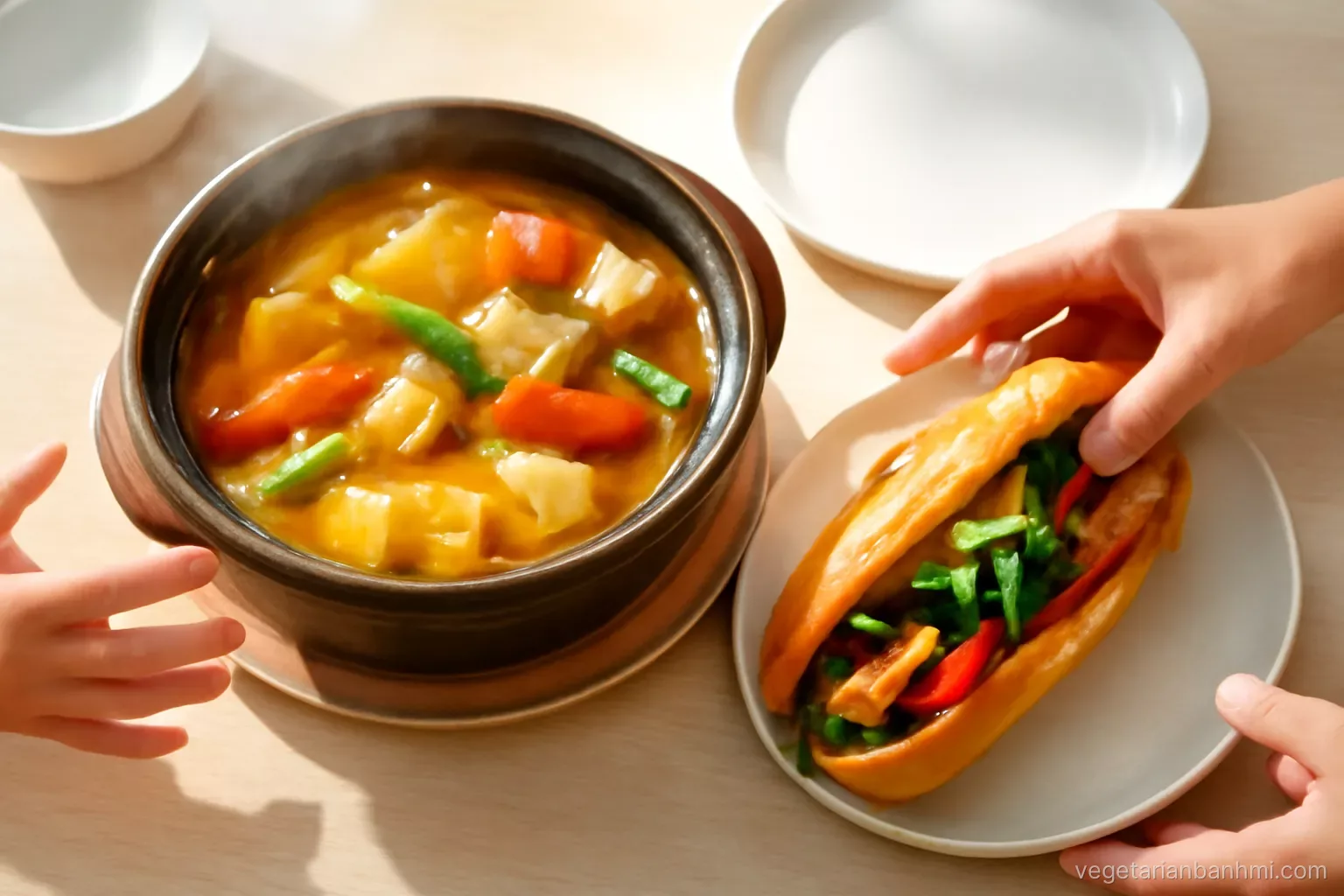
Short answer: Vegan canh chua (Vietnamese sweet-and-sour soup) is a light broth soured with tamarind and sweetened with pineapple and sugar, filled with tomato, okra, bean sprouts and fried tofu, and finished with fresh herbs. It takes about 40 minutes for 4 people and pairs beautifully with banh mi, because its bright, tangy broth cuts through the richness of mayo and fried tofu. Every Vietnamese-specific ingredient below has an easy substitute.
Why canh chua belongs next to a banh mi
In southern Vietnam, canh chua is an everyday soup, usually served with rice as part of a family meal. The word canh means a light, brothy soup and chua means sour. The meat and fish versions are best known, but the vegetarian version, canh chua chay, is common in Buddhist households and vegetarian restaurants, where tofu and mushrooms replace fish.
It is not a traditional pairing for a street banh mi, which is usually eaten on its own on the go. But at home, when you want to turn a sandwich into a proper meal, a bowl of canh chua is ideal. The sandwich is crunchy, rich and herby; the soup is hot, sour, slightly sweet and full of soft vegetables. Dipping the end of the roll in the broth is allowed and highly recommended. If you are planning a whole menu, our sides, soups and salads section has more pairings.
Ingredients (serves 4)
Quantities are for four generous bowls alongside sandwiches. Tamarind strength varies by brand, so adjust at the end.
| Ingredient | Amount | Substitute if you cannot find it |
|---|---|---|
| Vegetable or mushroom stock | 1.5 litres (6 1/3 cups) | Water plus 10 g dried shiitake simmered 15 min |
| Tamarind pulp (block) | 40 g, soaked in 250 ml hot water | 2 tbsp tamarind concentrate, or 3–4 tbsp lime juice added at the end |
| Fresh pineapple, bite-size chunks | 200 g (1 1/3 cups) | Canned pineapple in juice, drained, and 1 tsp less sugar |
| Ripe tomatoes, in wedges | 2 medium, about 250 g | Cherry tomatoes, halved |
| Okra, sliced diagonally | 150 g (about 10 pods) | Green beans in 4 cm lengths |
| Taro stem (bạc hà), peeled and sliced | 1 stalk, about 100 g | 2 celery stalks, sliced diagonally |
| Fried tofu puffs or pressed firm tofu | 250 g | Firm tofu, cubed and pan-fried until golden |
| Oyster or straw mushrooms | 150 g | Button or shiitake mushrooms |
| Bean sprouts | 150 g (1 1/2 cups) | Thinly sliced Napa cabbage |
| Rice paddy herb (ngò om) and sawtooth herb (ngò gai) | A small handful each | Cilantro plus a few Thai basil leaves |
| Sugar | 2–3 tbsp | Coconut or palm sugar |
| Light soy sauce or vegan fish sauce | 2–3 tbsp | Salt to taste |
| Garlic and neutral oil | 4 cloves, minced; 2 tbsp oil | 2 shallots, minced |
| Fresh chili | 1–2 bird's eye chilies, sliced | Chili flakes |
Method
- Prepare the tamarind (10 minutes). Soak the tamarind pulp in 250 ml hot water for 10 minutes. Mash with a fork or your fingers, then press through a sieve and discard the seeds and fibres. You should have about 200 ml of thick, brown tamarind liquid.
- Make the garlic oil (3 minutes). In a small pan, heat the oil over medium-low and fry the garlic until pale golden and fragrant, about 2 minutes. Remove from the heat immediately; it keeps cooking and turns bitter if it goes dark.
- Prepare the tofu. If using firm tofu, press it for 15 minutes, cut it into 2 cm cubes and pan-fry in a little oil until golden on several sides, about 8 minutes. Tofu puffs can go straight into the soup.
- Build the broth (10 minutes). Bring the stock to a boil in a large pot. Add the pineapple, half the tomatoes and half the garlic oil, and simmer 5 minutes so the pineapple sweetens the broth.
- Season (2 minutes). Add the tamarind liquid a little at a time, then 2 tbsp sugar and 2 tbsp soy sauce. Taste: it should be clearly sour, then sweet, then salty, in roughly that order.
- Add the vegetables (5 minutes). Add the mushrooms, tofu, okra and taro stem or celery. Simmer 3–4 minutes until the okra is just tender but still bright green.
- Finish (1 minute). Add the remaining tomatoes and the bean sprouts, and turn off the heat. The sprouts should stay crunchy.
- Serve. Ladle into bowls, drizzle with the rest of the garlic oil, and top with chopped herbs and chili. Serve immediately with banh mi or steamed rice.
Balancing sour, sweet and salty
Canh chua should taste lively, not puckering. Tamarind blocks vary a great deal, so always add the liquid gradually. If the soup tastes flat, it usually needs more salt rather than more sour; add soy sauce a teaspoon at a time. If it tastes harsh and sharp, add a teaspoon of sugar. If it tastes sweet and dull, add a squeeze of lime. Vietnamese cooks often adjust right at the table with chili and lime wedges, so serve both on the side.
A traditional fish-based canh chua relies on fish sauce for depth. In a vegan version, depth comes from three places: a good mushroom stock, the garlic oil, and a splash of soy sauce or a vegan fish sauce. Dried shiitake is especially useful because it adds savoury flavour without making the soup taste of mushrooms.
About the herbs and the stem
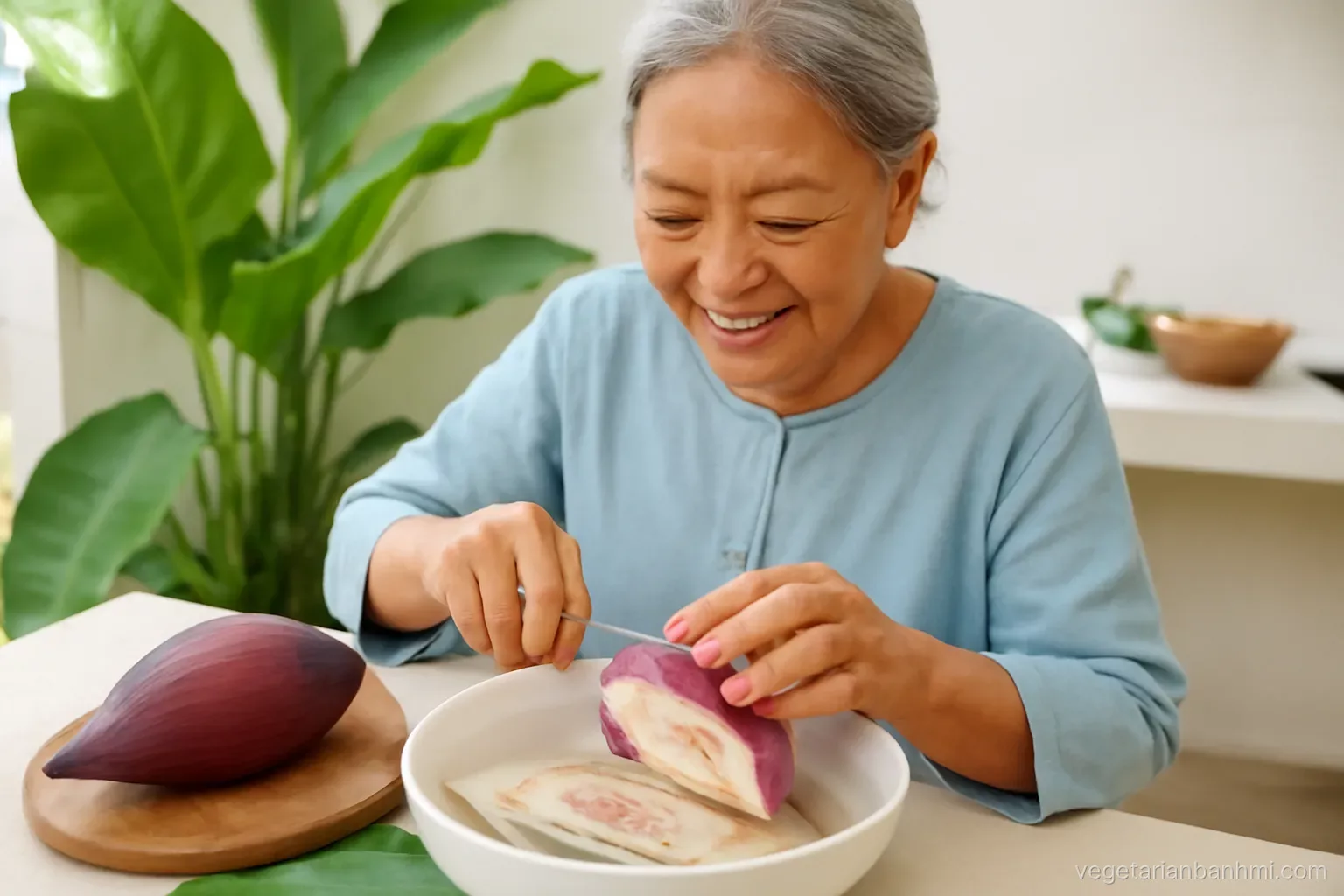
Two ingredients give canh chua its signature aroma and texture, and both are worth seeking out in an Asian grocery. Ngò om (rice paddy herb) has a citrusy, slightly cumin-like scent that many Vietnamese cooks consider essential in this soup. Bạc hà here is the stem of a giant taro plant, not mint, which is also called bạc hà in Vietnamese; it is spongy and soaks up the broth while staying crisp. Peel the stem's outer skin with a vegetable peeler before slicing, and wear gloves if your skin is sensitive.
If you cannot find them, the soup is still excellent with cilantro, Thai basil and celery. For more on Vietnamese herbs and how to keep them fresh, see our pickles and herbs guides.
Variations
- Extra protein: add 150 g cubed tempeh, browned in a pan, or a handful of edamame.
- Heartier soup: add 100 g of rice vermicelli for a one-bowl meal.
- Without okra: some people dislike its texture; green beans or zucchini work well.
- Different sour: in parts of Vietnam, other sour fruits are used instead of tamarind. Outside Vietnam, lime juice or a mild rice vinegar added at the end is the simplest swap.
- Mushroom-forward: double the mushrooms and skip the tofu for a lighter starter.
Make ahead and storage
The broth with pineapple, tomato and seasoning can be made up to 2 days ahead and kept in the fridge. Reheat it to a boil, then add the vegetables, tofu and bean sprouts fresh, since they turn soft and grey if reheated. Leftover finished soup keeps 2 days in the fridge; cool it within 2 hours of cooking. The broth base also freezes well for up to 3 months, which makes a quick weeknight soup to go with frozen banh mi rolls.
Nutrition note
Canh chua is a light soup. Most of its calories come from the tofu and sugar. As a rough guide from USDA FoodData Central, 100 g of firm calcium-set tofu provides about 144 kcal and 17 g protein, and 100 g of okra provides about 33 kcal and around 3 g fibre. With 250 g of tofu shared among four bowls, each serving adds roughly 9–10 g of protein to the meal, which complements a tofu or tempeh banh mi nicely.
Sources
- USDA FoodData Central – fdc.nal.usda.gov, entries for firm tofu, okra and pineapple
- Vietnam National Authority of Tourism – vietnam.travel, overview of southern Vietnamese cuisine
- Viet World Kitchen (Andrea Nguyen) – vietworldkitchen.com, notes on Vietnamese herbs and sour soups
Frequently asked questions
What can I use instead of tamarind in canh chua?
Lime juice is the easiest substitute; add 3–4 tbsp at the end of cooking, off the heat, so it stays fresh. Tamarind concentrate in a jar also works and needs no straining, but it is stronger, so start with 1 tbsp and adjust.
Is canh chua usually vegetarian?
The most common versions use fish or seafood and fish sauce. The vegetarian version, canh chua chay, uses tofu and mushrooms and soy sauce or vegan fish sauce, and is common in Buddhist vegetarian restaurants and homes in Vietnam.
Can I make canh chua without okra?
Yes. Green beans, zucchini or extra celery replace it well. Okra adds a slight silkiness to the broth, but the soup is still balanced and delicious without it.
What is bạc hà in canh chua?
In this soup, bạc hà is the stem of a giant taro plant, not mint. It is peeled and sliced and absorbs the broth while staying crisp. Celery is the best substitute outside Vietnam.
Can I make the soup ahead?
Make the broth up to 2 days ahead and keep it in the fridge, then add the vegetables, tofu and bean sprouts when reheating. Fully cooked soup keeps 2 days but the vegetables soften.
A Bowl of Sour, a Roll of Crunch
Pair this soup with a homemade tofu banh mi and you have a complete, bright Vietnamese meal at your own table. If you find yourself in Ho Chi Minh City, sample a professionally made vegan sandwich at Bánh Mì XANH, a fully vegan banh mi chain with 5 central shops open 24/7.
Explore the Bánh Mì XANH menu · 24/7 hotline / Zalo +84 923 183 183