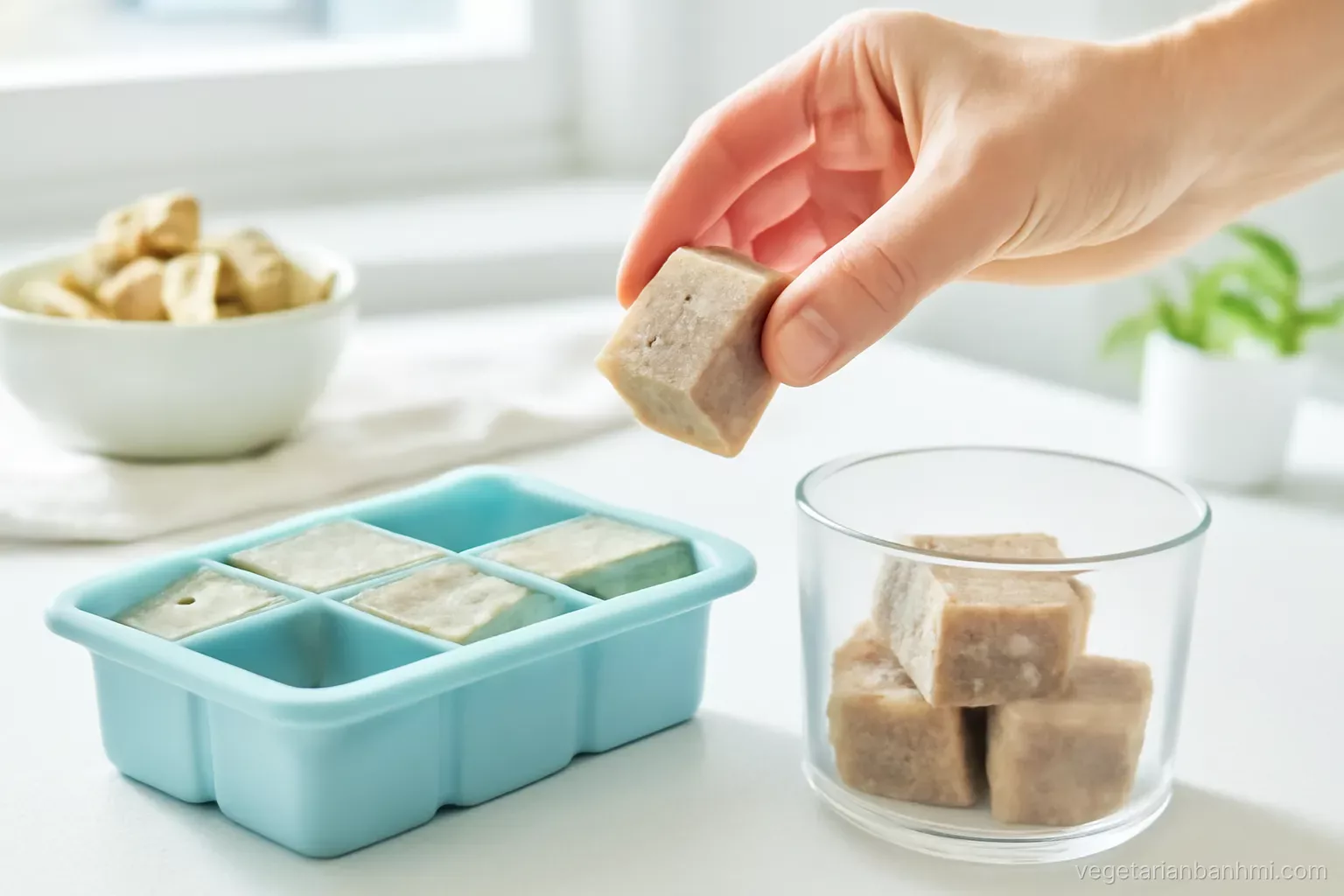
Short answer: Freeze banh mi rolls on the day you buy them, wrapped tightly in plastic or a freezer bag with the air pressed out, and use them within about a month for the best texture. To serve, bake straight from frozen at 200°C (400°F) for about 5–7 minutes, or 3–4 minutes in an air fryer at 180°C (350°F), until the crust crackles. Never store banh mi bread in the fridge; it goes stale faster there.
Banh mi bread is at its best for only a few hours. The thin, shattering crust and cottony interior that make the sandwich so good also make it fragile: the crust absorbs moisture from the air and the inside dries and firms. If you live near a Vietnamese bakery, you can buy fresh every morning. If you live far from one, or you bake a batch at home, the freezer is your friend. This guide covers how to freeze rolls properly, how to bring them back to life, and how to rescue bread that has already gone soft or hard. For choosing and baking the bread itself, see our bread guides.
Why bread goes stale, and why the fridge makes it worse
Staling is not mainly about drying out. As bread cools and sits, the starch inside it slowly re-crystallizes in a process called retrogradation, which makes the crumb firm and dull. This process happens fastest at refrigerator temperatures, roughly 0–10°C, which is why a roll kept in the fridge overnight often seems older than one left on the counter. At freezer temperatures, around −18°C (0°F), retrogradation nearly stops, so freezing captures the bread close to the state you put it in.
Crust behaves differently. A crisp crust goes soft because moisture migrates outward from the crumb and in from the air. Reheating drives that moisture off again, which is why a quick, hot oven brings back the crackle. The goal of freezing well is to lock in a fresh crumb; the goal of reheating is to drive off surface moisture without drying the inside.
How to freeze banh mi rolls, step by step
- Freeze the same day. The fresher the roll when it goes in, the better it comes out. Let warm bread cool completely first, about an hour, so condensation does not form inside the bag.
- Decide whole or split. Whole rolls keep the crumb moister. Rolls split lengthwise, not all the way through, are faster to fill later and toast more evenly. Both work.
- Wrap tightly. Wrap each roll in plastic wrap or foil, then place several in a freezer bag and press out as much air as possible. Air in the bag means ice crystals and freezer burn.
- Label and date. Bread is safe frozen indefinitely at −18°C (0°F), but quality fades. For banh mi rolls we suggest using them within about 1 month; up to 3 months is acceptable if well wrapped, with some loss of crust quality.
- Freeze flat, then stack. Lay the bag flat so rolls are not crushed, and stack once frozen.
If you bake banh mi rolls at home, consider par-baking part of the batch for the freezer. Bake those rolls until they are fully set and only lightly colored, a few minutes short of the usual time, cool them completely, then wrap and freeze. When you finish them later in a 200°C (400°F) oven for 8–10 minutes from frozen, the crust browns for the first time rather than the second, and the result is often closer to fresh-baked than a fully baked roll reheated. It takes a batch or two to learn the right timing for your oven, so note what works.
Re-crisping methods compared
All of these work; the right one depends on how many rolls you need and what you have. Times assume a typical roll of about 60–90 g; adjust for larger rolls and different appliances.
| Method | From frozen | From thawed or day-old | Result | Best for |
|---|---|---|---|---|
| Conventional oven, 200°C (400°F) | 5–7 min | 3–4 min | Even, very crisp crust | Several rolls at once |
| Toaster oven, 200°C (400°F) | 5–7 min | 3–4 min | Very good, watch the top | 1–2 rolls |
| Air fryer, 180°C (350°F) | 3–4 min | 2–3 min | Crisp fast, can over-brown | Quick single servings |
| Dry skillet, medium heat, lid on | 6–8 min, turning | 3–4 min | Crisp but uneven | No oven available |
| Microwave | Not recommended | Not recommended | Soft then rubbery | Only to thaw, followed by oven |
For an oven, put the rolls directly on the rack, not a tray, so hot air reaches the bottom. Check by tapping: a crisp roll sounds hollow and the crust crackles when squeezed gently. Let it rest one minute before splitting, as the crust firms slightly as it cools.
Rescuing soft or hard bread
If a roll has gone leathery and soft after a day in a bag, a quick hot oven usually fixes it: 3–4 minutes at 200°C (400°F). If a roll has gone hard and dry, it needs moisture before heat. Run it briefly under the tap so the crust is wet but the inside is not soaked, or mist it generously with water, then bake at 180–200°C (350–400°F) for 5–8 minutes. The water turns to steam, softening the crumb, while the crust re-crisps as it dries. This works once; a roll refreshed this way should be eaten right away, as it stales quickly afterward.
If the bread is beyond rescue, do not throw it out. Stale banh mi makes excellent croutons for a salad, breadcrumbs for coating tofu, or a savory bread pudding.
Thawing without heating
Sometimes you want to pack a frozen roll for lunch with no toaster at work. In that case, take it from the freezer in the morning still wrapped and let it thaw at room temperature for 1–2 hours; the wrapping keeps the condensation on the outside of the plastic rather than on the bread. It will be soft rather than crisp, but still pleasant. Fill it shortly before eating, and keep any cold fillings chilled. Plain bread is safe at room temperature; the fillings are what need the USDA 2-hour rule. More on that in our meal prep and storage guides.
Freezing filled banh mi: should you?
Generally, no. Fresh vegetables like cucumber and herbs turn limp and watery after freezing, pickles weep and mayo can separate. If you want a freezer-ready sandwich, freeze the bread and the cooked filling separately, then assemble with fresh vegetables after reheating. A reasonable compromise is a "hot banh mi" approach: freeze rolls already spread with pâté and filled with cooked tofu or mushrooms, then bake from frozen at 180°C (350°F) for about 12–15 minutes, foil-wrapped for the first half, until hot through, and add pickles and herbs after baking. Reheat cooked fillings until steaming hot; USDA's guidance for leftovers is 74°C (165°F).
Common mistakes
- Putting warm bread in the bag, which traps steam and makes the crust soggy and icy.
- Using a loose bag with lots of air, leading to freezer burn and a stale taste.
- Reheating on a sheet tray at a low temperature for a long time, which dries the inside before the crust crisps.
- Microwaving to save time; it softens the crust and turns the crumb chewy as it cools.
- Splitting the roll before reheating and toasting the cut sides hard, which leaves the inside dry and scratchy. Toast whole or barely split.
Sources
- USDA Food Safety and Inspection Service – fsis.usda.gov (Freezing and Food Safety; Leftovers and Food Safety)
- FoodSafety.gov – foodsafety.gov (Cold food storage chart)
Frequently asked questions
How long can I freeze banh mi bread?
It is safe indefinitely at −18°C (0°F), but for the best texture use it within about a month. Well-wrapped rolls are still good at up to three months, with some loss of crust quality.
Should I thaw bread before reheating?
No need. Baking straight from frozen at 200°C (400°F) for about 5–7 minutes gives a crisp crust and a soft inside. Thawing first is useful only if you have no way to heat the bread.
Why does bread go stale faster in the fridge?
Starch re-crystallizes fastest at refrigerator temperatures, which firms the crumb. Room temperature is better for a day, and the freezer is best for longer.
Can I re-crisp a baguette in an air fryer?
Yes. About 3–4 minutes at 180°C (350°F) from frozen, or 2–3 minutes from thawed, works for most rolls. Watch closely, since air fryers brown the top quickly.
Can I freeze a fully assembled banh mi?
It is not recommended, because fresh vegetables, pickles and mayo do not freeze well. Freeze bread and cooked filling separately and add fresh vegetables after reheating.
Crackling Crust, Any Day of the Week
With a stash of well-wrapped rolls in the freezer and five minutes in a hot oven, homemade banh mi is never far away. When you are in Ho Chi Minh City and want the crust fresh from the source, Bánh Mì XANH, a fully vegan banh mi chain with 5 central shops open 24/7, is never far either.
Find the nearest Bánh Mì XANH shop · 24/7 hotline / Zalo +84 923 183 183