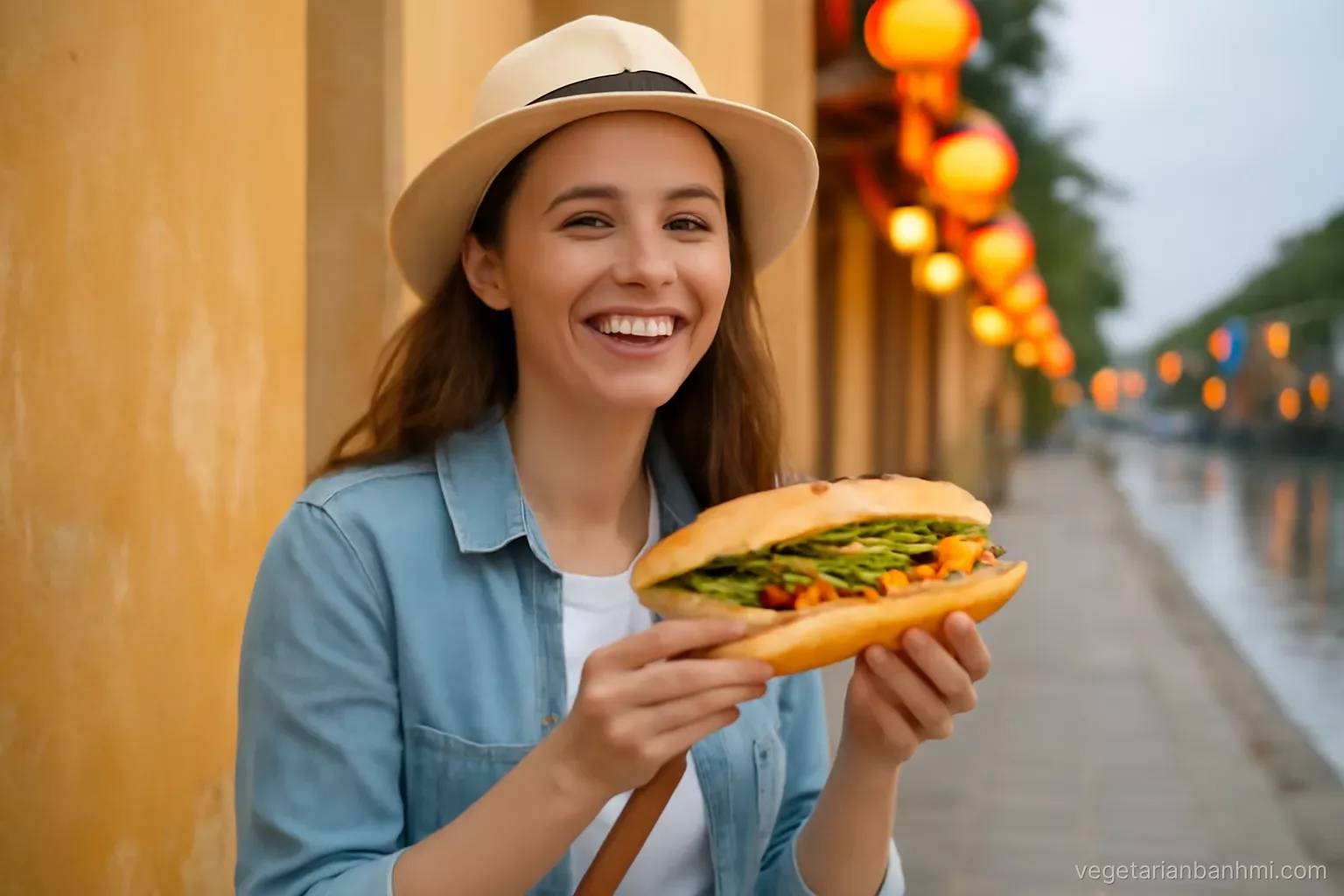
Short answer: A vegan banh mi is one of the easiest foods to carry on a Vietnamese travel day: buy it shortly before you leave, choose dry fillings such as fried tofu or vegan cold cuts, keep sauces separate, and eat it within about two hours, or one hour when it is hotter than 32 °C (90 °F). Solid sandwiches are generally fine through airport security, but sauces count as liquids on international flights. On trains and buses, the vegan choice on board is thin, so bring your own.
Why travel days are the hardest days to eat vegan
Most vegan travellers in Vietnam find the cities easy enough: Ho Chi Minh City, Hanoi and Huế all have vegetarian restaurants, and the word chay (vegetarian) opens a lot of doors. The trouble starts when you leave. Station kiosks, bus rest stops and airport cafés sell rice dishes, instant noodles and sandwiches that are almost always made with meat, fish sauce or egg. Rest stops on long bus routes may give you twenty minutes at a canteen where nothing is labelled, and a night train trolley usually offers rice boxes cooked with meat or fish sauce.
The fix is simple: plan one or two portable meals before you set off. A bánh mì chay (vegetarian banh mi) is ideal because the bread protects the filling, it needs no cutlery, and it tastes fine at room temperature. The rest of this guide covers where to buy one at awkward hours, which fillings keep best, and how long you can safely keep a sandwich on a hot day. If you are new to ordering vegan banh mi at a street cart, start with our Vegan Banh Mi in Vietnam guides first.
Train, bus or plane: what to expect on each
Each mode of transport has its own rhythm, and that decides how much food you should carry. The table below summarises the typical situation; details vary by route and operator, so treat it as a planning guide rather than a rule book.
| Travel mode | Typical journey | Vegan food on board or at stops | What to bring |
|---|---|---|---|
| Sleeper train (Vietnam Railways) | Saigon–Nha Trang overnight; Saigon–Hanoi takes well over a day | Trolley food and station kiosks, rarely labelled vegan | 2 banh mi per person per meal window, fruit, nuts, water |
| Sleeper or limousine bus | 4–12 hours, often overnight | Rest-stop canteens, mostly meat and fish sauce | 1–2 banh mi, crackers, bananas, drinks |
| Domestic flight | 1–2 hours | Airport cafés; vegan options limited | 1 banh mi eaten at the gate or on board |
| International flight | Several hours or more | Pre-ordered special meals on some airlines | A banh mi to eat before landing; no loose sauces |
On long train journeys the timing matters more than the quantity. A sandwich bought at 7 p.m. for an overnight trip will not be safe for breakfast the next morning unless it stayed cold, so plan dinner from your bag and breakfast from fruit, nuts and bread rather than a filled banh mi left in a warm carriage.
Where to buy vegan banh mi before you leave
The biggest practical problem is the clock. Night buses in Vietnam often leave between 7 p.m. and 10 p.m., early flights mean leaving your hotel at 4 or 5 a.m., and morning trains depart before most vegetarian restaurants open. Street carts selling banh mi are everywhere at breakfast time, but a cart that also sells pork means you need to check every layer, which is hard to do in a hurry with luggage.
In Ho Chi Minh City, the simplest option is a fully vegan shop that never closes. Bánh Mì XANH runs five fully vegan banh mi shops that are open 24/7, including Sundays and Tết. The one at 148B Đề Thám (Cầu Ông Lãnh ward) sits in the backpacker area by Bùi Viện, where many travellers stay before night buses and early airport runs, and there are also shops at 38 Lê Thị Riêng near Bến Thành Market and 15B Nguyễn Thị Minh Khai near Đa Kao. You can pick up sandwiches on the way out at 4 a.m. without having to explain anything about fish sauce or egg.
Outside Saigon, plan the night before. Ask your guesthouse whether a nearby quán chay (vegetarian eatery) opens early, or buy your banh mi in the evening and keep it in the guesthouse fridge, assembling the wet parts in the morning. Search "bánh mì chay" in map and delivery apps around your hotel, and remember that many vegetarian restaurants sell their best food before 10 a.m. and again at lunch.
Fillings that survive a hot travel day
Not every vegan banh mi travels equally well. Moisture is the enemy of crisp bread, and creamy spreads are the parts that spoil fastest. When you order for a journey, ask for the drier options and have the sauce on the side if the vendor can do it. A good rule: the fewer wet ingredients inside the loaf, the longer it stays pleasant.
- Travels well: fried or lemongrass tofu, vegan cold cuts such as chả lụa chay (vegan "cold cut"), dry-fried mushrooms, pickled carrot and daikon that has been drained, cucumber added at the last moment.
- Use with care: vegan mayonnaise and nut or mushroom pâté, which are perishable and make the bread soggy within an hour or two.
- Pack separately: soy-based seasoning, chili sauce and any dressing. Small sealed pots are easier than trying to keep a dripping sandwich upright.
- Skip for long trips: anything warm and saucy, such as tofu in tomato sauce, which turns the loaf to mush.
Ask the vendor to wrap the sandwich in paper rather than a sealed plastic bag. Paper lets steam escape, so the crust stays crisper; you can put the paper-wrapped sandwich inside a loose bag for hygiene. If you like making your own fillings, our Plant-Based Fillings section explains how to press and fry tofu so it stays firm for hours.
Food safety: the time limits that matter in Vietnam's heat
The US Department of Agriculture's Food Safety and Inspection Service (USDA FSIS) calls 4–60 °C (40–140 °F) the "danger zone", the range in which bacteria multiply quickly. Its advice is that perishable food should not stay in that range for more than 2 hours in total, or 1 hour when the air is above 32 °C (90 °F). Much of Vietnam is above 32 °C on a sunny afternoon for a good part of the year, and a parked bus or a sunny train window can be hotter still.
For a banh mi, the bread, pickles and fresh vegetables are low risk; the cooked tofu, vegan cold cuts, mayonnaise and pâté are the perishable parts. In practice that means a sandwich bought at the bus station should be eaten within the first hour or two of the journey, not saved for the 2 a.m. rest stop. If you want a later meal, carry it cold: a small insulated bag with a frozen water bottle keeps food below 4 °C (40 °F) for a few hours, and the bottle becomes cold drinking water as it melts. When in doubt, throw it out; a missed meal is better than a stomach bug on a twelve-hour bus.
Airports and flights: what you can bring through security
Solid food such as a sandwich is generally allowed through airport security, both in Vietnam and in most other countries. The catch is liquids. On international flights, liquids, gels and pastes in your cabin bag usually have to be in containers of 100 ml or less, all fitting in one clear resealable bag of about 1 litre. Thick chili sauce, soy sauce and even a generous layer of mayonnaise in a separate pot can count, so either eat the sauce inside the sandwich or leave it behind. Rules for domestic flights and for individual airports can differ, so check your airline and departure airport before you fly.
Two more things are worth knowing. First, many countries restrict bringing fresh food across the border, so eat your banh mi before you land rather than carrying the leftovers through arrivals. Second, if you want a vegan meal on board, many airlines let you request a vegan or strict vegetarian meal in advance; do it when you book, because last-minute requests are often not possible. Even so, a banh mi in your bag is good insurance against a missed special meal.
A simple travel-day kit
A small kit makes travel-day eating much less stressful. Pack it once and keep it in your day bag for the whole trip:
- A soft insulated lunch bag and one frozen water bottle or ice pack (refreeze it at your hotel when you can).
- Two or three small screw-top pots, under 100 ml each, for sauces and pickles.
- Greaseproof paper or beeswax wraps for re-wrapping half-eaten sandwiches.
- Wet wipes and a few paper napkins; banh mi crumbs get everywhere.
- Shelf-stable backups: bananas, roasted peanuts or cashews, rice crackers and dried fruit.
- A note on your phone with the phrases thuần chay (strictly vegan), không trứng (no egg) and không nước mắm (no fish sauce).
Budget for the sandwiches is modest. A street-cart vegetarian banh mi often costs around 15,000–30,000 VND, while a premium vegan sandwich costs more; at Bánh Mì XANH the menu runs from 28,000 VND for the sweet Bơ Đường to 75,000 VND for the big Thượng Hạng Premium. That is roughly US$1–3 at around 26,000 VND per USD (check current rate).
Sources
- USDA Food Safety and Inspection Service – fsis.usda.gov ("Danger Zone" and food safety on the go)
- Vietnam Railways – dsvn.vn (routes and ticket information)
- Vietnam Airlines – vietnamairlines.com (baggage, liquids and special meal requests)
- Bánh Mì XANH – banhmixanh.com (menu, prices and shop addresses)
Frequently asked questions
Can I take a banh mi through airport security in Vietnam?
A solid sandwich is generally allowed in your cabin bag. Separate sauces, spreads and drinks are treated as liquids on international flights and usually must be in containers of 100 ml or less. Check your airline and airport rules before you fly, especially for domestic routes.
How long can a vegan banh mi stay unrefrigerated?
Follow the USDA guidance: no more than 2 hours in the 4–60 °C (40–140 °F) danger zone, or 1 hour when it is above 32 °C (90 °F). The perishable parts are cooked tofu, vegan cold cuts, mayonnaise and pâté. Keep it cold with an ice pack if you want to eat it later.
Is there vegan food on Vietnamese sleeper trains?
Sometimes there is a simple vegetable dish, but most trolley and station food is cooked with meat or fish sauce and is rarely labelled. It is safer to bring your own banh mi, fruit and snacks, and to buy fresh food at major stations if you can check it.
Where can I buy vegan banh mi before a night bus from Saigon?
The backpacker area by Bùi Viện has a Bánh Mì XANH shop at 148B Đề Thám that is open 24/7 and fully vegan, so you can pick up sandwiches at any hour. Elsewhere, look for vegetarian restaurants near your departure point and buy before they close.
Which vegan banh mi filling is best for a long journey?
Choose dry fillings such as fried tofu or vegan cold cuts, with pickles drained and sauce on the side. Creamy spreads and saucy fillings make the bread soggy and spoil faster in the heat. Wrap the sandwich in paper rather than sealed plastic.
Grab Your Travel-Day Banh Mi at Any Hour
Pack your own kit with these tips, and if you are leaving Ho Chi Minh City, pick up a fully vegan sandwich on the way out: Bánh Mì XANH has 5 central shops open 24/7, including one in the backpacker area by Bùi Viện, so even a 4 a.m. airport run starts with a proper meal.
Find the Bánh Mì XANH shop nearest you · 24/7 hotline / Zalo +84 923 183 183