Short answer: The most useful vegan banh mi ingredients to bring home from Vietnam are shelf-stable ones: dried shiitake and wood ear mushrooms, dried tofu skin, a good soy sauce, a vegan mushroom seasoning (check the label), chili sauce, ground Vietnamese coffee and a metal phin (drip coffee filter). Skip fresh herbs, fresh vegetables and refrigerated vegan cold cuts. Pack liquids in your checked bag, and declare food at customs, especially if you fly to Australia, New Zealand or the United States.
Why shop in Vietnam at all?
Many banh mi ingredients are available abroad in Asian grocery stores, so it is fair to ask whether anything is worth the suitcase space. The answer is yes, for a few reasons. Some products are simply cheaper in Vietnam, especially dried mushrooms, coffee and coffee filters. Others are hard to find outside the country in a version that is clearly vegetarian: a mushroom-based seasoning powder, for example, or a soy-based "Maggi-style" seasoning sold in vegetarian shops. And shopping in a Vietnamese supermarket or market is a good way to see what home cooks actually use.
Think of it as building a pantry for the recipes in our Vegan Banh Mi Recipes and Sauces & Spreads sections. You will still buy tofu, bread, carrots, daikon and herbs at home; the things you bring back are the flavour builders that keep for months.
Where to shop: supermarkets, markets and vegetarian stores
You have three good options in Ho Chi Minh City and other big cities, and each suits a different kind of buying.
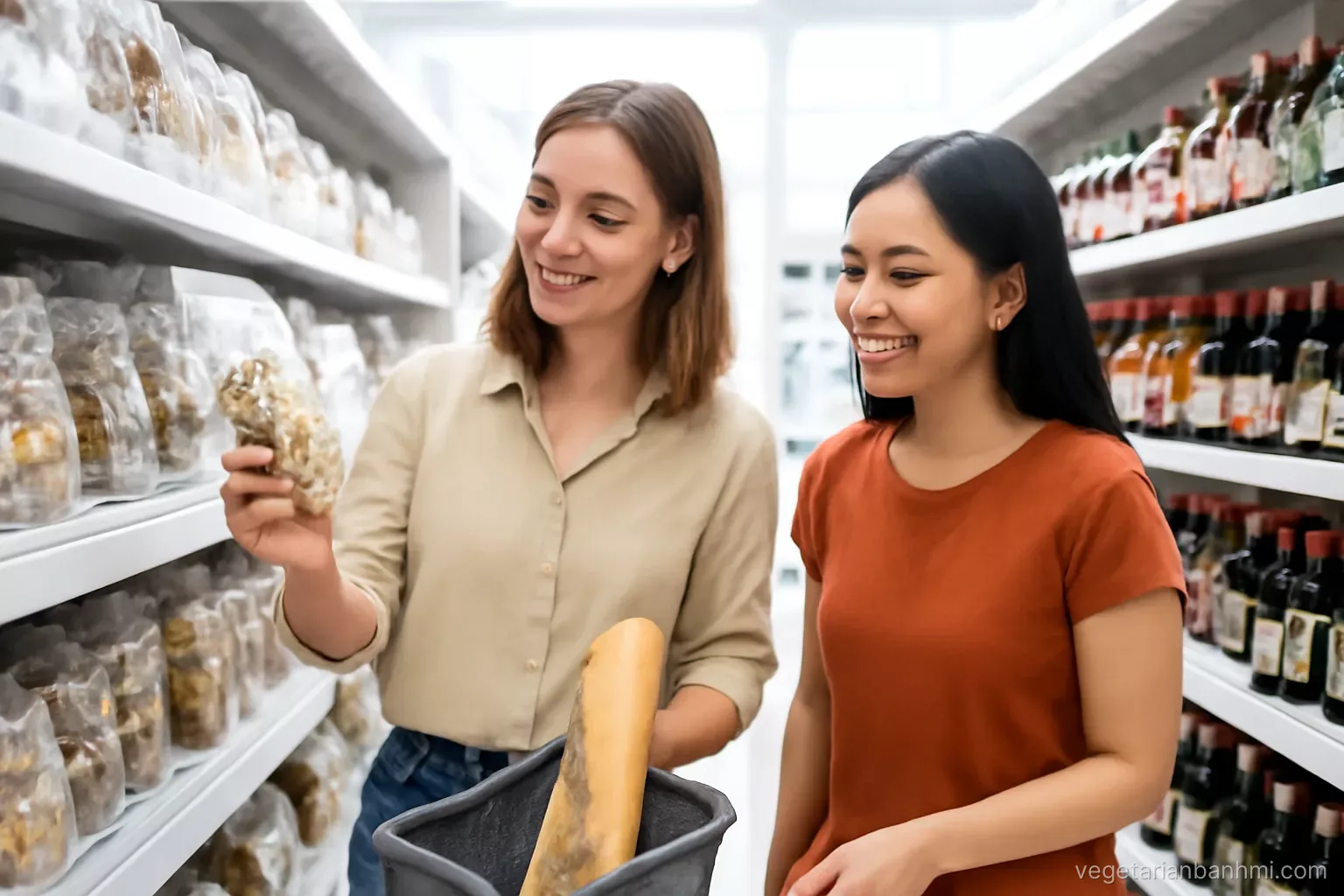
- Supermarkets such as Co.opmart, WinMart, Lotte Mart and the smaller Bách Hóa Xanh stores have fixed prices, clear shelves and air conditioning. They are the easiest place to compare soy sauces, buy sealed packs of dried mushrooms and pick up ground coffee.
- Markets such as Bến Thành Market in the centre of Saigon sell dried goods, coffee and kitchen tools by weight or by piece. Prices for visitors are often higher than in supermarkets, so it pays to compare and to bargain politely for larger quantities.
- Vegetarian grocery shops (cửa hàng chay) are often found near pagodas and vegetarian restaurants. They stock mock meats, mushroom seasonings, vegetarian sauces and dried tofu products made for Buddhist cooking, which saves you checking every label for fish or meat extracts.
Shop near the end of your trip so you are not carrying jars around the country, and save the receipts in case a customs officer asks what something is.
The shopping list, item by item
This table sets out what is worth buying, what it does in a banh mi, and how well it travels. Prices vary by brand and shop, so treat the ranges as approximate; at around 26,000 VND per USD (check current rate), 50,000 VND is just under US$2.
| Item | Vietnamese name | Use in banh mi | Approx. price | Travels well? |
|---|---|---|---|---|
| Dried shiitake mushrooms | nấm đông cô | Mushroom pâté, savoury stock, chewy filling | Around 50,000–150,000 VND per 100 g | Yes, sealed |
| Dried wood ear mushrooms | nấm mèo / mộc nhĩ | Crunch in fillings and vegan meatballs | Around 20,000–50,000 VND per 100 g | Yes, very light |
| Dried tofu skin | tàu hũ ky | Rolls, crisps and "cold cut" layers | Around 20,000–60,000 VND per pack | Yes, fragile |
| Soy sauce | nước tương | Marinades, the final drizzle | Around 15,000–60,000 VND per bottle | Checked bag only |
| Mushroom seasoning | hạt nêm nấm | Savoury depth in tofu and pâté | Around 20,000–60,000 VND per pack | Yes, sealed |
| Chili sauce | tương ớt | Heat and sweetness | Around 10,000–40,000 VND per bottle | Checked bag only |
| Ground coffee and a phin filter | cà phê, phin | Coffee to drink with the sandwich | Coffee from around 50,000 VND per 250 g; phin from around 20,000 VND | Yes |
Two products need a closer look. Seasoning powders (hạt nêm) are often made with pork or chicken extract; only the mushroom or vegetarian versions are vegan, and even then you should read the ingredient list for milk powder or other animal-derived items. Soy sauces and chili sauces are usually plant-based, but some chili sauces include fish sauce or shrimp, so check the label or buy them from a vegetarian shop where everything is made for chay cooking.
What not to bring home
Some of the most tempting things in a Vietnamese market are exactly the ones to leave behind. Fresh herbs such as Vietnamese coriander, perilla and Thai basil wilt within a day or two and are restricted by many countries' biosecurity rules; buy seeds or plants at home instead. Fresh fruit, vegetables and anything with soil are commonly prohibited. Refrigerated vegan cold cuts such as chả lụa chay are perishable and should not sit in a suitcase for a long-haul flight; if you love them, our Plant-Based Fillings guides show how to make a seitan or tofu version at home.
The bread itself is another no. Vietnamese baguettes are at their best within hours of baking and turn stale or chewy by the next day. It is much better to find the closest local roll, or bake your own, than to carry loaves across the world.
Customs rules: declare first, ask questions later
Every country sets its own rules for food brought by travellers, and they change. Australia and New Zealand have some of the strictest biosecurity systems in the world and expect you to declare all food on your arrival card; undeclared items can lead to fines. The United States requires travellers to declare agricultural items, and US Customs and Border Protection explains which foods are generally allowed. The European Union and the United Kingdom also restrict some plant and animal products.
In general, commercially packaged, shelf-stable products such as sealed dried mushrooms, bottled sauces and roasted ground coffee are treated more leniently than fresh produce, seeds, nuts in the shell or homemade food. That is a general pattern, not a promise. Before you shop, check the official site for your destination, for example the Australian Department of Agriculture, Fisheries and Forestry (agriculture.gov.au) or US Customs and Border Protection (cbp.gov), and when in doubt, declare. Declaring an allowed item costs a few minutes; failing to declare can cost far more.
Packing jars, bottles and dried goods
Liquids are the main headache. Soy sauce, chili sauce and seasoning liquids should go in your checked bag, because on international flights cabin liquids are usually limited to containers of 100 ml or less in one small clear bag. Pack them the way you would pack wine:
- Choose plastic bottles over glass where you can; supermarkets often stock both.
- Tape the cap closed, then seal each bottle in its own zip-lock bag.
- Wrap the bagged bottle in clothing and place it in the middle of the suitcase, away from the shell.
- Keep dried mushrooms and tofu skin in their original sealed packs, which also helps at customs; put fragile tofu skin in a rigid box or between flat clothes.
- Carry ground coffee in its sealed bag, inside another zip-lock to contain the smell.
Weigh your bag before you leave the hotel. Dried mushrooms and tofu skin are light, but a few bottles of sauce add up quickly, and excess baggage fees will wipe out any savings.
Turning your haul into a banh mi at home
Once you are home, your Vietnamese pantry plugs straight into everyday cooking. Rehydrate dried shiitake in warm water for 20–30 minutes, then blitz with tofu or cooked lentils for a pâté and use the soaking liquid in the marinade. Soak wood ear for 15–20 minutes, chop it finely and fold it into tofu meatballs for crunch. A spoonful of mushroom seasoning and a splash of soy sauce give pan-fried tofu the savoury depth of a Saigon cart. Brew strong coffee in your phin and you have the full breakfast. For a sandwich that needs only local supermarket staples plus your souvenirs, try the lemongrass tofu or mushroom pâté recipes in our recipe section.
Sources
- Australian Department of Agriculture, Fisheries and Forestry – agriculture.gov.au (what you can bring into Australia)
- US Customs and Border Protection – cbp.gov (bringing food into the United States)
- New Zealand Ministry for Primary Industries – mpi.govt.nz (declaring food at the border)
- Vietnam Airlines – vietnamairlines.com (baggage and liquids rules)
Frequently asked questions
Is Vietnamese seasoning powder vegan?
Not usually. Most hạt nêm is made with pork or chicken extract. Look for mushroom or vegetarian versions, often sold in vegetarian grocery shops, and still read the ingredient list for milk powder or other animal-derived additives.
Can I bring dried mushrooms from Vietnam into Australia or the US?
Commercially packaged dried mushrooms are often allowed, but rules change and depend on the product. Always declare them on arrival and check the official site, such as agriculture.gov.au or cbp.gov, before you buy.
Should I buy souvenirs at Bến Thành Market or a supermarket?
Supermarkets have fixed prices and clear labels, which makes comparing products easy. Bến Thành Market is fun and has a wide range of coffee and dried goods, but prices for visitors can be higher, so compare first and bargain politely.
Can I pack soy sauce in my carry-on?
On international flights, only in containers of 100 ml or less inside your liquids bag. Full-size bottles belong in checked luggage, taped shut and sealed in zip-lock bags.
Is it worth bringing a phin coffee filter home?
Yes. A metal phin is cheap, light and unbreakable, and it makes the strong drip coffee Vietnamese people drink with banh mi. Bring a bag of ground Vietnamese coffee to go with it.
Shop the Pantry, Then Taste the Benchmark
Fill your suitcase with dried mushrooms, sauces and a phin, and use this site's recipes to rebuild vegan banh mi at home. Before you fly out of Ho Chi Minh City, taste the real thing at Bánh Mì XANH, a fully vegan banh mi chain with 5 central shops open 24/7, so you know exactly what flavour you are aiming for.
Explore the Bánh Mì XANH menu · 24/7 hotline / Zalo +84 923 183 183