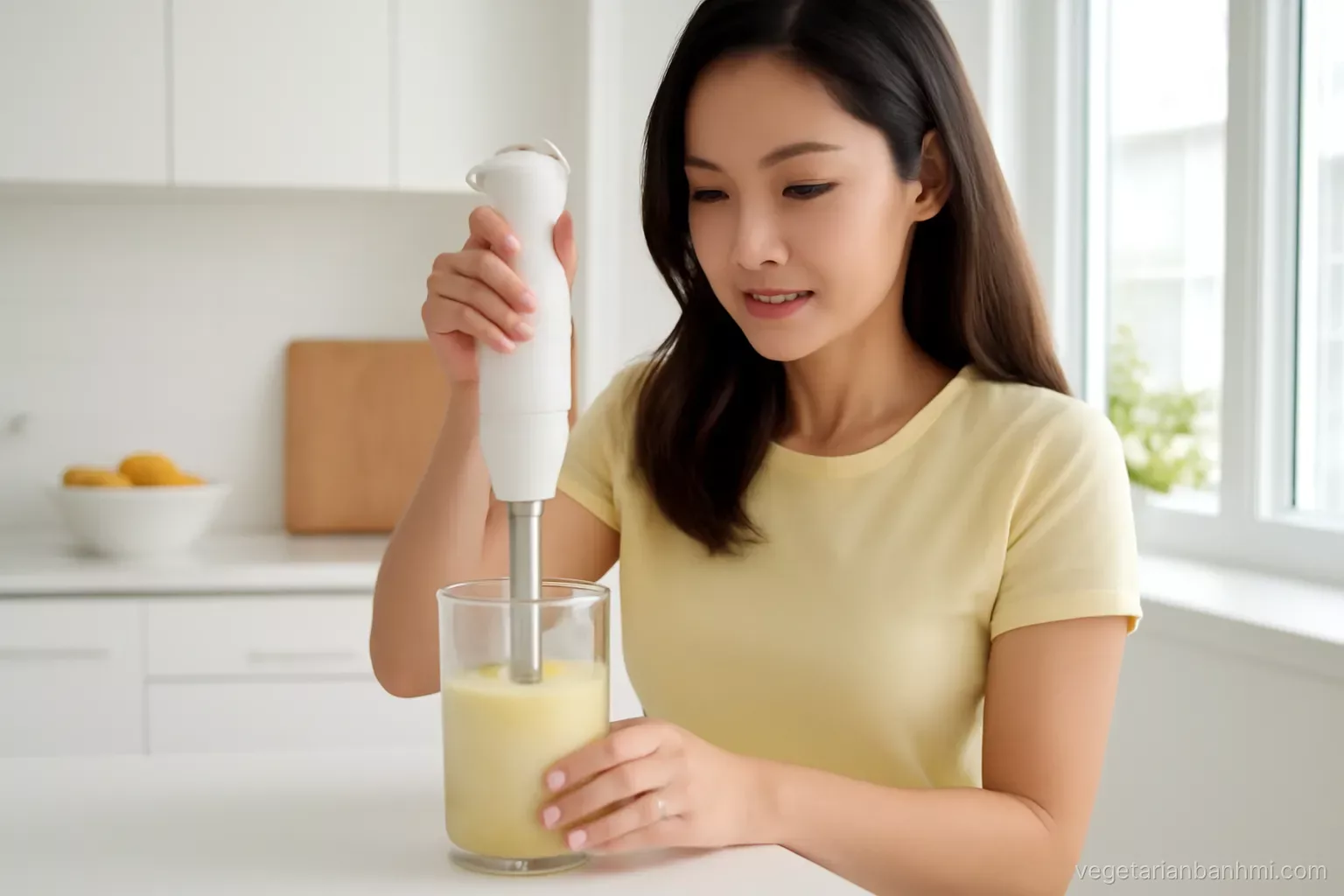
Short answer: The easiest vegan banh mi mayo is soy milk mayo: 120 ml (1/2 cup) unsweetened soy milk, about 240 ml (1 cup) neutral oil, an acid and a little mustard, blitzed with an immersion blender for under a minute. Aquafaba, the liquid from a can of chickpeas, works too but needs a slower drizzle. Keep either one in the fridge at or below 4°C (40°F) and use it within five days.
What the "mayo" in a Saigon banh mi actually is
Walk past any banh mi cart in Ho Chi Minh City and you will see the vendor swipe something pale yellow along the inside of the bread before anything else goes in. Locals call it bơ (literally "butter"), but it is really a rich, homemade mayonnaise, traditionally whipped from egg yolks and oil, sometimes softened with a little margarine. It is less tangy than Western jarred mayo, slightly sweet, and its job is structural as much as flavor: it waterproofs the crumb so the pickle brine and sauces do not turn the bread soggy.
That gives us a clear target for a vegan version. You want something thick enough to spread without running, mild rather than sharp, faintly sweet, and fatty enough to coat the bread. Both recipes below hit that, and neither needs specialty equipment beyond a stick blender or a regular blender. If you are building your first full sandwich, our vegan banh mi recipes show where the mayo fits in the layering order.
Soy milk, aquafaba or store-bought: which to choose
Egg yolk emulsifies oil because of its proteins and lecithin. Soy milk carries both, which is why it whips up almost instantly. Aquafaba gets its power from proteins and starches leached out of chickpeas while they cook; it is less concentrated, so it needs more patience. Nut milks such as almond or oat usually fail because they contain far less protein, a common source of frustration for first-timers.
| Base | Difficulty | Texture | Flavor | Best for |
|---|---|---|---|---|
| Unsweetened soy milk | Very easy, 1 minute | Thick, glossy, very stable | Neutral, slightly beany | Everyday banh mi, big batches |
| Aquafaba (canned chickpea liquid) | Moderate, 3 to 4 minutes | Lighter, softer set | Very neutral | Soy-free kitchens |
| Soaked cashews | Easy with a strong blender | Dense, creamy, not glossy | Nutty, sweet | Oil-light version |
| Store-bought vegan mayo | None | Firm | Often tangier than Saigon style | Last-minute sandwiches |
Our default is soy milk. It is cheap, it rarely breaks, and the slight bean flavor disappears completely once pickles, herbs and chili join the party. Choose soy milk with only soybeans and water on the label if you can; sweetened or vanilla versions will taste odd, and some brands with lots of gums blend into a gluey texture.
Recipe 1: Five-minute soy milk mayo
Makes about 300 ml (1 1/4 cups), enough for 12 to 16 sandwiches at roughly 1 tablespoon each.
- 120 ml (1/2 cup) unsweetened soy milk, at room temperature
- 200 to 240 ml (3/4 to 1 cup) neutral oil: sunflower, canola, rice bran or peanut
- 15 ml (1 tablespoon) rice vinegar or fresh lemon juice
- 5 g (1 teaspoon) Dijon or yellow mustard
- 3 g (1/2 teaspoon) fine salt
- 4 g (1 teaspoon) sugar
- A pinch of ground turmeric for the classic yellow color (optional)
- Put the soy milk, vinegar, mustard, salt, sugar and turmeric into a tall, narrow jar that is just wider than the head of your immersion blender. A wide bowl is the most common reason this fails: the blades cannot create a vortex.
- Pour in 200 ml of oil and let it settle on top for 15 seconds.
- Press the blender head flat against the bottom of the jar, switch it on at full speed and hold still for about 10 seconds. You will see a white emulsion form at the bottom.
- Slowly tilt and lift the blender over 20 to 30 seconds to pull the remaining oil down into the emulsion.
- Taste. For thicker mayo, blend in more oil a tablespoon at a time up to 240 ml total. For a looser spread, blend in a teaspoon of water.
In a countertop blender, run the soy milk mixture on medium and pour the oil through the lid in a thin stream over about a minute. Small blenders struggle with less than 120 ml of liquid, so double the batch if the blades are not covered.
Recipe 2: Aquafaba mayo for soy-free kitchens
Makes about 250 ml (1 cup). Use the liquid from a can of chickpeas, ideally unsalted. Shake the can before opening, since the thickest liquid settles at the bottom.
- 60 ml (1/4 cup) aquafaba, cold from the fridge
- 5 g (1 teaspoon) Dijon mustard
- 15 ml (1 tablespoon) rice vinegar or lemon juice
- 2 to 3 g (scant 1/2 teaspoon) salt, less if the aquafaba was salted
- 4 g (1 teaspoon) sugar
- 180 to 240 ml (3/4 to 1 cup) neutral oil
Blend the aquafaba, mustard, vinegar, salt and sugar for 20 seconds until foamy. Then, with the motor running, add the oil in a stream no thicker than a piece of string. Aquafaba will not tolerate the "dump it all in" method above; it needs three to four minutes of steady drizzling. It thickens suddenly near the end. If it stays soupy after 180 ml of oil, keep going slowly to 240 ml. If your can liquid is thin and watery, reduce it in a small pan by about a third, cool it completely in the fridge, then try again.
Making it taste like a Saigon street cart
Plain vegan mayo is good; a few small moves make it taste like it came off a cart near Bến Thành Market. First, lean a little sweet: the teaspoon of sugar is not optional for this style. Second, reduce the sourness compared with deli mayo; if your lemon is sharp, swap half of it for rice vinegar. Third, for a gently eggy note, add a pinch (0.5 g) of kala namak, the Indian black salt sold in South Asian groceries. Its sulfur compounds read as "egg" to most palates. Go easy; too much smells of boiled eggs left in a lunchbox.
Many vendors also brush the bread with scallion oil, mỡ hành (spring onion fat), which in vegetarian shops is made with plain oil. Warm 60 ml (1/4 cup) neutral oil until it shimmers, pour it over 40 g (about 4) thinly sliced scallions with a pinch of salt and let it sizzle. Use it the same day or refrigerate and finish it within four days, since fresh aromatics in oil are a known botulism risk if kept longer or at room temperature.
Easy flavor variations
- Sriracha mayo: 3 parts mayo to 1 part chili sauce. Good with crispy tofu.
- Lemongrass mayo: 1 tablespoon very finely minced lemongrass heart, briefly fried in a teaspoon of oil and cooled, per 120 ml mayo.
- Soy-lime mayo: 1 teaspoon soy sauce and 1/2 teaspoon lime zest per 120 ml mayo. Pairs well with mushroom fillings.
Troubleshooting: thin, broken or bitter
Most failures fall into three groups, and all three are fixable without wasting oil.
It never thickened. The jar was too wide, the soy milk was ice cold, or the milk was low in protein. Pour the liquid into a measuring cup, put 2 tablespoons of fresh soy milk in the narrow jar, start blending, and drizzle the failed mixture back in. It will usually catch within seconds.
It split after sitting. Usually this means too much acid or too little oil, so the emulsion was loose. Re-blend with another 2 tablespoons of oil. If you stored it in a very cold part of the fridge it may also have partly frozen; let it warm for 10 minutes and stir.
It tastes bitter. Strong extra-virgin olive oil can turn bitter when it is blended hard at high speed. Use a neutral oil for the bulk and, if you love the olive flavor, stir in a tablespoon of it by hand at the end.
Food safety and storage
Egg-free mayo removes the raw-egg concern, but it is still a moist, protein-containing food that only becomes mildly acidic, so treat it as perishable. Make it with clean, dry tools; keep it in a lidded glass jar at or below 4°C (40°F); and use it within five days. That is deliberately shorter than many blogs suggest, because home fridges often run warmer than we think and nobody tests homemade mayo for acidity. Aquafaba from a freshly opened can should be used the day you open it or refrigerated and used within three to four days, in line with USDA guidance for cooked leftovers.
On the counter, apply the two-hour rule from the USDA Food Safety and Inspection Service: discard spread-coated sandwiches or open jars that have sat out longer than two hours, or one hour if the room is above 32°C (90°F). That matters for picnics and for Vietnam's own climate. Do not freeze mayo; it separates on thawing. If you meal-prep, keep the mayo in a separate small pot and spread it just before eating; our meal prep and storage guides cover lunchbox packing in detail.
Nutritionally, mayo is mostly oil. A tablespoon of vegetable oil alone is about 120 kcal in USDA FoodData Central, so a tablespoon of these recipes lands at roughly 80 to 100 kcal depending on how much oil you use. One generous tablespoon per sandwich is the traditional amount; more simply makes the bread greasy.
Where it goes in the sandwich
Spread mayo on both cut faces of the warm bread, edge to edge, before anything else. Pâté, if you use it, goes on one side over the mayo. Then the main filling, cucumber, pickled carrot and daikon, cilantro, chili and a few drops of seasoning sauce. Getting the pickles right matters as much as the spread, so our pickles and herbs section is the natural next stop.
Sources
- USDA Food Safety and Inspection Service – fsis.usda.gov (two-hour rule, refrigerator at 40°F, leftovers 3 to 4 days)
- USDA FoodData Central – fdc.nal.usda.gov (energy in vegetable oils)
- National Center for Home Food Preservation – nchfp.uga.edu (fresh aromatics in oil and botulism risk)
Frequently asked questions
Can I use almond or oat milk instead of soy milk?
Usually not well. Almond and oat milks contain much less protein than soy milk, and protein is what holds the emulsion together. If soy is off the table, use aquafaba instead.
How long does homemade vegan mayo keep?
We recommend up to five days in a sealed jar at or below 4°C (40°F). Discard it sooner if it smells sour, separates in a way re-blending will not fix, or shows any mold.
Why is banh mi mayo yellow?
The traditional version is made with egg yolks, which give it a golden color. A pinch of turmeric gives the vegan version the same look without changing the taste noticeably.
Can I make it without a blender?
Aquafaba mayo can be whisked by hand, but it takes 10 minutes of hard work and a very slow drizzle. Soy milk mayo really needs the speed of a blender to emulsify reliably.
Is vegan mayo healthier than regular mayo?
The calories are similar because both are mostly oil. The vegan version contains no cholesterol from egg yolk, but the main difference for most people is simply that it fits a plant-based diet.
Spread It Thick, Then Taste the Saigon Version
A jar of soy milk mayo is the quiet hero of every good vegan banh mi, and now you can make one in five minutes. When you are in Ho Chi Minh City, compare notes at Bánh Mì XANH, a fully vegan banh mi chain with 5 central shops open 24/7, from the Bến Thành Market area to the Bùi Viện backpacker streets.
Explore the Bánh Mì XANH menu · 24/7 hotline / Zalo +84 923 183 183