Short answer: Beyond classic pickled carrot and daikon, great banh mi pickles include quick pickled red onion, Vietnamese chilies in vinegar, pickled cucumber, green papaya, kohlrabi and fermented mustard greens. Most use the same basic vinegar-sugar-salt brine, are ready in 30 minutes to a day, and should be refrigerated and eaten within two to three weeks. Pickled chilies with garlic should also stay in the fridge.
Why vary your pickles
Đồ chua, the classic Vietnamese pickled carrot and daikon, is the default for good reason. But once you make banh mi every week, a second pickle is the easiest way to change the whole sandwich without changing the filling. Pink onions bring sharpness and color, pickled chilies bring vinegary heat, green papaya adds crunch with no smell, and fermented mustard greens add savory depth. Vietnamese cooks already use most of these in other dishes; we are just borrowing them for the sandwich.
All of these are refrigerator pickles. Unless you follow a tested canning recipe from an authority such as the National Center for Home Food Preservation, assume your jar is not shelf-stable, keep it at or below 4°C (40°F), and use clean utensils every time.
The six pickles at a glance
| Pickle | Brine | Ready in | Our fridge limit | Best with |
|---|---|---|---|---|
| Pickled red onion | Equal vinegar and water, light sugar | 30 minutes | 2 weeks | Mushrooms, jackfruit |
| Chilies in vinegar (ớt ngâm giấm) | Straight vinegar, pinch of sugar and salt | 1 day | 1 month | Any filling, noodle soups |
| Quick pickled cucumber | Classic đồ chua brine | 20 minutes | 3 days | Fried tofu, pâté |
| Green papaya | Classic đồ chua brine | 2 hours | 2 weeks | Lemongrass tofu |
| Kohlrabi with carrot | Classic đồ chua brine | 1 hour | 2 weeks | Replaces daikon in any sandwich |
| Fermented mustard greens (dưa cải chua) | 2.5 to 3% salt brine, fermented | 3 to 5 days | 1 month | Mushroom and seitan fillings |
"Classic đồ chua brine" in this guide means 240 ml (1 cup) warm water, 180 ml (3/4 cup) 5% vinegar, 100 g (1/2 cup) sugar and 1 teaspoon (6 g) salt, enough for about 600 g (1.3 lb) of vegetables.
1. Quick pickled red onion
Slice 1 large red onion (about 250 g / 9 oz) into thin rings, 2 to 3 mm. Put in a jar. Warm 120 ml (1/2 cup) water with 1 tablespoon (12 g) sugar and 1 teaspoon (6 g) salt until dissolved, add 120 ml (1/2 cup) rice or apple cider vinegar, and pour over. In 30 minutes the onions turn bright pink and lose their harsh bite. A few onion rings across the filling cut through a rich mushroom pâté beautifully. Keep refrigerated and eat within two weeks; they soften after that.
2. Vietnamese chilies in vinegar
Ớt ngâm giấm (chilies soaked in vinegar) sits on almost every Vietnamese noodle-shop table. It adds heat with a sharp, clean edge, and a few drops of the chili vinegar itself are delicious in a banh mi. Slice 100 g (3 1/2 oz) red bird's eye or Fresno chilies into thin rings. Add 2 cloves of garlic, thinly sliced, if you like. Pack into a small jar and cover with 200 ml (scant 1 cup) 5% white vinegar into which you have dissolved 1 teaspoon sugar and 1/2 teaspoon salt. Seal and refrigerate. It is ready the next day.
Safety note: garlic and chilies are low-acid, but here they sit in undiluted vinegar, which is far more acidic than a sandwich pickle brine. Still, home kitchens do not test pH, so keep the jar in the fridge and use it within one month. If the garlic turns blue-green, do not worry: that is a harmless reaction between garlic compounds and acid. Discard if you see mold, cloudiness that was not there before, or fizzing.
3 to 5. Cucumber, green papaya and kohlrabi
Quick pickled cucumber
Most banh mi use fresh cucumber, which we recommend for crunch. But a quick pickle is handy when your cucumbers are watery or bland. Cut 1 cucumber (about 300 g) into long spears, remove the seedy core if it is large, and toss with 1/2 teaspoon salt for 10 minutes. Drain, then cover with half a batch of classic đồ chua brine for 20 minutes to an hour. Cucumbers soften fast, so eat within three days.
Green papaya and kohlrabi
Green (unripe) papaya is used in Vietnamese salads and in dưa góp, a mixed pickle of papaya, carrot and sometimes kohlrabi. It is crunchy, mild and has none of daikon's sulfur smell. Peel a 400 g (14 oz) green papaya, halve it, scoop out the white seeds, and cut into matchsticks or thin slices. Massage with 1 teaspoon salt for 15 minutes, rinse and squeeze well; green papaya releases a sticky white sap, and rinsing removes it. Mix with 200 g carrot matchsticks, cover with the classic brine and refrigerate. It is good after two hours and keeps two weeks.
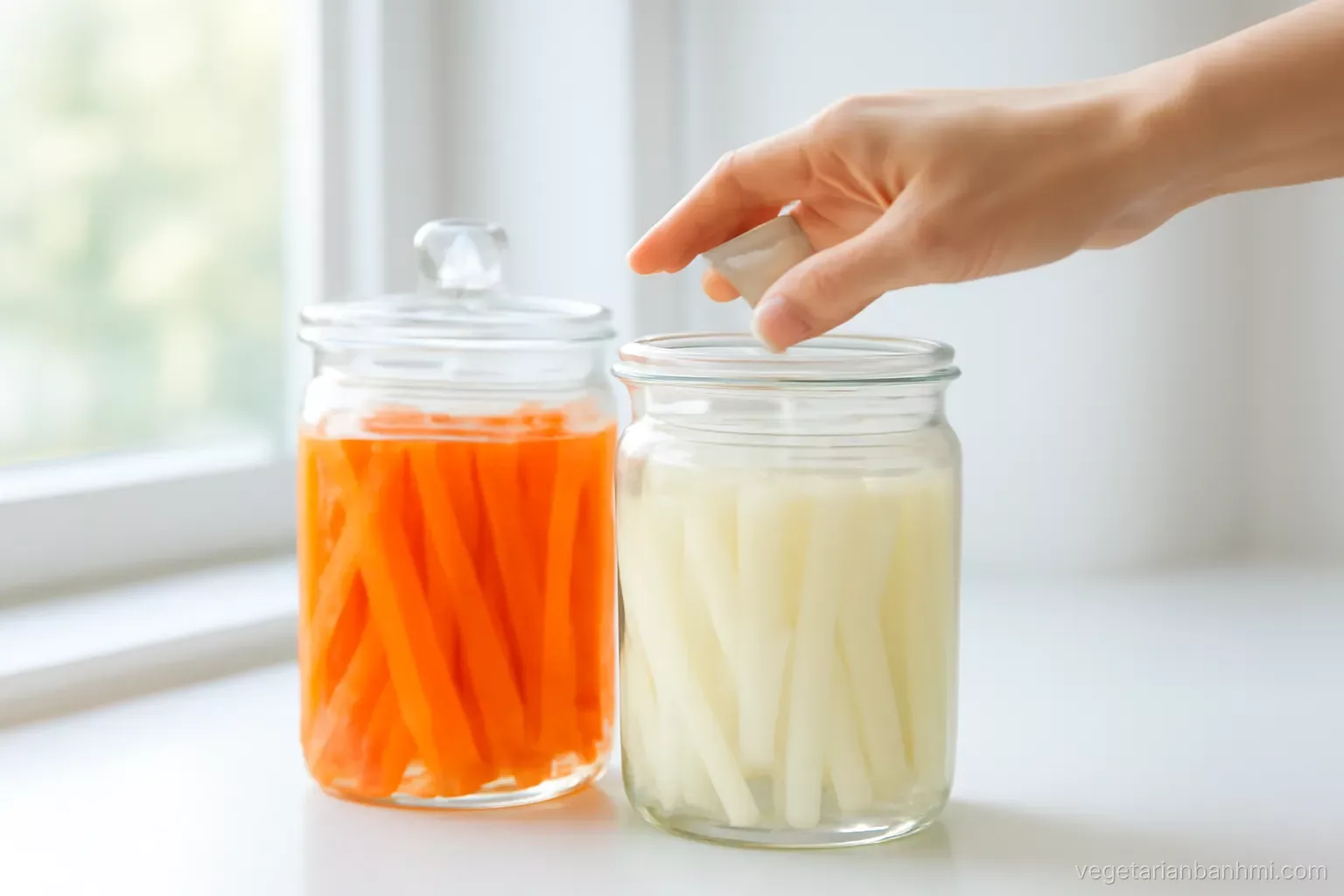
Kohlrabi is the best daikon substitute in countries where daikon is hard to find. Peel off the tough skin, cut into matchsticks and treat it exactly like daikon in the classic recipe. It is sweeter and stays crisp for longer.
6. Fermented mustard greens
Dưa cải chua, sour fermented mustard greens, is a staple of Vietnamese home cooking, served with braised dishes and soups. Finely chopped, it adds a savory, tangy depth to mushroom or seitan banh mi. Wilt 500 g (1.1 lb) Chinese mustard greens in the sun or a warm room for a few hours until limp, wash well and cut into 4 cm pieces. Pack into a jar with 2 sliced shallots. Cover with a brine of 500 ml (2 cups) water, 15 g (2 1/2 teaspoons) salt and 1 tablespoon sugar, which is about 3% salt. Weigh the greens under the brine and ferment at 20 to 25°C (68 to 77°F) for 3 to 5 days, until sour and golden-yellow. In tropical kitchens it may take only 2 days. Refrigerate and eat within one month.
Discard any batch with fuzzy or colored mold, slimy greens or a rotten smell. A flat white film is usually harmless kahm yeast that can be skimmed off. The classic quick-versus-fermented comparison in our pickles and herbs section covers these signs in more detail.
Combining pickles in one sandwich
- Classic plus heat: carrot and daikon with a few rings of chili in vinegar.
- Bright and sharp: carrot and daikon with pickled red onion, for mushroom pâté sandwiches.
- Mild and crunchy: green papaya and carrot, for kids or anyone who dislikes the daikon smell.
- Deep and savory: a spoonful of chopped fermented mustard greens with carrot, for seitan or grilled mushrooms.
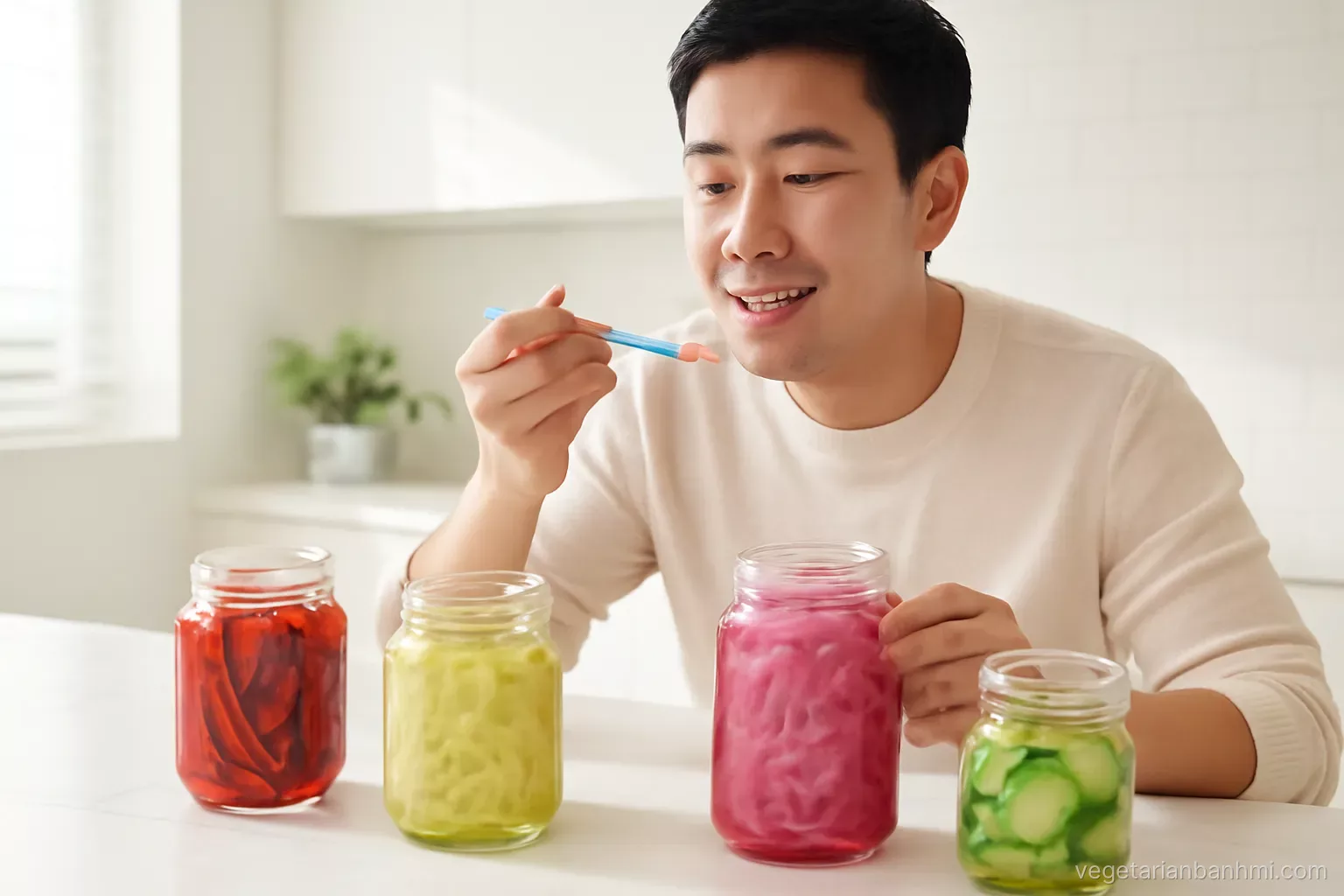
Keep the total amount of pickles to about 40 to 50 g per sandwich, drained well. More than that and the brine soaks the bread and overwhelms the filling. If you are preparing a banh mi spread for guests, three jars of different colors make a striking table, as described in our parties and gatherings guides.
Storage rules for all pickles
Label each jar with the date you made it (on the lid, with a marker), keep vegetables under the brine, and never return unused pickles from the table to the jar. Follow the USDA's two-hour rule for pickles served at room temperature. When you plan your week, our meal prep and storage section explains how to rotate jars so nothing goes past its limit.
Sources
- National Center for Home Food Preservation – nchfp.uga.edu (pickling and fermenting vegetables)
- USDA Food Safety and Inspection Service – fsis.usda.gov (refrigeration and the two-hour rule)
- US Food and Drug Administration – fda.gov (acidified foods guidance)
Frequently asked questions
What other vegetables can I pickle for banh mi?
Red onion, cucumber, green papaya, kohlrabi, jicama, red radish and mustard greens all work well. Most use the same sweet-sour vinegar brine as classic đồ chua.
Why did my pickled garlic turn blue?
Garlic sometimes turns blue or green in acidic brine because of a natural reaction between its sulfur compounds and the acid. It is harmless and does not indicate spoilage.
How long do pickled red onions last?
We recommend up to two weeks in the fridge at or below 4°C (40°F). They are best in the first week, when they are still crisp.
Can I mix different vegetables in one jar?
Yes, as long as they pickle at similar speeds. Carrot, papaya and kohlrabi mix well; cucumber and onion soften faster and are better in separate jars.
Is green papaya safe to eat raw?
Green papaya is widely eaten raw in Vietnamese and Thai salads. Rinse off the sap after salting, as it can irritate sensitive skin and tastes bitter. Pregnant people are often advised to avoid unripe papaya, so check with a doctor if relevant.
More Pickles, More Possibilities
A fridge with two or three pickle jars turns one vegan banh mi recipe into a week of different sandwiches. If you are visiting Ho Chi Minh City, taste how a fully vegan chain does it at Bánh Mì XANH, with 5 central shops open 24/7, from Bến Thành to the former District 7.
Find a Bánh Mì XANH shop near you · 24/7 hotline / Zalo +84 923 183 183