Short answer: Store cilantro and mint like flowers: stems in a jar of water, loosely covered with a bag, in the fridge, where they keep about a week. Keep Thai basil in water at room temperature, since cold blackens it. To grow your own, mint and Vietnamese coriander root easily from cuttings in water, Thai basil needs warmth and at least six hours of sun, and cilantro grows best in cool weather and should be sown every few weeks.
Why herbs are the weak link in home banh mi
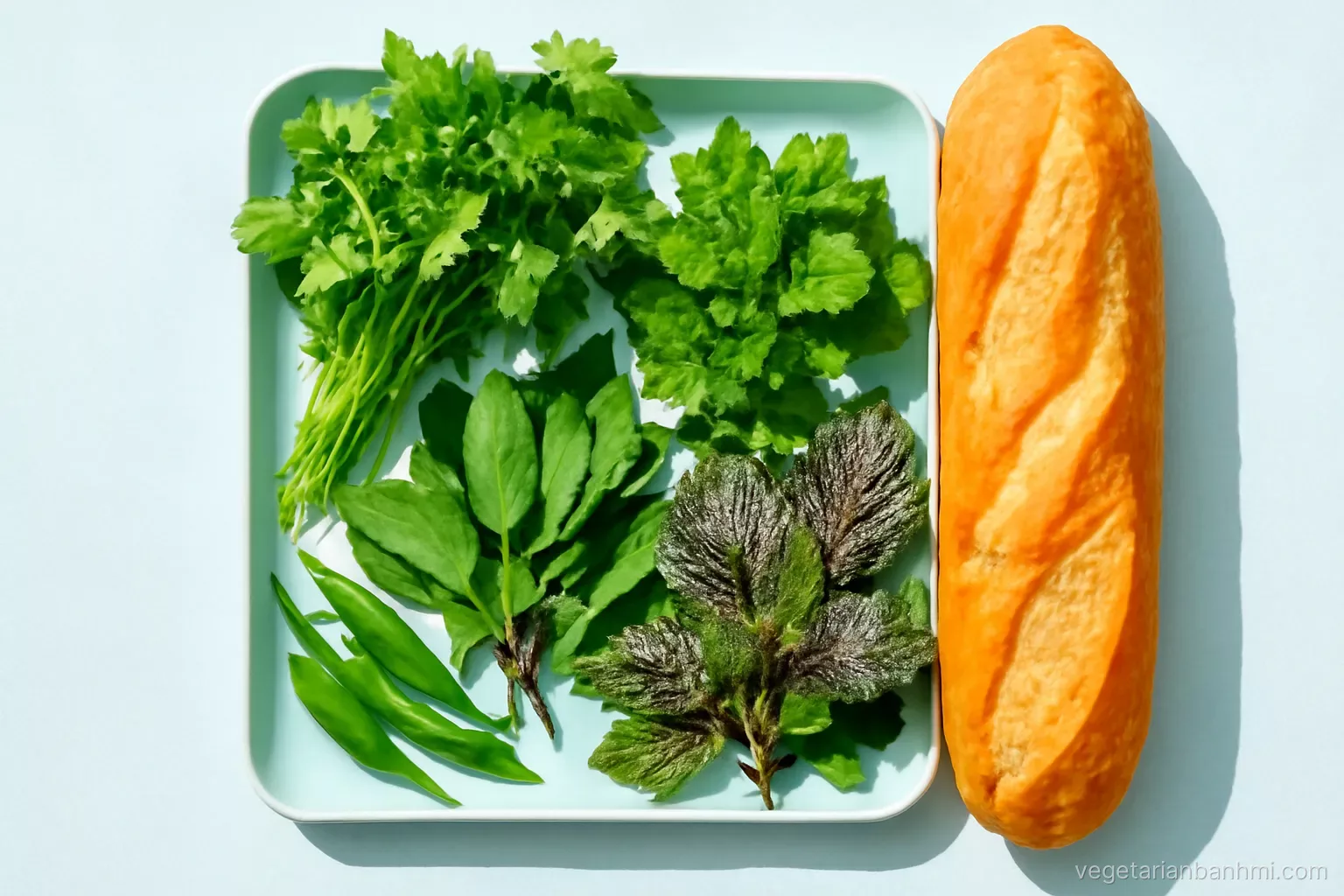
Bread, pickles and sauces can all be made ahead, but herbs decide whether a banh mi tastes fresh. Shop-bought bunches often wilt within two days, and a whole packet of cilantro for three sprigs per sandwich leads to a lot of waste. Learning to store herbs properly, and growing the ones you use most, solves both problems. It also gives you access to herbs such as rau răm (Vietnamese coriander) and tía tô (perilla) that can be hard to buy outside Vietnam.
The methods below are simple and use only jars, bags and paper towels. For a refresher on which herbs go in a banh mi in the first place, see our herb guide in the pickles and herbs category.
Storage methods by herb
| Herb | Best method | Where | Typical life |
|---|---|---|---|
| Cilantro (ngò) | Stems in water, loose bag over leaves | Fridge | About 1 week, sometimes longer |
| Mint (húng lủi) | Stems in water, loose bag, or wrapped in damp towel | Fridge | About 1 week |
| Thai basil (húng quế) | Stems in water like flowers, uncovered | Room temperature, out of sun | 3 to 5 days |
| Rau răm | Stems in water; often roots | Room temperature | 1 week or more |
| Perilla (tía tô) | Leaves between damp paper towels in a box | Fridge, warmest shelf | 3 to 5 days |
| Spring onion (hành lá) | Roots in a little water, or wrapped in paper | Fridge or windowsill | 1 to 2 weeks |
The jar method step by step
- When you get home, untie the bunch and remove any yellow or slimy leaves.
- Trim 1 cm (1/2 inch) off the stems with a sharp knife, as you would for flowers.
- Stand the bunch in a jar with 3 to 4 cm (about 1 1/2 inches) of cold water.
- Cover the leaves loosely with a produce bag or a reusable bag; do not seal it tight.
- Store in the fridge (or on the counter for basil and rau răm) and change the water every two days.
- Wash only what you need, just before using, then dry thoroughly. Herbs stored wet rot quickly.
Keep herbs away from the coldest back wall of the fridge, where leaves can freeze and turn to mush, and away from ethylene-producing fruit such as apples and ripe bananas, which speeds yellowing.
Freezing herbs: when it works
Frozen herbs lose their crisp texture, so they are not a substitute for fresh sprigs on a banh mi. They are useful, though, for marinades, soups and sauces. Chop cilantro, Thai basil or lemongrass, pack into ice-cube trays, cover with water or neutral oil and freeze. Use straight from frozen in cooking. Herb cubes frozen in oil should go directly from the freezer into a hot pan or into the fridge for same-day use; do not thaw and keep herbs in oil at room temperature, as fresh herbs in oil carry a botulism risk once they are warm.
Growing your own: the easiest herbs first
Mint and rau răm from cuttings
These are the easiest herbs to start. Take 10 to 15 cm (4 to 6 inch) stem cuttings from a fresh supermarket bunch, strip the lower leaves and stand them in a glass of water on a bright windowsill. Change the water every few days. Roots usually appear within one to two weeks. Once roots are 3 to 5 cm long, plant in a pot of general-purpose potting mix. Grow mint in its own pot: it spreads aggressively by runners and will swamp anything sharing its container. Rau răm loves moist soil and warmth and dies back in frost, so in cold climates keep it indoors in winter.
Thai basil
Thai basil also roots from cuttings, or grows easily from seed. It needs warmth and light: at least six hours of direct sun a day, and nights that do not drop much below about 10°C (50°F). Pinch out the growing tips regularly and remove flower buds as they appear; once basil flowers, leaf production slows and the leaves turn tougher. Water when the top of the soil feels dry, and avoid leaving the pot standing in water.
Cilantro
Cilantro is the hardest of the group, because it bolts, rushing to flower and seed, in heat and long days. Grow it in cool seasons, give it some afternoon shade in summer, and sow a small pot every three weeks so you always have young plants. Sow seeds directly where they will grow, as cilantro dislikes being transplanted. Lightly crushing the round seed husks before sowing can help germination. If it does bolt, let a few plants set seed: dried, those seeds are coriander seed for your marinades.
Perilla
Perilla grows readily from seed in warm weather and often self-seeds in gardens. Seeds benefit from light to germinate, so press them onto the soil surface rather than burying them deep. Harvest leaves from the top to keep the plant bushy.
A simple windowsill setup
- Position: the sunniest window you have; south-facing in the Northern Hemisphere, north-facing in the Southern Hemisphere.
- Pots: at least 15 cm (6 inches) wide and deep, with drainage holes. One herb per pot makes watering easier.
- Soil: a peat-free or general potting mix; garden soil compacts in pots.
- Feeding: a liquid fertilizer at half strength every two to three weeks in the growing season.
- Light: in dark winters, an inexpensive LED grow light on a 12 to 14 hour timer keeps basil and cilantro going.
- Harvest: cut no more than about a third of a plant at once, so it can regrow.
Four pots, mint, Thai basil, cilantro and rau răm, cover nearly every banh mi you will make. Harvest just before assembling, rinse under running water without soap as the FDA recommends for produce, and pat dry.
Food safety for homegrown herbs
Homegrown herbs still need washing, especially if pets, birds or soil splashes can reach them. Use only fertilizers and pest treatments labeled for edible plants, and follow the label's waiting time before harvest. If you are packing sandwiches with herbs for later, keep them chilled and follow the USDA's two-hour rule: food that sits out longer than two hours, or one hour above 32°C (90°F), should be thrown away. For lunchbox timing and packing tricks, our meal prep and storage section has full guides.
Herbs are eaten in small amounts, so they contribute little to overall nutrition, although cilantro and basil are notable sources of vitamin K in USDA FoodData Central. For the nutrients that really matter on a plant-based diet, see our plant-based nutrition section.
Sources
- Royal Horticultural Society – rhs.org.uk (growing basil, mint, coriander and perilla)
- US Food and Drug Administration – fda.gov (washing and storing fresh produce)
- USDA Food Safety and Inspection Service – fsis.usda.gov (refrigerator storage and the two-hour rule)
Frequently asked questions
What is the best way to store cilantro?
Trim the stems, stand the bunch in a jar of water, cover loosely with a bag and keep it in the fridge. Change the water every two days, and it usually lasts about a week.
Why does my basil turn black in the fridge?
Basil is sensitive to cold and its leaves darken below about 10°C (50°F). Keep it in a glass of water at room temperature, out of direct sun.
Can I grow Vietnamese herbs from supermarket bunches?
Yes. Mint, rau răm and Thai basil root easily from stem cuttings placed in water on a bright windowsill, usually within one to two weeks.
Why does my cilantro keep flowering?
Heat and long days trigger bolting. Grow cilantro in cooler seasons, give it afternoon shade, and sow new seeds every three weeks.
Can I freeze herbs for banh mi?
Frozen herbs lose their crunch, so use them in marinades and soups rather than on sandwiches. Freeze chopped herbs in ice-cube trays with water or oil.
Grow the Herbs, Know the Nutrients
A windowsill of fresh herbs means every homemade vegan banh mi tastes market-fresh. If you eat plant-based, Bánh Mì XANH, a fully vegan banh mi chain with 5 central shops in Ho Chi Minh City open 24/7, has a helpful page on nutrients to watch on a vegan diet.
Read Bánh Mì XANH's vegan nutrient guide · 24/7 hotline / Zalo +84 923 183 183