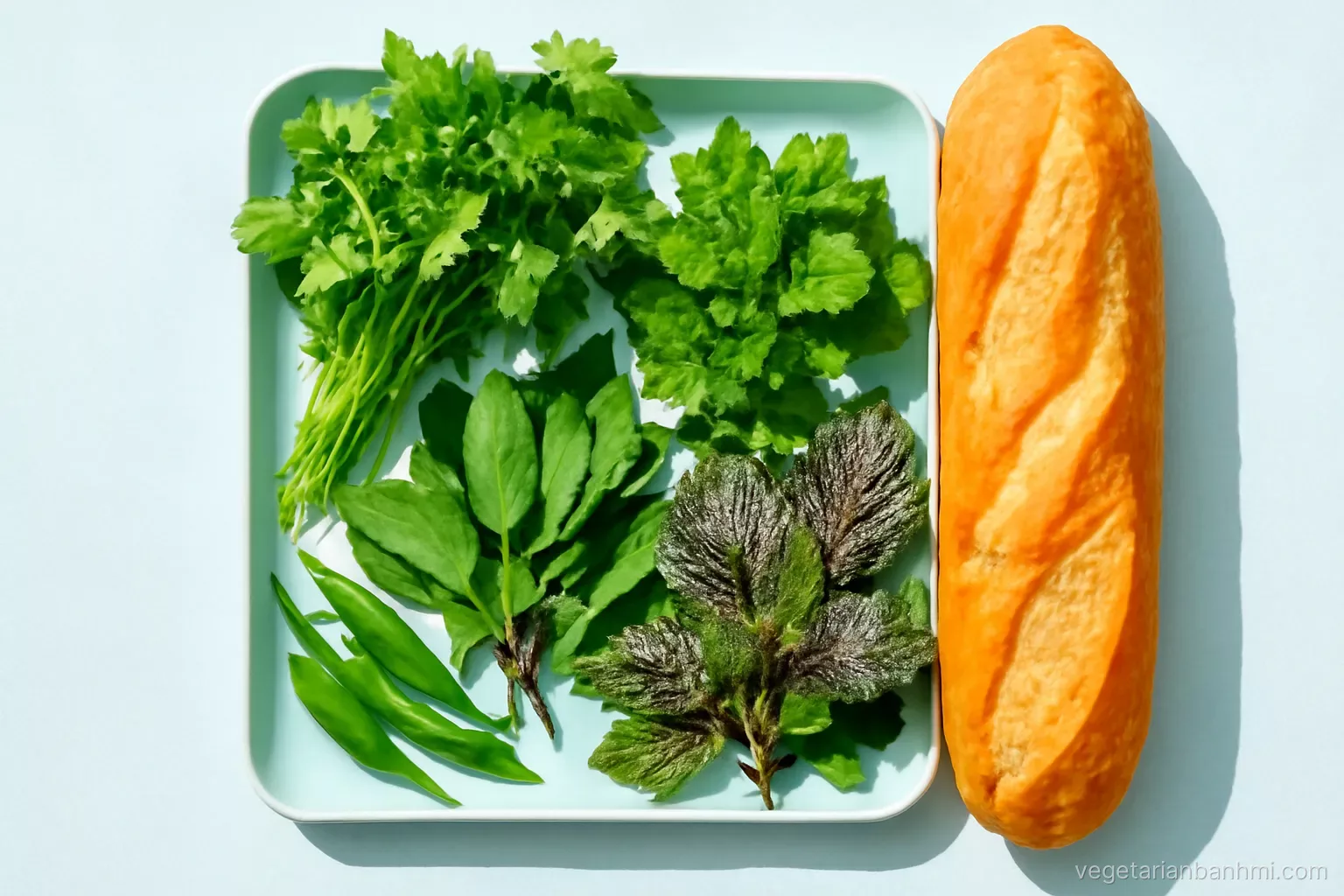
Short answer: A classic banh mi uses cilantro (ngò), usually with spring onion, cucumber and fresh chili. Thai basil, mint, Vietnamese coriander (rau răm) and perilla are common in Vietnamese cooking and make excellent optional additions, especially in vegan banh mi. Use about 5 g (a small handful of sprigs) per sandwich, washed and completely dry, and add herbs last so they stay fresh.
The role of herbs in a banh mi
Fresh herbs are what make banh mi taste Vietnamese rather than French. Vietnamese cooking treats herbs almost as vegetables, piling them onto noodle soups, wrapping them into rolls and stuffing them into sandwiches. In banh mi, the herbs do three jobs: they bring a sharp, green aroma that cuts through mayo and pâté; they add a cool, juicy contrast to warm fillings; and they make the sandwich smell inviting when you bite in.
The standard herb in a Saigon banh mi is cilantro, often joined by a strip of spring onion. Many vendors add slices of cucumber and fresh red chili, which work alongside the herbs. Beyond that, shops and home cooks improvise. Vegan banh mi benefits from being a little more generous with herbs than meat versions, because plant-based fillings have gentler flavors that herbs lift beautifully.
The herb guide
| Herb | Vietnamese name | Flavor | In banh mi? | Substitute abroad |
|---|---|---|---|---|
| Cilantro (coriander leaf) | ngò / rau mùi | Bright, citrusy, green | Standard | Widely available |
| Spring onion | hành lá | Mild onion | Common | Widely available |
| Thai basil | húng quế | Anise, clove, sweet | Optional, great with tofu | Italian basil plus a few fennel fronds |
| Mint | húng lủi, bạc hà (varies by region) | Cool, fresh | Optional | Spearmint |
| Vietnamese coriander | rau răm | Peppery, citrusy, slightly hot | Optional, bold | Cilantro plus a little mint |
| Culantro (sawtooth herb) | ngò gai | Like strong cilantro | Optional, chop finely | Extra cilantro stems |
| Perilla | tía tô | Herbal, faintly cinnamon and mint | Rare, but good with mushrooms | Japanese shiso (same species) |
| Vietnamese balm | kinh giới | Lemony, minty | Rare | Lemon balm |
Two naming notes. In southern Vietnam, cilantro is usually ngò or ngò rí, while northerners say rau mùi. Mint names differ from region to region and even from market to market, so if you are shopping in Vietnam, pointing works better than any dictionary.
How each herb works in a sandwich
Cilantro
Use whole sprigs, stems included: the tender upper stems carry as much flavor as the leaves and add crunch. Three to five sprigs per sandwich is typical. If cilantro tastes like soap to you, you are not alone, and our cilantro substitutes guide in the pickles and herbs category gives practical swaps.
Thai basil
Thai basil has purple stems, pointed leaves and a strong anise scent that holds up to heat better than sweet Italian basil. Tear a few leaves over lemongrass tofu or grilled mushrooms. It pairs especially well with chili sauce and with jackfruit fillings.
Mint
A few leaves of mint make a heavy sandwich taste lighter, which is welcome with fried tofu or a thick layer of pâté. Too much tastes like toothpaste against soy sauce, so keep it to four to six leaves.
Rau răm
Vietnamese coriander has narrow, pointed leaves with a dark mark in the middle and a peppery bite. It is a classic partner for eggs and for chicken salads in Vietnam; in vegan banh mi, it is excellent with chickpea-flour "egg" or tofu scrambles. Use just a few leaves; it is assertive.
Herb pairings by filling
Once cilantro is in place, the second herb is where you can steer the sandwich. A few pairings that consistently work, all built on fillings from our plant-based fillings guides:
- Lemongrass tofu: cilantro plus Thai basil. The anise in the basil picks up the citrus of lemongrass.
- Mushroom pâté and grilled mushrooms: cilantro plus a couple of perilla leaves, whose warm, slightly spiced aroma suits earthy flavors.
- Crispy fried tofu with chili sauce: cilantro plus mint, which cools the heat and the oil.
- Chickpea-flour "egg" or tofu scramble: cilantro plus rau răm, echoing the way Vietnamese cooks pair that herb with eggs.
- Sweet caramelized jackfruit: cilantro plus a little culantro, finely chopped, for a sharper green edge against the sweetness.
Avoid stacking more than two strong herbs in one sandwich. With pickles, chili and seasoning sauce already competing, a third aromatic herb tends to muddy rather than lift. If you are feeding a crowd, the easiest solution is to set out a herb platter and let everyone choose; it is the centerpiece of the banh mi bars described in our parties and gatherings section. Plan roughly 10 g of mixed herbs per guest, a little more if you are also serving rolls or noodle salads.
Prep: washing, drying and keeping crisp
Herbs are eaten raw, so washing matters. The US Food and Drug Administration advises rinsing produce under running water, gently rubbing it, and not using soap or detergent. For leafy herbs, swish them in a large bowl of cold water, lift them out so grit stays behind, repeat once, then rinse under the tap.
- Pick off yellowed or slimy leaves and thick woody stems.
- Wash as above.
- Dry thoroughly in a salad spinner or rolled in a clean towel. Wet herbs make the bread soggy and dilute the sauces, which is the most common mistake in home banh mi.
- Keep washed herbs in a container lined with a dry paper towel in the fridge, and use within two to three days.
Basil is the exception for storage: it blackens in the cold. Keep Thai basil stems in a glass of water at room temperature, like flowers, out of direct sun, for up to three or four days.
How much to use
- Cilantro: 3 to 5 sprigs, about 3 to 4 g.
- Spring onion: 1 strip, about 10 cm (4 inches), halved lengthwise.
- Thai basil or mint: 4 to 6 leaves.
- Rau răm or perilla: 2 to 4 leaves.
- Cucumber: 2 long spears, about 40 g.
- Fresh chili: 2 to 4 thin slices, to taste.
Herbs go in last, on top of the pickles, just before you close the bread. That way the warmth of the filling releases their aroma without wilting them.
Finding Vietnamese herbs outside Vietnam
Cilantro, mint and spring onion are sold almost everywhere. Thai basil appears in Asian grocers and increasingly in large supermarkets. Rau răm, perilla and culantro are mostly found at Vietnamese, Thai or Korean grocers; Japanese green shiso is the same species as Vietnamese perilla, although Vietnamese tía tô is usually green on top and purple underneath, and a little different in aroma. Many of these herbs are easy to grow on a sunny windowsill, and rau răm and mint root readily from cuttings placed in a glass of water.
In Vietnam itself, herbs are inexpensive and abundant at every wet market, and a basket of them often arrives free with a bowl of noodle soup. If you are traveling, a market walk to learn the herbs by smell is one of the most delicious crash courses you can take; our sister site vietbanhmi.com covers Vietnamese food travel.
Sources
- US Food and Drug Administration – fda.gov (selecting and washing fresh produce safely)
- USDA FoodData Central – fdc.nal.usda.gov (nutrient data for cilantro, basil and mint)
- Royal Horticultural Society – rhs.org.uk (growing herbs such as basil, mint and coriander)
Frequently asked questions
What herbs are in a traditional banh mi?
Cilantro is the standard herb, often with spring onion, alongside cucumber and fresh chili. Thai basil, mint and rau răm are common optional extras.
Can I use Italian basil instead of Thai basil?
Yes, though it is sweeter and less anise-forward. A few fennel fronds or a tiny pinch of crushed fennel seed brings it closer to Thai basil.
What is rau răm in English?
It is usually called Vietnamese coriander or Vietnamese mint, although it is related to neither. It has a peppery, citrusy flavor and is used in small amounts.
How do I keep herbs fresh for a week of sandwiches?
Wash and dry them, then store in a container lined with paper towel in the fridge for two to three days. Keep basil in a glass of water at room temperature. For a full week, buy herbs twice.
Should I chop herbs for banh mi?
Generally no. Whole sprigs and leaves stay fresher and give bursts of flavor. Only culantro, which is tough, is usually chopped finely.
Fresh Herbs, Warm Bread, Saigon Style
A generous handful of washed, dry herbs is the easiest upgrade you can give a homemade vegan banh mi. In Ho Chi Minh City, taste the Thập Cẩm, a mixed banh mi with vegetables, tofu and mushrooms, at Bánh Mì XANH, a fully vegan chain with 5 central shops open 24/7.
Explore the Bánh Mì XANH menu · 24/7 hotline / Zalo +84 923 183 183