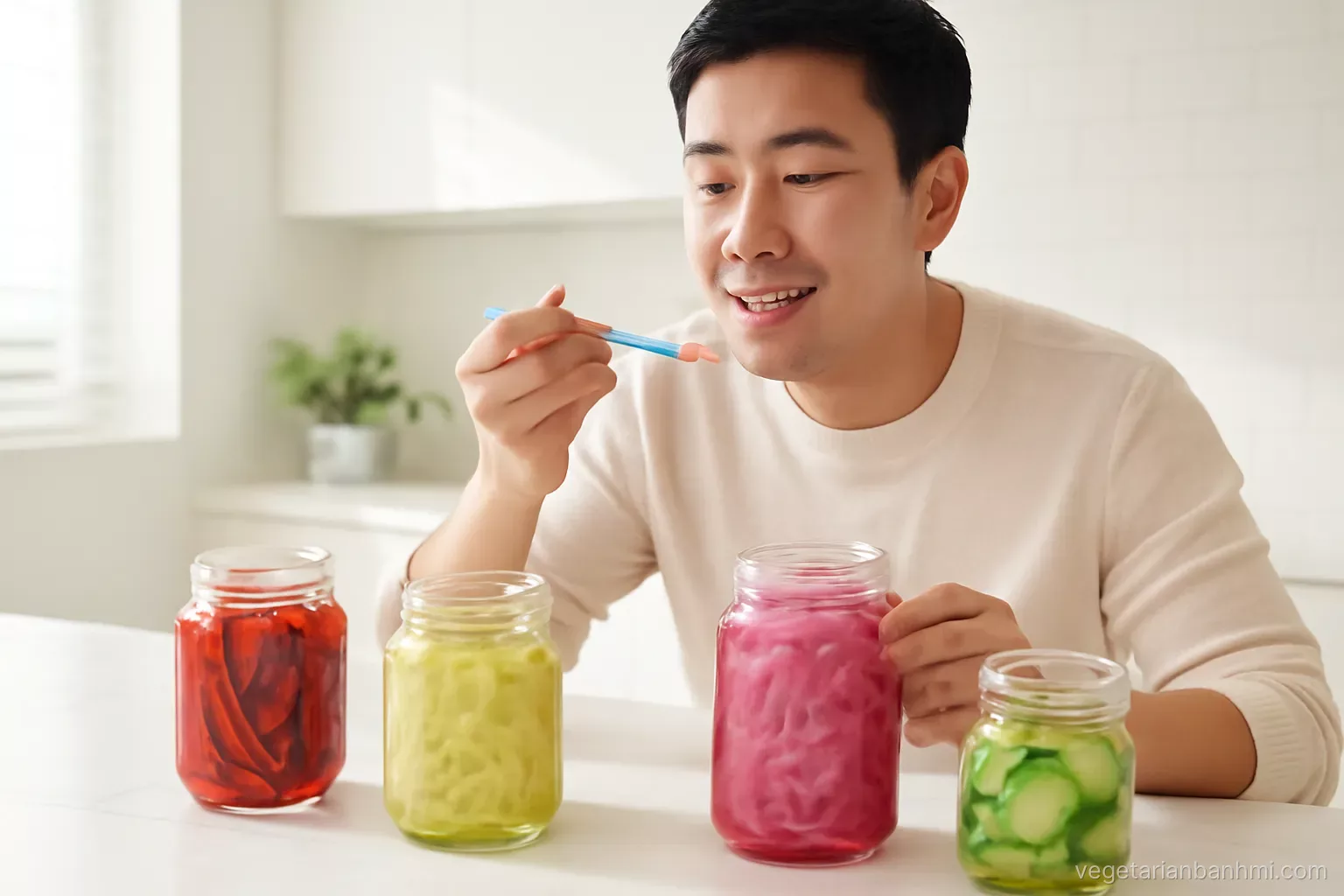
Short answer: Quick pickles get their sourness from vinegar and are ready in an hour; they taste bright, sweet and clean, which is the classic banh mi style. Fermented pickles get their sourness from lactic acid bacteria in a salt brine over three to seven days; they taste deeper and more complex. For most sandwiches, quick pickles are the right choice, but a fermented jar is a rewarding project if you follow a few safety rules.
Two ways to make vegetables sour
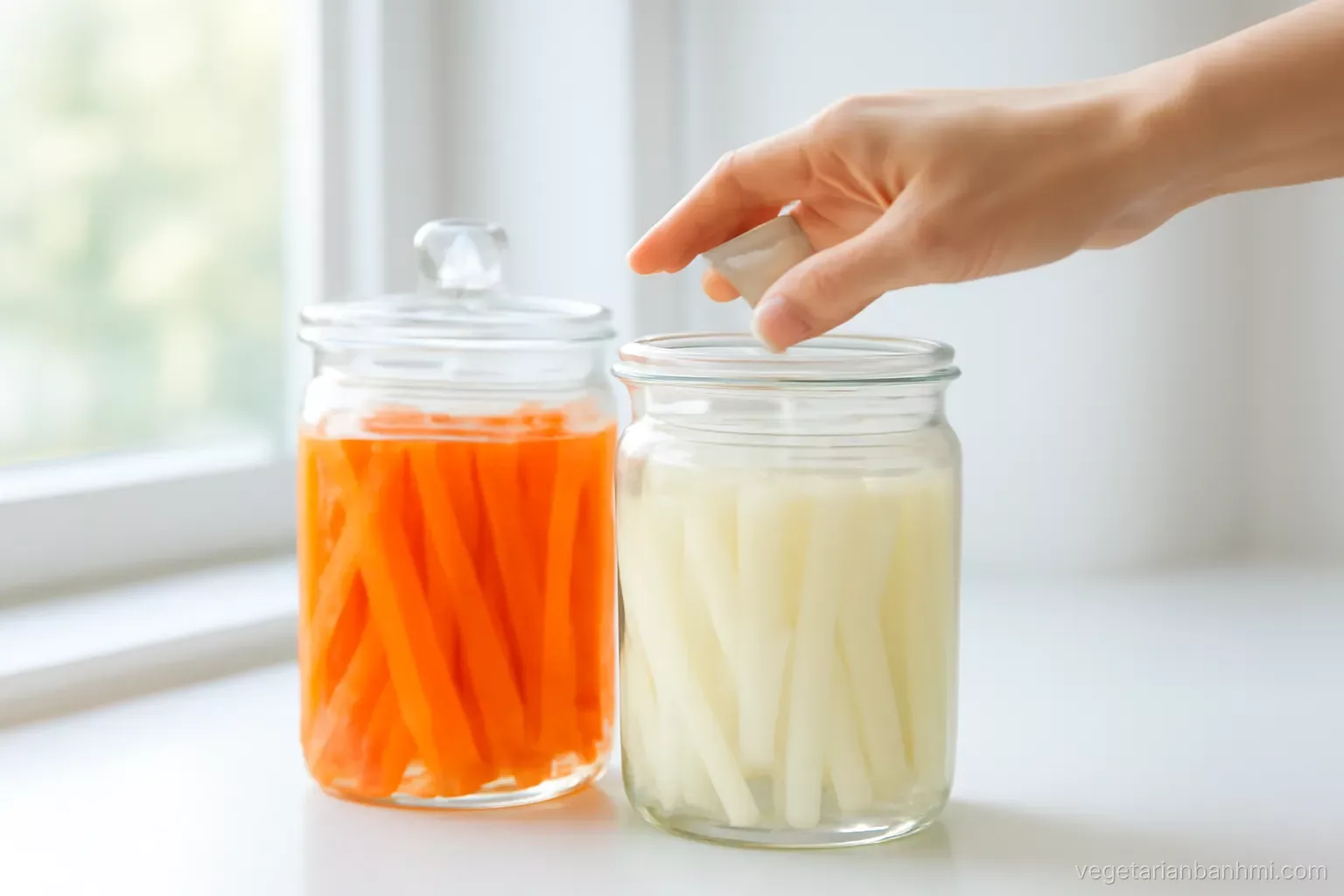
Both methods end in a sour vegetable, but they get there differently. A quick pickle, like Vietnamese đồ chua (pickled carrot and daikon), is simply vegetables soaked in a vinegar brine. The acid is added, and the flavor depends entirely on your vinegar, sugar and salt. A fermented pickle starts with no acid at all. Vegetables sit under salty water, salt-tolerant lactic acid bacteria that live naturally on the vegetables multiply, and they turn sugars into lactic acid. As the acid builds, it preserves the vegetables and creates a more layered sourness.
Vietnam has strong traditions of both. Đồ chua for banh mi is usually a quick pickle. Fermented pickles include dưa cải chua (sour fermented mustard greens), dưa giá (quick-fermented bean sprouts) and củ kiệu (pickled small shallot bulbs), a Tết favorite. Knowing both methods lets you choose the right one for the sandwich you are building.
Side-by-side comparison
| Feature | Quick (vinegar) pickles | Fermented (salt brine) pickles |
|---|---|---|
| Source of sourness | Added vinegar (acetic acid) | Lactic acid made by bacteria |
| Time to eat | 1 hour, best after 1 day | 3 to 7 days at 18 to 24°C (64 to 75°F) |
| Flavor | Bright, sweet-sour, predictable | Tangy, savory, complex, slightly funky |
| Texture | Crisp, softens after 2 weeks | Crisp-tender, softer over time |
| Sugar | Usually generous in Vietnamese style | Little or none |
| Skill and attention | Very low | Moderate; check daily |
| Our fridge limit | 3 weeks | 1 month after fermenting |
| Live bacteria | No | Yes, if not heated |
Fermented vegetables contain live bacteria, which interests many people, but research on specific health effects is still developing and we make no health claims here. Choose based on taste and convenience.
How to ferment carrot and daikon for banh mi
This method uses a 2.5% salt brine, a common, well-established strength for brined vegetable ferments. It makes a 1-liter (1-quart) jar.
- 250 g (about 2 small) carrots and 250 g daikon, cut into 5 mm (1/4 inch) sticks
- 2 thin slices fresh ginger and 1 small red chili, split (optional)
- 500 ml (2 cups) non-chlorinated water: filtered, or tap water left uncovered for a few hours
- 12.5 g fine non-iodized salt (about 2 level teaspoons), which makes a 2.5% brine with 500 ml water
- A clean 1-liter jar, plus a fermentation weight or a small zip bag filled with brine
- Weigh the salt. Use a kitchen scale. Teaspoons vary a lot between salt types, and too little salt is the most common reason ferments go wrong.
- Dissolve. Stir the salt into the water until fully dissolved.
- Pack. Pack the vegetables tightly into the jar with the ginger and chili, leaving about 4 cm (1 1/2 inches) of headspace.
- Submerge. Pour over brine to cover by at least 2 cm (3/4 inch), then add the weight so nothing floats. Anything above the brine can mold.
- Cover loosely. Use a fermentation airlock lid, or rest the lid on top without tightening it, so gas can escape. Stand the jar on a plate to catch overflow.
- Ferment. Keep at 18 to 24°C (64 to 75°F), out of direct sun. Within 1 to 3 days the brine turns cloudy and small bubbles rise. Taste from day 3 with a clean fork.
- Refrigerate. When it is pleasantly sour, usually day 4 to 7, tighten the lid and move it to the fridge. Cold slows fermentation dramatically.
In a hot climate such as Vietnam's, where kitchens often sit around 30°C (86°F), fermentation runs much faster, sometimes just 1 to 2 days, and the risk of soft, over-sour vegetables rises. Taste daily and move the jar to the fridge sooner.
Safety: what is normal and what is not
Properly salted vegetable ferments have a long safety record because the acid produced drops the pH quickly, and below pH 4.6 the bacteria that cause botulism cannot grow, according to the US Food and Drug Administration's acidified-food guidance. If you want certainty, inexpensive pH strips reading below 4.6, ideally around 4 or lower, are a useful check before refrigerating. The National Center for Home Food Preservation publishes fermentation guidance for products such as sauerkraut that follows the same principles.
- Normal: cloudy brine, bubbles, a clean sour smell, white sediment at the bottom of the jar.
- Usually harmless but skim it: a flat, wrinkled white film on the surface, called kahm yeast. Skim it off. If it keeps returning or smells unpleasant, discard.
- Discard the whole batch: fuzzy mold of any color (blue, green, black, pink), slimy vegetables, or a rotten or putrid smell.
Once refrigerated at or below 4°C (40°F), we recommend eating fermented carrot and daikon within one month. That is more conservative than many fermentation books suggest, but it keeps both texture and margin for error on your side.
A word on fermented bean sprouts
Dưa giá, bean sprouts briefly fermented with garlic chives and carrot, is a beloved Vietnamese side. It deserves a specific warning: raw sprouts have been linked to many foodborne illness outbreaks, because bacteria can grow inside the seeds during sprouting, and the FDA advises children, older adults, pregnant people and anyone with a weakened immune system to avoid raw or lightly cooked sprouts. If you make dưa giá, buy very fresh sprouts, use clean equipment, refrigerate as soon as it turns sour, and eat it within a few days. Vulnerable eaters should skip it.
Which pickle for which banh mi
Quick pickles suit the classic sandwich: they bring the sweetness that balances salty soy-glazed tofu, mushroom pâté and chili sauce. Fermented carrot and daikon work brilliantly with rich, sweet fillings such as caramelized tofu or jackfruit, where an unsweetened sourness keeps the sandwich from tasting cloying. Fermented mustard greens, chopped finely, are an unusual but excellent addition to a mushroom banh mi.
A practical approach many home cooks settle on: keep a quick jar going every week, and ferment a batch once a month for variety. Both slot neatly into weekly planning, covered in our meal prep and storage section. For the classic quick pickle in detail, see the đồ chua ratio guide in our pickles and herbs category.
Troubleshooting fermented pickles
No bubbles after three days. The room may be too cold, below about 16°C (60°F), or the water was chlorinated. Move the jar somewhere warmer and give it two more days.
Soft, mushy vegetables. Too warm, too long, or too little salt. Next time weigh the salt carefully, ferment cooler and taste earlier. A grape, oak or black tea leaf in the jar adds tannins that help some vegetables stay crisp.
Too salty. Rinse before using, or mix fermented pickles half and half with quick pickles for a sandwich.
Sources
- National Center for Home Food Preservation – nchfp.uga.edu (fermenting vegetables and pickling)
- US Food and Drug Administration – fda.gov (acidified foods, pH 4.6, and safety advice on raw sprouts)
- USDA Food Safety and Inspection Service – fsis.usda.gov (refrigerator storage)
Frequently asked questions
Are banh mi pickles fermented?
Usually not. The standard đồ chua in banh mi is a quick vinegar pickle, which gives the familiar sweet-sour crunch. Fermented versions are a home-cook variation.
What salt percentage should I use for fermenting?
A 2 to 3% brine by weight works well for carrot and daikon; this guide uses 2.5%, which is 12.5 g of salt in 500 ml of water. Always weigh the salt rather than measuring by spoon.
Is the white film on my ferment mold?
A flat, wrinkled white film is usually kahm yeast, which can be skimmed off. Fuzzy, raised or colored growth is mold, and the batch should be discarded.
Can I ferment with sugar like đồ chua?
A small pinch is fine, but large amounts of sugar can encourage yeasts and make the ferment boozy. Add sweetness when you serve instead.
How long do fermented pickles last in the fridge?
We recommend up to one month at or below 4°C (40°F), kept under brine and handled with clean utensils. Discard if you see mold or notice a rotten smell.
Sour Done Right, at Home and in Saigon
Whether you go quick or fermented, homemade pickles turn a good vegan banh mi into a great one. When you are in Ho Chi Minh City, compare your jar with the real thing at Bánh Mì XANH, a fully vegan banh mi chain with 5 central shops open 24/7.
Find a Bánh Mì XANH shop near you · 24/7 hotline / Zalo +84 923 183 183