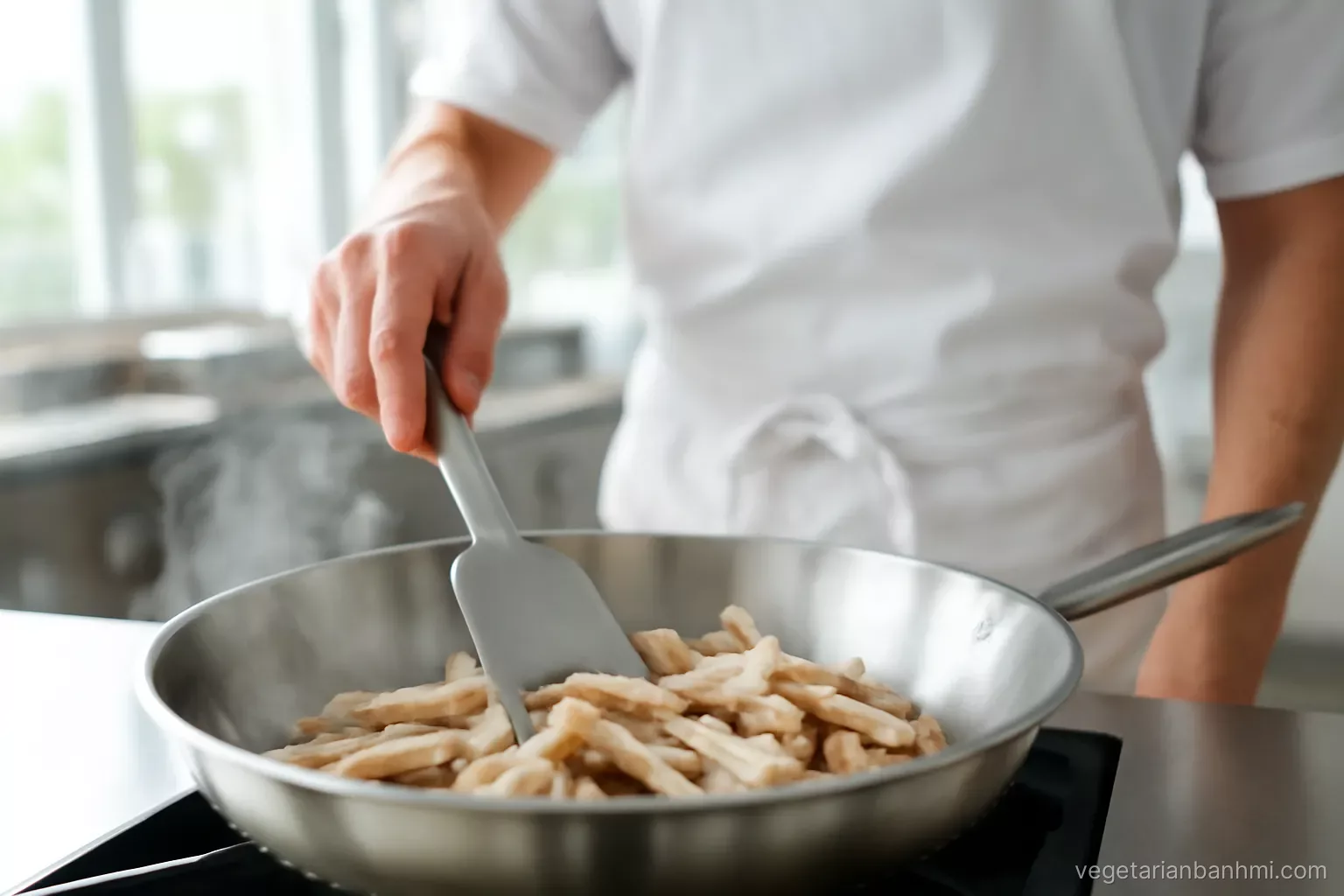
Short answer: Mushrooms crisp when you drive out their water fast: use a very hot, uncrowded pan, press them flat with a weight or spatula, and salt only at the end. Oyster mushrooms torn into clusters and king oyster mushrooms cut into thick slices or shreds give the best texture for banh mi; shiitake adds flavor. Plan on 8–12 minutes of searing, or 20–25 minutes in a 220°C (425°F) oven.
Vietnamese vegetarian cooking leans heavily on mushrooms, called nấm. You will see nấm bào ngư (oyster mushrooms) fried in batter, nấm đùi gà (king oyster mushrooms) grilled or shredded like meat, and nấm đông cô (shiitake) simmered in rich sauces. In a banh mi, mushrooms give savoriness and chew, but only if they are cooked right. Raw mushrooms are mostly water, and if that water stays in the pan, you get gray, slippery pieces that slide out of the bread. This guide shows how to choose, cut and cook them so they come out browned, crisp at the edges and meaty inside.
Why mushrooms go soggy
Mushrooms are around 90 percent water, and they release it as soon as they heat up. If the pan is crowded or not hot enough, that water pools and the mushrooms boil in it. Salt added early pulls water out even faster, adding to the puddle. Only once the water has evaporated can the surface reach the temperatures needed for browning. The practical lessons are simple: give mushrooms room, use high heat, salt late, and be patient through the watery phase. Unlike many vegetables, mushrooms are hard to overcook in the pan; they just keep getting browner and chewier.
Washing is less of a problem than people think, because mushrooms absorb little water from a quick rinse. Rinse them briefly if dirty, then pat dry; for cultivated oyster and king oyster mushrooms, a wipe with a damp towel is usually enough.
Choosing mushrooms for banh mi
| Mushroom | Vietnamese name | How to cut | Best method | Result |
|---|---|---|---|---|
| Oyster | nấm bào ngư | Tear into clusters along the gills | Press-and-sear or batter-fry | Crisp, frilly edges, tender |
| King oyster | nấm đùi gà | Thick coins, lengthwise planks, or shred with a fork | Score and sear, or shred and pan-crisp | Meaty, chewy, scallop or pulled texture |
| Shiitake (fresh) | nấm đông cô / nấm hương | Remove stems, slice caps 5 mm | Sear with soy glaze | Deeply savory, slightly chewy |
| Shiitake (dried) | nấm đông cô khô | Soak 30 min in warm water, squeeze, slice | Braise, then sear | Intense flavor, firm |
| Cremini / button | nấm mỡ | Slice 5 mm or quarter | High-heat sauté or roast | Mild, juicy, good in pâté |
| Enoki | nấm kim châm | Pull into small bundles | Batter and deep-fry | Very crunchy strands |
For a single banh mi, budget about 100–120 g raw mushrooms per sandwich; they shrink by roughly a third or more as they cook. A mix of oyster for crispness and shiitake for depth is hard to beat.
Method 1: Press and sear (the everyday technique)
- Tear oyster mushrooms into large clusters, or cut king oyster mushrooms lengthwise into 1 cm planks.
- Heat a heavy pan (cast iron is ideal) over high heat for 2 minutes, then add 1–2 tablespoons oil.
- Lay the mushrooms in a single layer with space between them. Work in batches; a 28 cm (11 inch) pan holds about 200 g at a time.
- Press them flat with a second heavy pan, a grill press or a sturdy spatula. Hold or weigh down for 3–4 minutes, until the undersides are deeply browned.
- Flip, press again and cook 2–3 minutes more.
- Off the heat, season with salt and pepper, a few drops of soy sauce, or a mix of 1 tablespoon soy sauce and 1 teaspoon sugar that you let bubble for 20 seconds.
Pressing increases contact with the hot pan and squeezes water out, so the mushrooms brown evenly and become almost crunchy at the edges. Garlic and shallot, if you want them, go in for the last 30 seconds so they do not burn.
Method 2: Shredded king oyster, "pulled" style
King oyster stems have long fibers that pull apart like cooked meat. Drag a fork down the length of each stem to shred it into strands, or slice thinly and then tear. Sear the shreds in a hot pan with 2 tablespoons oil for 6–8 minutes, stirring only occasionally, until golden and crisp in places. Toss with a glaze of 1 tablespoon soy sauce, 1 teaspoon sugar, 1 minced garlic clove, 1/2 teaspoon black pepper and a little minced lemongrass. This makes an excellent substitute for grilled meat in a banh mi, and it reheats well.
For whole coins, score both faces in a crosshatch pattern 2 mm deep, sear 3 minutes per side, then glaze. The scoring helps the inside cook and catches sauce.
Method 3: Oven-roasted or batter-fried
Oven: Toss 500 g torn oyster or sliced king oyster mushrooms with 2 tablespoons oil and spread on a large lined tray without overlapping. Roast at 220°C (425°F) for 20–25 minutes, stirring once, until browned and crisp at the edges. Season after roasting. This is the easiest way to cook for 4 or more.
Batter-fried: For a crunchy, street-food style filling, toss torn oyster mushrooms in a mix of 60 g (1/2 cup) rice flour, 30 g (1/4 cup) cornstarch, 1/2 teaspoon salt and pepper, and about 120 ml (1/2 cup) ice-cold sparkling water to a thin batter. Fry in oil at 180°C (350°F) for 3–4 minutes until golden, then drain on a rack. Eat within 20 minutes, as batter softens once it meets sauce and pickles. In an air fryer, spray the coated mushrooms with oil and cook at 200°C (400°F) for 10–12 minutes.
Glazes and seasonings that suit mushrooms
Mushrooms already have plenty of savory depth, so the seasoning for banh mi should add salt, a touch of sweetness for caramelization, and something fresh. These three combinations work well, each enough for about 400 g of mushrooms, added in the last minute of cooking:
- Soy-pepper glaze: 1 1/2 tablespoons soy sauce, 2 teaspoons sugar, 1/2 teaspoon coarse black pepper, 1 minced garlic clove. Simple and closest to everyday Vietnamese home cooking.
- Lemongrass-chili: 1 tablespoon finely minced lemongrass, 1 minced chili, 1 tablespoon soy sauce, 1 teaspoon sugar. Fry the lemongrass in the oil for 30 seconds before adding the rest.
- Five-spice and hoisin: 1 tablespoon hoisin sauce, 2 teaspoons soy sauce, a pinch of five-spice, a squeeze of lime. Gives a sticky, barbecue-like coating similar to roast meat fillings.
Add glazes only after the mushrooms are browned. Sugar in the pan from the start will burn before the mushrooms have released their water. For a sandwich, keep the glaze thick and minimal; extra sauce soaks into the bread within minutes.
Putting mushrooms into a banh mi
Mushrooms pair well with richness, so spread the bread with vegan mayo or mushroom pâté first. Add cucumber, then the warm mushrooms, then well-drained pickles, cilantro and chili. Because mushrooms are lower in protein than tofu or tempeh, many cooks combine them: half mushrooms, half tofu. USDA FoodData Central lists raw oyster mushrooms at about 33 kcal and about 3.3 g protein per 100 g, and raw shiitake at about 34 kcal per 100 g, so mushrooms bring flavor and texture with very little energy. For full recipes, browse our vegan banh mi recipes, and for a mushroom-based spread see sauces and spreads.
Common fixes, briefly: if the pan floods with liquid, keep cooking on high until it evaporates rather than pouring it off, as it holds flavor. If mushrooms taste bland, season again at the end and add soy sauce. If they turn rubbery, they were cut too thick and cooked too fast; slice thinner or finish them in a covered pan for a minute with a splash of water.
Sources
- USDA FoodData Central – fdc.nal.usda.gov (mushrooms, oyster, raw; mushrooms, shiitake, raw)
- Mushroom Council – mushroomcouncil.org (mushroom varieties and handling)
- USDA Food Safety and Inspection Service – fsis.usda.gov (storing cooked foods)
Frequently asked questions
Should I salt mushrooms before or after cooking?
After they have browned, or at least once the released water has evaporated. Salt draws moisture out quickly, which slows browning. A pinch at the start is fine only for chopped mushrooms you want to cook down, such as for pâté.
Which mushroom is the most meat-like?
King oyster mushrooms, thanks to their thick, dense stems. Shredded and seared, they resemble pulled meat; cut into coins and scored, they resemble scallops. Oyster mushrooms are softer but crisp better at the edges.
Can I prep mushrooms ahead for banh mi?
Yes. Seared or roasted mushrooms keep 3–4 days in the fridge. Re-crisp them in a hot dry pan or air fryer for 2–3 minutes before assembling. Batter-fried mushrooms are best eaten fresh.
Are dried shiitake worth using?
Yes, for flavor. Soak them in warm water for 30 minutes, squeeze, slice and sear. Keep the soaking liquid, strained, to add savoriness to sauces or a glaze.
How should I store raw mushrooms?
In the fridge in a paper bag or their original packaging, not sealed in plastic, which traps moisture and makes them slimy. Most cultivated mushrooms are best within 4–7 days.
Crispy mushrooms at home, a mixed banh mi in Saigon
Once your mushrooms come out golden and crisp, they can carry a banh mi on their own or alongside tofu. In Ho Chi Minh City, the Thập Cẩm (mixed) banh mi at Bánh Mì XANH combines vegetables, tofu and mushrooms, at a fully vegan chain with 5 central shops open 24/7.
Explore the Bánh Mì XANH menu · 24/7 hotline / Zalo +84 923 183 183