Short answer: Buy young (green) jackfruit packed in brine or water, never ripe jackfruit in syrup. Rinse it, simmer for 10 minutes, squeeze it hard in a towel, then shred and cook it in a very hot pan or oven until the edges brown. Squeezing and dry-heat crisping are what turn it from mushy to chewy. Because jackfruit is low in protein, pair it with tofu, pâté, seitan or peanuts in a banh mi.
Young jackfruit, mít non in Vietnamese, has become a famous meat substitute in Western cafes, mostly as "pulled" barbecue jackfruit. In Vietnam it has a much longer history in everyday cooking: shredded into gỏi mít non (young jackfruit salad), braised in caramel and pepper, or simmered in vegetarian stews. What it offers is texture rather than flavor or protein. Handled well, it is fibrous, chewy and absorbent. Handled badly, it is soggy, briny and stringy. This guide explains the differences between canned, vacuum-packed and fresh jackfruit, and how to get the texture you want for a sandwich filling.
Young vs ripe: the most common mistake
Jackfruit is the same fruit at different stages. Picked young and green, the flesh is pale, firm and neutral, a bit like a cross between artichoke heart and palm heart. Left to ripen, it turns yellow, soft, sweet and strongly fragrant, and it is eaten as fruit or in desserts. For savory fillings you need young jackfruit. The labels to look for are "young", "green" or "unripe" jackfruit, "in brine" or "in water". If the can says "in syrup", it is ripe and sweet, and no amount of seasoning will make it taste like a savory filling.
| Form | Where to find it | Pros | Cons |
|---|---|---|---|
| Canned in brine or water | Asian grocers, many supermarkets | Cheap, consistent, ready to cook | Briny taste; must be rinsed and simmered |
| Vacuum-packed, unseasoned | Health food shops, supermarkets in Europe, UK, US | Firmer, less briny | Costs more per gram |
| Vacuum-packed, pre-seasoned | Supermarket chilled aisles | Ready in minutes | Usually barbecue-flavored; hard to make taste Vietnamese |
| Frozen young jackfruit | Some Asian grocers | Closer to fresh | Variable texture; drain well |
| Fresh young jackfruit | Markets in Vietnam and other tropical countries | Best texture and flavor | Sticky latex, heavy, laborious to prepare |
A standard can of around 565 g (20 oz) yields roughly 280 g (10 oz) drained jackfruit, enough filling for 2 banh mi on its own or 4 if combined with another protein.
Preparing canned jackfruit, step by step
- Drain and rinse. Tip the jackfruit into a sieve and rinse under cold running water for a minute, tossing it with your hands.
- Trim. Each piece is a wedge with a firmer core along one edge and soft seed pods in the middle. In most cans everything is tender enough to eat; if the core edge feels hard, slice it off.
- Simmer. Cover with fresh water, bring to a boil and simmer 10 minutes. This softens the fibers for shredding and removes the briny, tinny note. Some cooks add a slice of ginger or a bay leaf to the water.
- Squeeze. Let it cool slightly, wrap it in a clean towel or cheesecloth and squeeze firmly. You will be surprised how much water comes out. This is the step that most decides the final texture.
- Shred. Pull the pieces apart with two forks or your fingers. Mash the seed pods lightly and keep them; they add body.
At this point the jackfruit is a blank canvas. It will absorb marinades and sauces readily because it is dry and fibrous. Season it boldly, since it brings almost no flavor of its own.
Working with fresh young jackfruit
In Vietnam, you can buy a section of young jackfruit at a market and have the vendor cut it for you, which is the easiest route. If you cut it yourself, the white sap is extremely sticky. Rub your knife, cutting board and hands (or gloves) with cooking oil first; oil, not water, removes the latex afterward. Cut off the skin and the central core, slice the flesh into chunks and drop them into salted water. Boil fresh pieces for about 20–30 minutes until tender, then squeeze and shred as above. Fresh jackfruit has a cleaner, slightly sweeter taste and a firmer bite than canned.
Making jackfruit chewy, not mushy
Raw shredded jackfruit is soft. To give it the chew and crisp edges that make a sandwich satisfying, you need dry heat after it has absorbed its sauce. Choose one of these methods:
- Oven roast: spread the seasoned jackfruit thinly on a lined tray and roast at 220°C (425°F) for 15–20 minutes, stirring once, until the edges are dark and crisp.
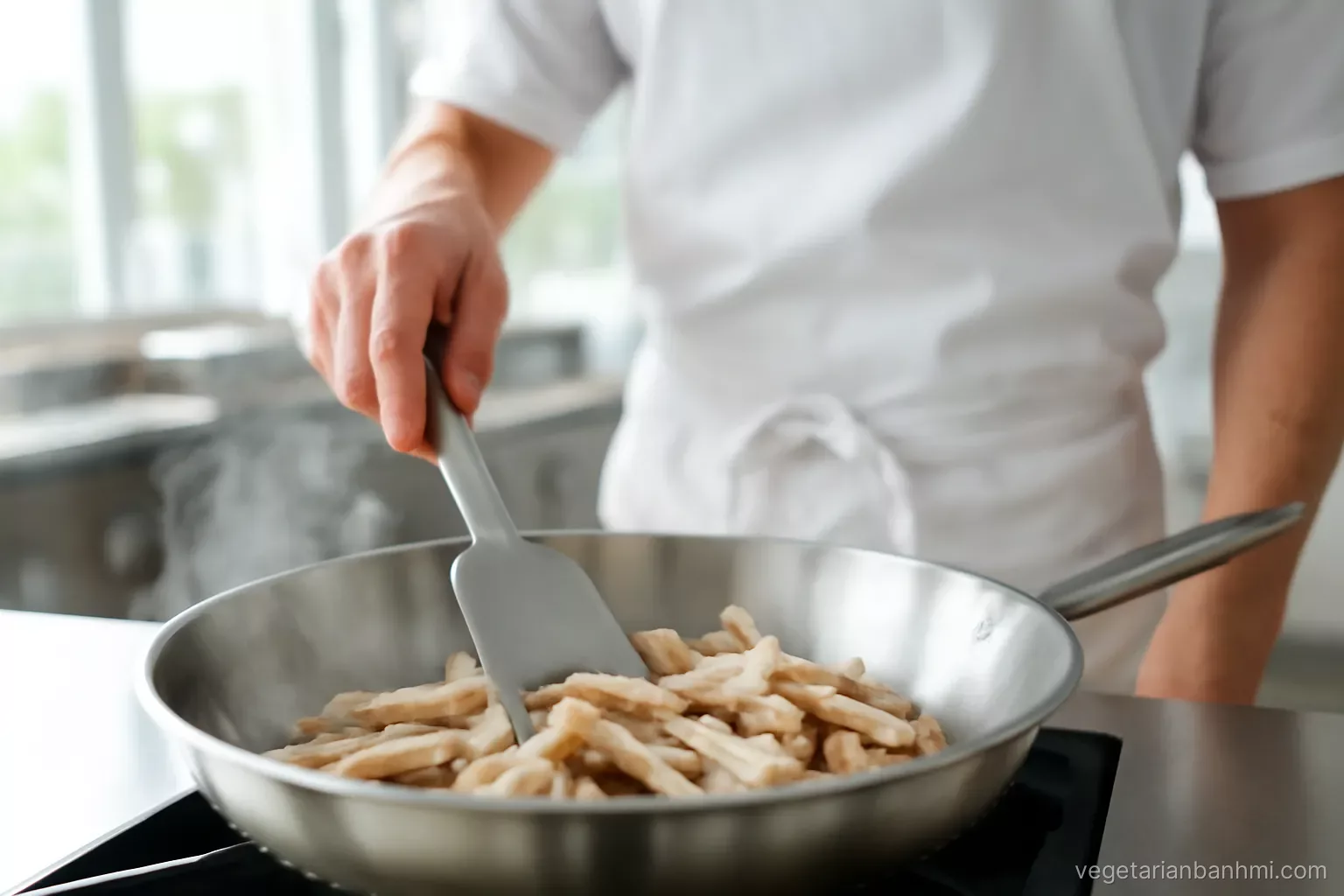
- Pan crisp: in a wide nonstick pan with 1–2 tablespoons oil over medium-high heat, press the jackfruit flat and leave it for 2–3 minutes until it browns underneath, then stir and repeat 2–3 times.
- Air fryer: 200°C (400°F) for 8–10 minutes, shaking twice. Very effective for small batches.
- Glaze last: if your sauce contains sugar, simmer the jackfruit in it until nearly dry, then roast or pan-crisp; the sugars caramelize at the edges.
Another trick is to dust the squeezed, shredded jackfruit with 1 tablespoon cornstarch before pan-frying. It forms a light crust and helps the strands cling together. Freezing cooked jackfruit and reheating it in a hot oven also firms the texture slightly.
Flavors that suit jackfruit in banh mi
Jackfruit carries strong, savory flavors best. Vietnamese-style options include a dark caramel with soy sauce, black pepper and coconut water, inspired by kho (caramel-braised) dishes; lemongrass, garlic and chili; or five-spice and soy for a char siu-like note. Finish with lime juice or a little rice vinegar to brighten it. For a step-by-step caramel jackfruit sandwich, see our vegan banh mi recipes.
Nutritionally, jackfruit is a texture ingredient, not a protein source. USDA FoodData Central lists raw jackfruit at about 95 kcal and about 1.7 g protein per 100 g, and canned young jackfruit in brine is typically lower in energy. A banh mi filled only with jackfruit will feel lighter and less filling than tofu or seitan. Add one of these to the sandwich: a layer of mushroom or nut pâté, slices of fried tofu, seitan cold cuts, a scattering of chopped roasted peanuts, or mashed chickpeas cooked into the jackfruit. Our plant-based nutrition section gives more on balancing fillings.
A 20-minute weeknight jackfruit filling
When you do not have time for a full caramel recipe, this shortcut gives good results. Rinse, squeeze and shred one can of young jackfruit without simmering. Heat 2 tablespoons oil in a wide pan, fry 2 minced garlic cloves and 1 minced shallot for 30 seconds, then add the jackfruit and spread it out. Leave it for 3 minutes to brown, stir, and repeat twice. Add 1 1/2 tablespoons soy sauce, 2 teaspoons sugar, 1/2 teaspoon black pepper and 2 tablespoons water, and stir until absorbed. Finish with a squeeze of lime and a handful of chopped scallions.
The texture is slightly softer than the oven-roasted version and the brine flavor a little more noticeable, but it is ready in about 20 minutes and fills two sandwiches generously. Spread the bread with pâté or vegan mayo, add cucumber and pickles, and scatter chopped roasted peanuts over the jackfruit for crunch and protein.
Storage and food safety
Once opened, transfer unused canned jackfruit to a covered container, cover with fresh water and refrigerate for up to 3 days. Cooked, seasoned jackfruit keeps 3–4 days in the fridge and freezes well for up to 2 months; spread it flat in a freezer bag so it thaws quickly. As with any cooked food, refrigerate leftovers within two hours, or within one hour if the room is above 32°C (90°F), as is common in Vietnam.
Sources
- USDA FoodData Central – fdc.nal.usda.gov (jackfruit, raw)
- Food and Agriculture Organization of the United Nations – fao.org (jackfruit as a tropical crop)
- USDA Food Safety and Inspection Service – fsis.usda.gov (two-hour rule for leftovers)
Frequently asked questions
Why is my jackfruit mushy?
It was not squeezed dry, it was simmered too long, or it was never crisped with dry heat. Squeeze firmly after simmering and finish it in a hot oven, pan or air fryer.
Does jackfruit taste like meat?
No. Young jackfruit tastes mild and slightly vegetal; its shredded, fibrous texture is what resembles pulled meat. The flavor comes entirely from your seasoning.
Can I eat the seeds in canned jackfruit?
In canned young jackfruit, the seeds are immature and soft and are usually eaten along with the flesh. Mature jackfruit seeds from ripe fruit must be cooked; they are boiled or roasted as a separate snack.
How much jackfruit do I need per banh mi?
About 120–140 g of cooked jackfruit per sandwich if it is the only filling, or 60–70 g if you pair it with tofu, seitan or pâté. A 565 g can, drained, covers 2–4 sandwiches.
Is jackfruit eaten in Vietnam?
Yes. Ripe jackfruit is a popular fruit, and young jackfruit is used in salads, braises and vegetarian dishes. Its use as a "pulled" meat substitute is more of a Western trend.
Jackfruit at home, more vegan banh mi in Saigon
Get the texture right and jackfruit becomes one of the most fun fillings to cook. When you travel to Ho Chi Minh City, explore the full range of vegan banh mi at Bánh Mì XANH, a fully vegan chain with 5 central shops open 24/7, including one in the backpacker area by Bùi Viện.
Explore the Bánh Mì XANH menu · 24/7 hotline / Zalo +84 923 183 183