Short answer: Buy extra-firm or firm tofu, press it for 20–30 minutes under a weighted pan (or freeze and thaw it for a chewier texture), and cut it into 1 cm slabs. Marinate for 20–30 minutes, since flavor only penetrates a few millimeters, then scrape off loose bits, dust with cornstarch and pan-fry at about 180°C (350°F) until deep gold. Season the outside at the end, and your tofu will taste of something and stay crisp inside the bread.
Tofu is the most common protein in a bánh mì chay (vegetarian banh mi), and also the one most often done badly: pale, wet, bland slabs that make the bread soggy. In Vietnam, many sandwich makers use đậu hũ chiên (deep-fried tofu) that is fried until it has a thin golden skin and a soft center, often bought ready-made at markets. At home, you can get close with a pan and a little patience. This guide covers buying, pressing, marinating and cooking, with the reasons behind each step so you can adapt it to whatever tofu your local shop sells.
Which tofu to buy
Tofu firmness is about water content: the firmer the block, the less water and the more protein per gram. For banh mi you want a block that holds its shape when sliced and fried. Labels vary between countries and brands, so use the table as a guide and squeeze the pack gently: it should feel solid, not wobbly.
| Type | Texture | Pressing needed | Best banh mi use |
|---|---|---|---|
| Silken / soft | Custard-like, falls apart | Not suitable for frying | Blend into vegan mayo or creamy spreads |
| Medium | Tender, fragile | Gentle, 30–40 min | Crumbled into meatballs or scrambles |
| Firm | Creamy center, holds shape | 20–30 min | Fried slabs with a soft middle, closest to street style |
| Extra-firm | Dense, sliceable | 15–20 min | Crisp slabs and cubes, lemongrass tofu |
| Super-firm / vacuum-packed | Very dense, almost dry | None | Thin crispy slices, quick weeknights |
| Pre-fried tofu puffs or blocks | Golden skin, spongy | None; blanch to remove oil | Simmered in sauce, then sliced |
Check the coagulant on the label. Tofu made with calcium sulfate is a useful calcium source: USDA FoodData Central lists firm calcium-set tofu at about 144 kcal, about 17 g protein and several hundred milligrams of calcium per 100 g. Tofu made with nigari (magnesium chloride) has a slightly silkier texture and less calcium. Both fry well.
Four ways to press tofu
Pressing removes the free water around the curds so the surface can brown instead of steaming, and so the marinade is not diluted. You do not need special equipment.
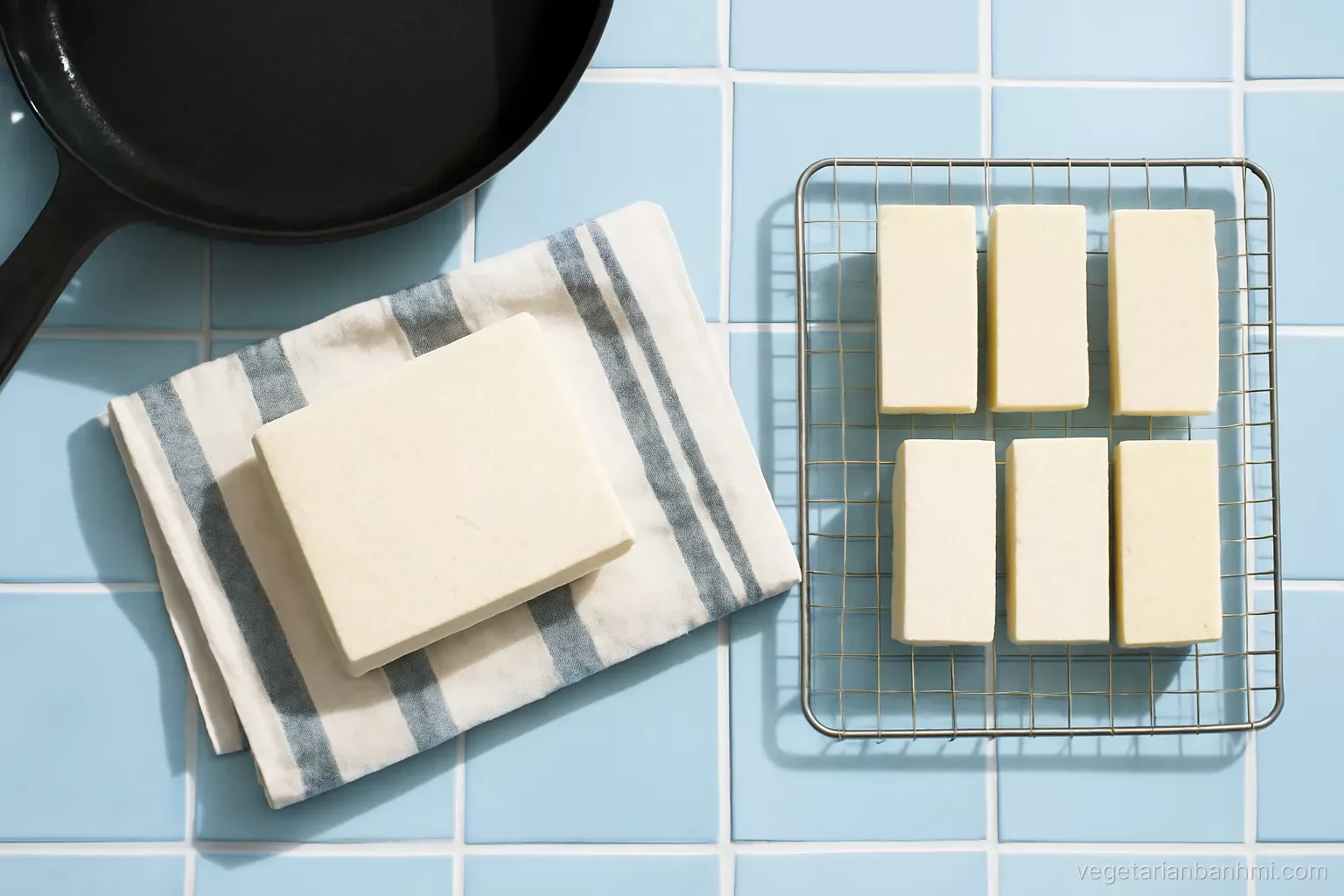
- Towel and weight (20–30 minutes). Wrap the block in a clean kitchen towel or several paper towels, set it on a plate, and put a heavy pan, a cutting board with cans, or a few books on top. Aim for 1–2 kg (2–4 lb) of weight. Too much weight cracks the block.
- Tofu press (15–20 minutes). Spring or screw presses apply even pressure and save counter space. Worth buying if you cook tofu weekly.
- Slice first, then press (10 minutes). Cut the block into slabs, lay them on a towel, cover with another towel and press with a baking tray. More surface area means faster draining.
- Freeze and thaw (overnight plus 1 hour). Freeze the block in its package, thaw it in the fridge or in warm water, then squeeze. Ice crystals open up the structure, giving a chewier, spongier, almost meaty texture that soaks up marinade. Great for shredded or "chicken-style" fillings.
A useful extra trick: soaking slabs in very hot, lightly salted water for 10–15 minutes before patting dry seasons them lightly throughout and firms the surface, which helps them crisp. It is optional but noticeably improves plain tofu.
How long to marinate, and what to put in it
Here is the truth most recipes avoid: tofu is a dense, water-filled curd, and marinades only travel a few millimeters into it, even overnight. An hour gives you nearly all the benefit you will get. Long marinades are not harmful, and they are convenient for meal prep, but they will not transform the center of a thick slab. That is why thin slabs work better for banh mi: proportionally more of each slice is seasoned.
A good banh mi marinade balances salt, a little sugar for browning and aromatics. A reliable base for 400 g tofu:
- 2 tablespoons (30 ml) soy sauce or tamari
- 2 teaspoons sugar or maple syrup
- 2 cloves garlic, minced, and 1 small shallot, minced
- 1/2 teaspoon black pepper
- 1 tablespoon neutral oil
- Optional: 2 tablespoons minced lemongrass (sả), 1/2 teaspoon turmeric for color, 1 teaspoon chili flakes, or 1 teaspoon five-spice powder
Before cooking, scrape off loose garlic, shallot and lemongrass; they burn in hot oil long before the tofu is crisp. Fry them separately at the end and spoon them back on. For complete sandwiches using this method, see our vegan banh mi recipes.
Shapes that work in a sandwich
How you cut tofu changes how a banh mi eats. Long slabs about 1 cm thick and roughly as wide as the bread are the classic choice: two or three overlap neatly, they do not roll out when you bite, and each slice has two large faces to crisp. Thin planks of 5 mm crisp almost all the way through and suit super-firm tofu; they are good if you like crunch but can dry out in the oven. Cubes of 2 cm look appealing in a bowl but tend to tumble out of a baguette, so save them for rice dishes or crush them lightly once inside the bread.
Torn tofu is an underrated option. Rip a pressed block into rough, bite-sized pieces with your hands instead of cutting it. The ragged surfaces catch more starch and marinade and fry into craggy, crunchy edges, a little like fried chicken. Frozen-and-thawed tofu, squeezed and torn, gives the chewiest result of all and works well with a sticky glaze. For a block of 400 g, expect enough slabs for two generous sandwiches or three moderate ones; the full recipe guides in our recipe section use about 150 g per sandwich.
Cooking methods compared
Each method gives a different result, and the right one depends on how much oil you want to use and how much time you have. For banh mi, the goal is crisp edges and enough structure to survive being pressed into bread with pickles.
- Pan-frying (best balance). Dust slabs with cornstarch, heat 3–4 tablespoons oil in a nonstick or cast-iron pan to about 180°C (350°F), cook 3–4 minutes per side without moving. Crisp outside, creamy inside.
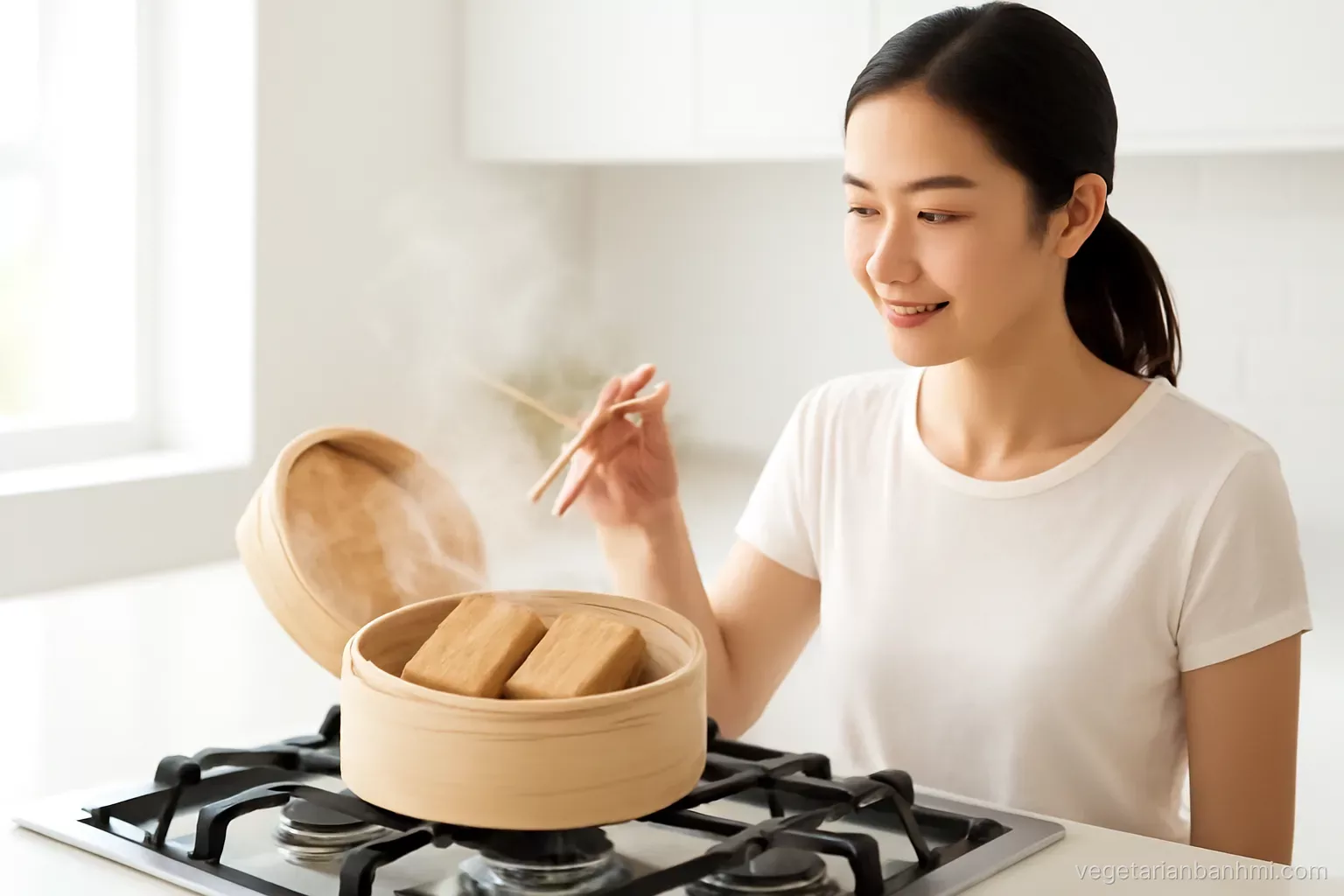
- Deep-frying (closest to Vietnamese street tofu). Fry cubes or slabs at 180°C (350°F) for 5–7 minutes until golden and puffed. You need about 750 ml (3 cups) oil in a small pot; use a thermometer.
- Oven (hands-off, larger batches). Toss with 1–2 tablespoons oil and cornstarch, bake at 220°C (425°F) for 25–30 minutes, flipping halfway. Chewier, drier and good for lunchboxes.
- Air fryer (quick, low oil). 200°C (400°F) for 12–15 minutes, shaking twice. Very crisp but can dry out thin slices.
- Glazing after frying. Fry first, then toss in a reduced sauce for 1–2 minutes. Sauce on raw tofu prevents browning.
Common mistakes and fixes
Most tofu problems come down to water, heat or timing. Tofu sticks to the pan when it goes in before the oil is hot or is moved too soon; wait until it releases on its own. Pale, soft tofu means too little heat or a crowded pan, which drops the temperature and steams the slices; fry in batches. Burnt spots with raw-tasting tofu mean sugary marinade on the surface; pat it off, or cook at medium heat. Crispy tofu that goes soft in the sandwich is usually caused by wet pickles; squeeze them well and place cucumber between the tofu and the pickles. And if your tofu is crisp but tastes of nothing, season it again once it is out of the pan: a few drops of soy sauce, a pinch of salt and pepper, or a spoon of fried lemongrass make an enormous difference.
For storage, keep leftover raw tofu submerged in fresh water in the fridge, changing the water daily, and use within 3–4 days. Cooked tofu keeps 3–4 days in a sealed container; re-crisp in a hot pan or air fryer. Our meal prep and storage pages explain how to prep tofu for a week of sandwiches.
Sources
- USDA FoodData Central – fdc.nal.usda.gov (tofu, raw, firm, prepared with calcium sulfate)
- Soyfoods Association of North America – soyfoods.org (tofu types and coagulants)
- USDA Food Safety and Inspection Service – fsis.usda.gov (refrigerated storage of leftovers)
Frequently asked questions
Do I really need to press tofu?
For frying, yes, unless you buy super-firm vacuum-packed tofu. Pressing removes surface water so the tofu browns instead of steaming. For crumbled or blended uses, a quick squeeze is enough.
Is it worth freezing tofu?
If you want a chewy, meaty texture, yes. Freezing and thawing makes tofu spongy, so it absorbs marinade well and holds together when shredded. For a creamy-centered slab, use fresh tofu instead.
Can I marinate tofu overnight?
Yes, in the fridge in a covered container. It is convenient but adds only a little flavor compared with 30 minutes, because marinades penetrate only a few millimeters. Seasoning the surface after cooking matters more.
Why add cornstarch?
A light dusting absorbs surface moisture and forms a thin, crisp shell when fried. Use about 1 tablespoon per 200 g tofu and tap off the excess, or it will turn gummy.
Can I use pre-fried tofu from an Asian grocer?
Yes. Pour boiling water over it to remove excess oil, then simmer it in a seasoned sauce or pan-fry it again briefly. It gives a texture close to the fried tofu used in many Vietnamese sandwiches.
Perfect tofu at home, or a spicy tofu banh mi in Saigon
Master pressing and frying, and every tofu banh mi you make will improve. When you are in Ho Chi Minh City, compare yours with the Đậu Hũ Cay (spicy tofu) at Bánh Mì XANH, a fully vegan banh mi chain with 5 central shops open 24/7.
Explore the Bánh Mì XANH menu · 24/7 hotline / Zalo +84 923 183 183